

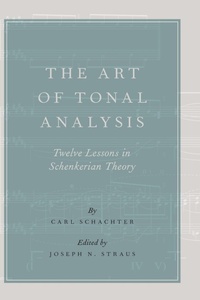
The Art of Tonal Analysis
Twelve Lessons in Schenkerian Theory
Published on 28. January 2016
Book
Hardback
306 pages
978-0-19-022739-5 (ISBN)
Description
Carl Schachter is the world's leading practitioner of Schenkerian theory and analysis. His articles and books have been broadly influential, and are seen by many as models of musical insight and lucid prose. Yet, perhaps his greatest impact has been felt in the classroom. At the Mannes College of Music, the Juilliard School of Music, Queens College and the Graduate Center of the City University of New York, and at special pedagogical events around the world, he has taught generations of musical performers, composers, historians, and theorists over the course of his long career.
In Fall 2012, Schachter taught a doctoral seminar at the CUNY Graduate Center in which he talked about the music and the musical issues that have concerned him most deeply; the course was in essence a summation of his extensive and renowned teaching. In The Art of Tonal Analysis, music theorist Joseph Straus presents edited transcripts of those lectures. Accompanied by abundant music examples, including analytical examples transcribed from the classroom blackboard, Straus's own visualizations of material that Schachter presented aurally at the piano, and Schachter's own extended Schenkerian graphs and sketches, this book offers a vivid account of Schachter's masterful pedagogy and his deep insight into the central works of the tonal canon. In making the lectures of one of the world's most extraordinary musicians and musical thinkers available to a wide audience, The Art of Tonal Analysis is an invaluable resource for students and scholars of music.
In Fall 2012, Schachter taught a doctoral seminar at the CUNY Graduate Center in which he talked about the music and the musical issues that have concerned him most deeply; the course was in essence a summation of his extensive and renowned teaching. In The Art of Tonal Analysis, music theorist Joseph Straus presents edited transcripts of those lectures. Accompanied by abundant music examples, including analytical examples transcribed from the classroom blackboard, Straus's own visualizations of material that Schachter presented aurally at the piano, and Schachter's own extended Schenkerian graphs and sketches, this book offers a vivid account of Schachter's masterful pedagogy and his deep insight into the central works of the tonal canon. In making the lectures of one of the world's most extraordinary musicians and musical thinkers available to a wide audience, The Art of Tonal Analysis is an invaluable resource for students and scholars of music.
Reviews / Votes
With Carl Schachter's The Art of Tonal Analysis, the world's foremost Schenkerian scholar and superb musician gives us the opportunity to step into his classroom and experience the unabashedly exuberant, persuasive style for which he is renowned and beloved as a teacher. Schachter's lectures, marvelously transcribed and edited by Joseph N. Straus, offer moments of delight, surprise, and brilliant insight on every page. * Janet Schmalfeldt, Professor Emerita of Music, Tufts University * Since the late 1970s it has been my extraordinary good fortune to attend numerous courses taught by Carl Schachter. In each class session he offered breathtakingly profound insights into the wonders of musical masterpieces, and I am happy to see that The Art of Tonal Analysis will now allow everyone to share in the excitement of these lessons. * L. Poundie Burstein, Hunter College and the Graduate Center, CUNY/ Mannes College * Teaching is clearly central to how Schachter views his own musicianship, and in his volume he adds tremendously to our understanding of tonal music and how it can be communicated to performers, listeners, and scholards. We are fortunate to have the opportunity to learn the art of tonal analysis from Carl Schachter: his book is essential reading for the next generation of musicians who care about common-practice tonal music, musical analysis, and pedagogy. * William M. Marvin, Spectrum *More details
Language
English
Place of publication
New York
United States
Target group
College/higher education
Dimensions
Height: 260 mm
Width: 183 mm
Thickness: 21 mm
Weight
774 gr
ISBN-13
978-0-19-022739-5 (9780190227395)
Copyright in bibliographic data and cover images is held by Nielsen Book Services Limited or by the publishers or by their respective licensors: all rights reserved.
Schweitzer Classification
Other editions
Additional editions
Book
09/2018
Oxford University Press Inc
€54.40
Shipment within 15-20 days
Carl Schachter | Joseph N. Straus
Art of Tonal Analysis: Twelve Lessons in Schenkerian Theory
Twelve Lessons in Schenkerian Theory
E-Book
12/2015
1st Edition
Oxford University Press
€35.99
Available for download
E-Book
12/2015
1st Edition
OUP eBook
€30.49
Available for download
Persons
Carl Schachter is an extraordinary musician and musical thinker, and the world's leading practitioner of Schenkerian theory and analysis. He has written extensively on the masterworks of the tonal common practice and on the analytical delights and challenges that they present. Although his articles and books have been broadly influential, and are seen by many as models of musical insight and lucid prose, perhaps his greatest impact has been felt in the classroom. At the Mannes College of Music, the Juilliard School of Music, Queens College and the Graduate Center of the City University of New York, and at special pedagogical events around the world, he has taught generations of musical performers, composers, historians, and theorists.
Joseph Straus has published widely on topics in modernist music and post-tonal music theory. He is a former President of the Society for Music Theory.
Joseph Straus has published widely on topics in modernist music and post-tonal music theory. He is a former President of the Society for Music Theory.
Content
Prelude Editor's Preface
Lesson One: Linear Progressions and Neighbor Notes
Lesson Two: J.S. Bach, Menuet in C minor from French Suite No. 2 and Chopin, Etude, Op. 10, No. 12
Lesson Three: Chopin, G#-minor and E-major Preludes from Op. 28
Lesson Four: Schubert, Sonata in Bb major, Scherzo
Lesson Five: Handel, Suite No. 8 for Harpsichord, Courante
Lesson Six: J.S. Bach, Gavotte en Rondeaux from Violin Partita No. 3 in E major
Lesson Seven: Mozart, Sonata for Violin and Piano, K. 481, Adagio
Lesson Eight: Beethoven, String Quartet, Op. 18, No. 6, first movement
Lesson Nin: Beethoven, String Quartet, Op. 18, No. 6, fourth movement
("La Malinconia")
Lesson Ten: Rhythm, Hypermeter, and Phrase
Lesson Eleven: Haydn, Symphony No. 99, Adagio
Lesson Twelve: Beethoven, Piano Sonata, Op. 53 ("Waldstein"), first movement
Postlude. Q and A
Glossary
Works Cited
Index
Lesson One: Linear Progressions and Neighbor Notes
Lesson Two: J.S. Bach, Menuet in C minor from French Suite No. 2 and Chopin, Etude, Op. 10, No. 12
Lesson Three: Chopin, G#-minor and E-major Preludes from Op. 28
Lesson Four: Schubert, Sonata in Bb major, Scherzo
Lesson Five: Handel, Suite No. 8 for Harpsichord, Courante
Lesson Six: J.S. Bach, Gavotte en Rondeaux from Violin Partita No. 3 in E major
Lesson Seven: Mozart, Sonata for Violin and Piano, K. 481, Adagio
Lesson Eight: Beethoven, String Quartet, Op. 18, No. 6, first movement
Lesson Nin: Beethoven, String Quartet, Op. 18, No. 6, fourth movement
("La Malinconia")
Lesson Ten: Rhythm, Hypermeter, and Phrase
Lesson Eleven: Haydn, Symphony No. 99, Adagio
Lesson Twelve: Beethoven, Piano Sonata, Op. 53 ("Waldstein"), first movement
Postlude. Q and A
Glossary
Works Cited
Index