

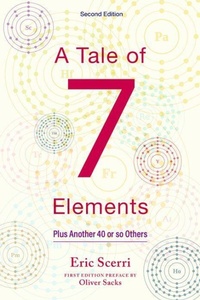
A Tale of Seven Elements
Plus Another 40 or So Others
2nd Edition
Published on 7. October 2025
Book
Paperback/Softback
320 pages
978-0-19-778532-4 (ISBN)
Description
In 1913, English physicist Henry Moseley transformed our understanding of the elements by organizing them by atomic number, from hydrogen to uranium. However, it soon became obvious that researchers had yet to discover seven completely unknown elements.
In this updated and expanded edition of his acclaimed book, Eric Scerri presents the intriguing stories of these elements--protactinium, hafnium, rhenium, technetium, francium, astatine, and promethium. It follows their discoveries through the two world wars, starting with protactinium in 1917 and ending with promethium in 1945. Scerri details the research leading to each discovery, the pivotal experiments, the chemists involved, the properties of each element, and their applications. For example, hafnium alloys, named after Copenhagen (hafnia), have some of the highest boiling points and are used in rocket thrusters like those on the Apollo Lunar Modules. Scerri then examines the integration of twenty-five new elements into the periodic table over the past fifty years and concludes with a new chapter on rare earth elements and the histories of their discoveries.
The Second Edition of A Tale of Seven Elements vividly portrays the journey of chemical research, from missteps and disputes to the thrill of discovery, illuminating the researchers behind the elements, as much as their breakthroughs.
In this updated and expanded edition of his acclaimed book, Eric Scerri presents the intriguing stories of these elements--protactinium, hafnium, rhenium, technetium, francium, astatine, and promethium. It follows their discoveries through the two world wars, starting with protactinium in 1917 and ending with promethium in 1945. Scerri details the research leading to each discovery, the pivotal experiments, the chemists involved, the properties of each element, and their applications. For example, hafnium alloys, named after Copenhagen (hafnia), have some of the highest boiling points and are used in rocket thrusters like those on the Apollo Lunar Modules. Scerri then examines the integration of twenty-five new elements into the periodic table over the past fifty years and concludes with a new chapter on rare earth elements and the histories of their discoveries.
The Second Edition of A Tale of Seven Elements vividly portrays the journey of chemical research, from missteps and disputes to the thrill of discovery, illuminating the researchers behind the elements, as much as their breakthroughs.
More details
Edition
2nd Revised edition
Language
English
Place of publication
New York
United States
Target group
College/higher education
Edition type
Revised edition
Product notice
Paperback (trade)
Unsewn / adhesive bound
Illustrations
79 figures
Dimensions
Height: 207 mm
Width: 139 mm
Thickness: 18 mm
Weight
370 gr
ISBN-13
978-0-19-778532-4 (9780197785324)
Copyright in bibliographic data and cover images is held by Nielsen Book Services Limited or by the publishers or by their respective licensors: all rights reserved.
Schweitzer Classification
Other editions
Additional editions
E-Book
07/2025
2nd Edition
OUP eBook
€16.49
Available for download
E-Book
07/2025
2nd Edition
OUP eBook
€16.49
Available for download
Person
Eric Scerri is founder and editor-in-chief of the Springer journal Foundations of Chemistry. He has authored around 200 journal articles in the history and philosophy of science, chemistry and chemical education, in addition to five books. He has been teaching chemistry as well as history and philosophy of science at UCLA since the year 2000.
Content
Preface
An A-Z of Acknowledgments
Introduction
1. From Dalton to the Discovery of the Periodic System
2. The Invasion of the Periodic Table by Physics
3. Element 91-Protactinium
4. Element 72-Hafnium
5. Element 75-Rhenium
6. Element 43-Technetium
7. Element 87-Francium
8. Element 85-Astatine
9. Element 61-Promethium
10. From Missing Elements to Synthetic Elements
11. The Rare Earth Elements
Notes
Bibliography
Author Index
Index
An A-Z of Acknowledgments
Introduction
1. From Dalton to the Discovery of the Periodic System
2. The Invasion of the Periodic Table by Physics
3. Element 91-Protactinium
4. Element 72-Hafnium
5. Element 75-Rhenium
6. Element 43-Technetium
7. Element 87-Francium
8. Element 85-Astatine
9. Element 61-Promethium
10. From Missing Elements to Synthetic Elements
11. The Rare Earth Elements
Notes
Bibliography
Author Index
Index