

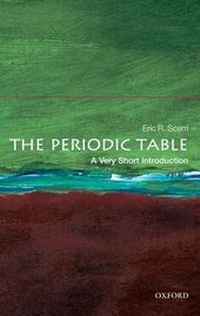
The Periodic Table: A Very Short Introduction
A Very Short Introduction
Published on 27. October 2011
Book
Paperback/Softback
168 pages
978-0-19-958249-5 (ISBN)
Description
Here, Eric Scerri looks at the trends in properties of elements that led to the construction of the periodic table, and how the deeper meaning of its structure gradually became apparent with the development of atomic theory and quantum mechanics, so that, as Scerri puts it, one science, physics, arguably came to colonize another, chemistry, although such a view is resisted by chemists. Scerri shows that quantum mechanics is absolutely central to chemistry, as it
underlies the behaviour of all of the elements and their compounds, and therefore underpins the structure of the periodic table.
Concluding with an overview of the huge variety of periodic tables that have been proposed in the print media and on the Internet, he explores the debated question of whether there is an optimal periodic table and what form it might take.
ABOUT THE SERIES: The Very Short Introductions series from Oxford University Press contains hundreds of titles in almost every subject area. These pocket-sized books are the perfect way to get ahead in a new subject quickly. Our expert authors combine facts, analysis, perspective, new ideas, and enthusiasm to make interesting and challenging topics highly readable.
underlies the behaviour of all of the elements and their compounds, and therefore underpins the structure of the periodic table.
Concluding with an overview of the huge variety of periodic tables that have been proposed in the print media and on the Internet, he explores the debated question of whether there is an optimal periodic table and what form it might take.
ABOUT THE SERIES: The Very Short Introductions series from Oxford University Press contains hundreds of titles in almost every subject area. These pocket-sized books are the perfect way to get ahead in a new subject quickly. Our expert authors combine facts, analysis, perspective, new ideas, and enthusiasm to make interesting and challenging topics highly readable.
Reviews / Votes
an ideal ... gift to anyone intersted in the "central icon" of the "central science", especially students and young persons in general. * Foundations of Chemistry * Scerri's writing is lively, engaging, and accessible. * Journal of Chemical Education * Overall this stylish and snappy book will entertain and enlighten you, and its convenient size means it can do so when you're on the go * Chemistry World *More details
Series
Language
English
Place of publication
Oxford
United Kingdom
Target group
Ideal for general readers who came across the periodic table in school and are curious to learn more, as well as students of courses in the physical sciences.
Illustrations
15 black and white line drawings
Dimensions
Height: 173 mm
Width: 113 mm
Thickness: 9 mm
Weight
130 gr
ISBN-13
978-0-19-958249-5 (9780199582495)
Copyright in bibliographic data and cover images is held by Nielsen Book Services Limited or by the publishers or by their respective licensors: all rights reserved.
Schweitzer Classification
Other editions
New editions
Book
07/2019
2nd Edition
Oxford University Press
€13.00
Shipment within 15-20 days
Person
Dr Eric Scerri is a lecturere in chemistry as well as hisotry and philosophy of science at the University of California, Los Angeles. He is the author of three books, The Periodic Table: Its story and its significance, (OUP, 2007), Collected Papers on the Philosophy of Chemistry (Imperial College Press, 2008), and Selected Papers on the Periodic Table (Imperial College Press, 2009). He has authored over 100 articles in peer-reviewed
journals and many articles in popular science magazines including Scientific American, American Scientist, Cosmos, and Chemical Heritage, among others. He is the editor of the Springer journal Foundations of Chemistry.
journals and many articles in popular science magazines including Scientific American, American Scientist, Cosmos, and Chemical Heritage, among others. He is the editor of the Springer journal Foundations of Chemistry.
Content
1. Introduction ; 2. Atomic weight, Triads and Prout ; 3. Steps towards the periodic table ; 4. Triumph of a Russian genius ; 5. The impact of the new physics ; 6. How the electron explains the periodic table ; 7. How chemists reacted ; 8. Quantum Mechanics makes further advances ; 9. Forged in the stars ; 10. Back to Chemistry ; 11. Why so many tables? Which is best? ; Further reading