

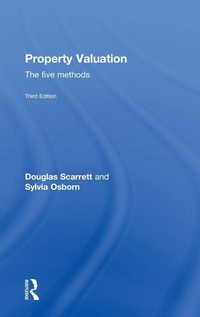
Property Valuation
The Five Methods
3rd Edition
Published on 20. June 2014
Book
Hardback
192 pages
978-0-415-71767-0 (ISBN)
Description
The third edition of Property Valuation: The Five Methods introduces students to the fundamental principles of property valuation theory by means of clear explanation and worked examples. An ideal text for those new to the subject, the book provides 1st year undergraduate students with a working knowledge and understanding of the five methods of valuation and the ways in which they are interlinked.
In this fully revised edition, the new author team have:
restructured the chapters to ensure a more logical order
outlined the economic theory of value and the rules and constraints under which a valuer works
provided detailed consideration of each of the five recognised approaches
placed a larger emphasis on the Discounted Cash Flow approach
These revisions are all written in the concise and accessible style which has made previous editions of the book so successful. The new edition of this textbook will be essential reading for undergraduates on all property, real estate, planning and built environment courses.
In this fully revised edition, the new author team have:
restructured the chapters to ensure a more logical order
outlined the economic theory of value and the rules and constraints under which a valuer works
provided detailed consideration of each of the five recognised approaches
placed a larger emphasis on the Discounted Cash Flow approach
These revisions are all written in the concise and accessible style which has made previous editions of the book so successful. The new edition of this textbook will be essential reading for undergraduates on all property, real estate, planning and built environment courses.
More details
Edition
3rd edition
Language
English
Place of publication
London
United Kingdom
Publishing group
Taylor & Francis Ltd
Target group
College/higher education
Illustrations
64 s/w Tabellen
64 Tables, black and white
Dimensions
Height: 240 mm
Width: 161 mm
Thickness: 16 mm
Weight
485 gr
ISBN-13
978-0-415-71767-0 (9780415717670)
Copyright in bibliographic data and cover images is held by Nielsen Book Services Limited or by the publishers or by their respective licensors: all rights reserved.
Schweitzer Classification
Other editions
Additional editions
E-Book
06/2014
3rd Edition
Routledge
€69.99
Available for download
E-Book
06/2014
3rd Edition
Routledge
€69.99
Available for download
Book
06/2014
3rd Edition
Routledge
€82.30
Shipment within 15-20 days
Previous edition
Book
06/2008
2nd Edition
Routledge
€163.42
Article exhausted; check for reprint
Persons
Douglas Scarrett is now retired from his last post as Director of Estate Management at De Montfort University where he was previously Deputy Head of the School of Land and Building Studies. He was joint founding editor of the Journal of Property Management and has been an external tutor for the College of Estate Management for the past 25 years.
Sylvia Osborn is Dean of Postgraduate Studies at The College of Estate Management and has worked as a chartered surveyor in two London practices, specialising in valuation and property management. She has worked in higher education for many years, teaching on RICS accredited degree programmes and on leisure property degrees.
Sylvia Osborn is Dean of Postgraduate Studies at The College of Estate Management and has worked as a chartered surveyor in two London practices, specialising in valuation and property management. She has worked in higher education for many years, teaching on RICS accredited degree programmes and on leisure property degrees.
Content
1. The property market in context 2.Professional Valuation Practice 3. Valuation formulae 4. The comparative method 5. The investment method - traditional approaches 6. The investment method -discounted cash flow approaches 7. The residual method 8. The profits method - financial data 9. The profits method - valuation 10. Cost-based methods