

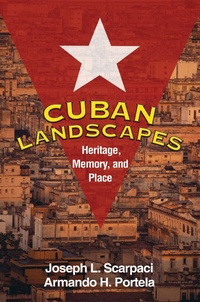
Cuban Landscapes
Heritage, Memory, and Place
1st Edition
Will be published approx. on 10. August 2009
Book
Paperback/Softback
216 pages
978-1-60623-323-8 (ISBN)
Description
This accessible book offers a vivid geographic portrait of Cuba, exploring the island's streetscapes, sugar cane fields, beaches, and rural settlements; its billboards, government buildings, and national landmarks. The authors illuminate how natural and built landscapes have shaped Cuban identity (cubanidad), and vice versa. They provide a unique perspective on Cuba's distinct historical periods and political economies, from the colonial period through republicanism and today's socialist era. Compelling topics include the legacies of slavery and the sugar industry, the past and future of urban development, and the impact of "islandness" on sociocultural processes.
Reviews / Votes
"This book is a welcome addition to the literature on Cuba and a joy to read. Weaving together historical and contemporary themes, it provides a deeply contextualized impression of Cuban landscapes over time. The authors are serious scholars of Cuba who have written a book that can be read and appreciated by people across the political spectrum. This is essential reading for anyone embarking on a trip to Cuba, especially one that goes beyond Havana."--Thomas Klak, Director, Latin American Studies Program, Miami University, Oxford, Ohio"Full of interesting data for researchers and visitors, this book offers multiple views of Cuba, knitting together stitches of such diverse disciplines as geography, landscape architecture, urban planning, sociology, and fine arts. I especially recommend it to readers who want to be well informed on the many nuances of Cuba and cubanidad--something the book captures on page after page. Written by renowned researchers who have long studied the country, the book demonstrates that Cuban landscapes are far more complex than the idyllic impressions displayed in tourist magazines."--Victor Marin, UNESCO Chair, National Center for Conservation, Restoration and Museology, Havana, Cuba
"Scarpaci and Portela give us a fascinating and revealing picture of the many 'Cuban landscapes' that make up the reality of Cuba past and present. Their canvas is ambitiously broad in its historical sweep and its range of sources and materials, but it nonetheless excels in the detail--from Humboldt's nineteenth-century observations to Cuba's love/hate relationship with sugar and the images and landscapes that Cuba projects to tourists. The result is visually expressive and conceptually masterful."--Antoni Kapcia, Director, Centre for Research on Cuba, University of Nottingham, UK
"Cuban Landscapes is overflowing with original and very useful landscapes of its own--musical, historical, urban, rural, agricultural, industrial, cartographic, touristic, artistic, economic, and theoretical. This innovative, eclectic volume manages to synthesize a wide variety of analytic approaches to Cuba's unique physical, historical, and cultural geography, making the book simultaneously intellectually engaging and visually stimulating."--Ted Henken, Departments of Sociology and Black and Hispanic Studies, Baruch College, City University of New York
"This is a book that will make you think--about how the landscapes of Cuba were made, what they represent today, and how they have changed. The authors skillfully recount the histories of deforestation, sugar plantations, railroad expansion, urban development, tourism, and political ideology, all reflected through the prisms of landscape elements. The vibrant text and the numerous thoughtfully selected images allow many Cubas to come alive. This is a volume to open the eyes of undergraduates and would-be travelers, or to be debated in graduate seminars. Cuban Landscapes challenges us to derive meaning from what is visible on this complex Caribbean island."--David J. Robinson, Department of Geography, Syracuse University "Cuban Landscapes is overflowing with original and very useful landscapes of its own-musical, historical, urban, rural, agricultural, industrial, cartographic, touristic, artistic, economic, and theoretical. This innovative, eclectic volume manages to synthesize a wide variety of analytic approaches to Cuba's unique physical, historical, and cultural geography, making the book simultaneously intellectually engaging and visually stimulating." - Ted Henken, Departments of Sociology and Black and Hispanic Studies, Baruch College, City University of New York, USA
"This book is a welcome addition to the literature on Cuba and a joy to read. Weaving together historical and contemporary themes, it provides a deeply contextualized impression of Cuban landscapes over time. The authors are serious scholars of Cuba who have written a book that can be read and appreciated by people across the political spectrum. This is essential reading for anyone embarking on a trip to Cuba, especially one that goes beyond Havana." - Thomas Klak, Director, Latin American Studies Program, Miami University, Oxford, Ohio, USA
"Scarpaci and Portela give us a fascinating and revealing picture of the many 'Cuban landscapes' that make up the reality of Cuba past and present. Their canvas is ambitiously broad in its historical sweep and its range of sources and materials, but it nonetheless excels in the detail-from Humboldt's nineteenth-century observations to Cuba's love/hate relationship with sugar and the images and landscapes that Cuba projects to tourists. The result is visually expressive and conceptually masterful." - Antoni Kapcia, Director, Centre for Research on Cuba, University of Nottingham, UK
"This is a book that will make you think-about how the landscapes of Cuba were made, what they represent today, and how they have changed. The authors skillfully recount the histories of deforestation, sugar plantations, railroad expansion, urban development, tourism, and political ideology, all reflected through the prisms of landscape elements. The vibrant text and the numerous thoughtfully selected images allow many Cubas to come alive. This is a volume to open the eyes of undergraduates and would-be travelers, or to be debated in graduate seminars. Cuban Landscapes challenges us to derive meaning from what is visible on this complex Caribbean island." - David J. Robinson, Department of Geography, Syracuse University, USA
"Full of interesting data for researchers and visitors, this book offers multiple views of Cuba, knitting together stitches of such diverse disciplines as geography, landscape architecture, urban planning, sociology, and fine arts. I especially recommend it to readers who want to be well informed on the many nuances of Cuba and cubanidad - something the book captures on page after page. Written by renowned researchers who have long studied the country, the book demonstrates that Cuban landscapes are far more complex than the idyllic impressions displayed in tourist magazines." - Victor Marin, UNESCO Chair, National Center for Conservation, Restoration and Museology, Havana, Cuba
"What a great idea for a book. Joseph Scarpaci and Armando Portela examine the many fascinations of Cuba - including history, music, revolutions, relations with the United States, sugar industry past, tourism industry present, potential of the future - through the lens of landscape. And, what an appropriate and useful lens it is.... Cuban Landscapes also has appeal beyond the academy, for it speaks to applied pursuits such as planning and development....It includes a great deal of information, based both on fairly up-to-date secondary data and primary research by the authors. A large number of tables, graphs, maps, and photographs supplement and enhance the text. Beyond simply dry data, however, shine some of the anecdotes that give life to the larger concepts." - Mark M. Miller, Geographical Review, Vol. 101, No. 2, April 2011
More details
Series
Language
English
Place of publication
New York
United States
Target group
College/higher education
Scholars and students in regional geography and Latin American studies; other readers interested in Cuban history, politics, and culture. Will serve as a supplemental text for advanced undergraduate or graduate-level courses on Cuba, Latin America, or the Caribbean.
Product notice
Paperback (trade)
Unsewn / adhesive bound
Dimensions
Height: 224 mm
Width: 150 mm
Thickness: 15 mm
Weight
318 gr
ISBN-13
978-1-60623-323-8 (9781606233238)
Copyright in bibliographic data and cover images is held by Nielsen Book Services Limited or by the publishers or by their respective licensors: all rights reserved.
Schweitzer Classification
Other editions
Additional editions
Book
08/2009
1st Edition
Guilford Publications
€75.79
Article exhausted; check different version
Persons
Joseph L. Scarpaci, PhD, until his death in 2023, was Professor Emeritus at Virginia Tech, where he taught in a range of fields, including geography, urban planning, historic preservation, landscape architecture, and Latin American studies. He was also the Executive Director of the Center for the Study of Cuban Culture + Economy. Dr. Scarpaci received multiple Fulbright Fellowships and was the recipient of awards from the Association of American Geographers, the Conference of Latin American Geography, and the Library of Congress. Most known for his research on Cuba and Cuban communities in the United States, he began conducting research in Cuba in 1990 and made nearly 100 trips to the island.
Armando H. Portela is a physical geographer who worked for 23 years in the Institute of Geography of the Cuban Academy of Sciences. He coauthored the section "Geomorphology (Relief)" in the Nuevo Atlas Nacional de Cuba (Institute of Geography of the Academy of Sciences of Cuba, 1989) and produced a number of geomorphologic maps of the island. He currently works at the Miami Herald and freelances for the newsletter CubaNews, where he regularly publishes on geographical issues of the island.
Armando H. Portela is a physical geographer who worked for 23 years in the Institute of Geography of the Cuban Academy of Sciences. He coauthored the section "Geomorphology (Relief)" in the Nuevo Atlas Nacional de Cuba (Institute of Geography of the Academy of Sciences of Cuba, 1989) and produced a number of geomorphologic maps of the island. He currently works at the Miami Herald and freelances for the newsletter CubaNews, where he regularly publishes on geographical issues of the island.
Content
1. On Cuban Landscapes
2. HumboldtaEUR (TM)s Landscape: Connecting Then and Now
3. Sugar
4. Heritage
5. Tourism
6. Information
7. Conclusions: Whither Cuban Landscapes?
2. HumboldtaEUR (TM)s Landscape: Connecting Then and Now
3. Sugar
4. Heritage
5. Tourism
6. Information
7. Conclusions: Whither Cuban Landscapes?