

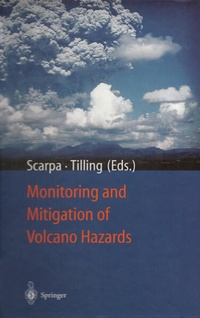
Monitoring and Mitigation of Volcano Hazards
Published on 12. February 2012
Book
Paperback/Softback
XX, 842 pages
978-3-642-80089-4 (ISBN)
Description
By the year 2000, the population worldwide at risk from volcanic hazards is likely to increase to about half a billion. Since 1980, significant advances have been made in volcano monitoring, data from which provide the sole scientific basis for eruption prediction. In this book, internationally renowned specialists provide 25 comprehensive articles covering a wide range of related topics: monitoring techniques and data analysis; modelling of monitoring data and eruptive pheneomena; volcanic hazards and risk assessment; and volcanic emergency management. Reviews of selected case histories of recent volcanic disasters demenostrate that effective communication - between scientists, civil authorities, news media and population - are essential to reduce volcanic risks.
More details
Edition
Softcover reprint of the original 1st ed. 1996
Language
English
Place of publication
Berlin
Germany
Publishing group
Springer Berlin
Target group
Professional and scholarly
Research
Illustrations
8 farbige Abbildungen
XX, 842 p. 8 illus. in color.
Dimensions
Height: 235 mm
Width: 155 mm
Thickness: 47 mm
Weight
1288 gr
ISBN-13
978-3-642-80089-4 (9783642800894)
DOI
10.1007/978-3-642-80087-0
Schweitzer Classification
Other editions
Additional editions
Roberto Scarpa | Robert I. Tilling
Monitoring and Mitigation of Volcano Hazards
E-Book
12/2012
Springer
€149.79
Available for download
Roberto Scarpa | Robert I. Tilling
Monitoring and Mitigation of Volcano Hazards
Book
10/1996
Springer
€85.55
Article exhausted; check different version
Content
I Volcano Monitoring: Techniques and Case Histories.- A Review of Volcano Geophysics and Volcano-Monitoring Methods.- New Methods and Future Trends in Seismological Volcano Monitoring.- Seismic Monitoring and Eruption Forecasting of Volcanoes: A Review of the State-of-the-Art and Case Histories.- Ground-Deformation Methods and Results.- Microgravity Monitoring.- Chemical Characters of the Gaseous Phase in Different Stages of Volcanism: Precursors and Volcanic Activity.- Chemical Composition of Volcanic Gases.- Satellite Monitoring of Volcanoes.- Detection of Explosive Eruptions and Regional Tracking of Volcanic Ash Clouds with Geostationary Meteorological Satellite (GMS).- The Integrated Mobile Volcano-Monitoring System Used by the Volcano Disaster Assistance Program (VDAP).- II Modeling of Monitoring Data and Eruptive Phenomena.- Ground Deformation Modeling in Volcanic Areas.- Physical Modeling of Collapsing Volcanic Columns and Pyroclastic Flows.- Modeling of Tephra Fallout from Explosive Eruptions.- Physical Modeling of Eruptive Phenomena: Lahars.- Patterns and Predictability in the Emplacement of Subaerial Lava Flow and Flow Fields.- III Volcano Hazards and Risk Assessment.- Hazards of Large Volcanic Debris Avalanches and Associated Eruptive Phenomena.- Hazardous Crater Lakes.- Long-Term Probabilistic Analysis of Future Explosive Eruptions.- Quantitative Reconstruction of Recent Volcanic Activity: A Contribution to Forecasting of Future Eruptions.- Volcanic Hazards Risk Assessment.- IV Volcanic Emergency Management.- Mitigation Measures and Preparedness Plans for Volcanic Emergencies.- The Management of Volcano Emergencies: Nevado del Ruiz.- The Problem of Volcanic Unrest: The Campi Flegrei Case History.- Volcanic Emergency Management in Japan: Case Histories of Izu-Oshima and Unzen.- The Narrow Margin of Successful Volcanic-Risk Mitigation.