

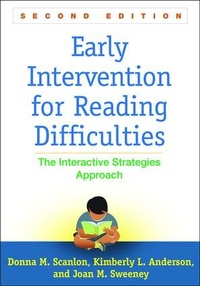
Early Intervention for Reading Difficulties, Second Edition
The Interactive Strategies Approach
2nd Edition
Published on 17. January 2017
Book
Paperback/Softback
450 pages
978-1-4625-2809-7 (ISBN)
Description
This book has been replaced by Early Literacy Instruction and Intervention, Third Edition, ISBN 978-1-4625-5365-5.
Reviews / Votes
"A lot of people talk about research-based practice, but Scanlon and colleagues deliver. They draw on their own and others' research to show how we can greatly reduce the prevalence of reading difficulties. The book addresses many facets of literacy development--from phonological awareness to reading comprehension--and shows how to organize instruction to respond to each child's needs. I am thrilled that the authors have developed a second edition of this book! I used the first edition in my preservice literacy methods course and as a trusted resource in my work with practicing teachers, and the second edition provides even more guidance. If you are an early literacy teacher educator, coach, or specialist, I strongly urge you to put this book on your reading list. You won't be disappointed."--Nell K. Duke, EdD, School of Education, University of Michigan"If you really want to know how to teach young children to read, this is a good place to start. In their second edition, the authors have perfected the ISA, based on hundreds of hours of work with beginning readers. What is truly remarkable is the degree of detail about every aspect of the beginning reading lesson, from phonological awareness to fluency. I would use this book as a primary text in an elementary methods course or in a graduate reading specialist or special education course."--Heidi Anne E. Mesmer, PhD, School of Education, Virginia Tech
"What a fantastic resource for anyone who teaches reading in the primary grades! What sets the second edition apart for me is that every section now includes an excellent discussion of possible challenges for English learners (ELs), along with recommendations for instructional modifications, making it a great resource for EL educators as well as reading teachers."--Karen L. Ford, PhD, Department of Curriculum, Instruction, and Special Education, University of Virginia
"A valuable resource for all early elementary teachers, whether they want to improve their implementation of reading interventions or build knowledge about effective reading instruction more generally. Detailed descriptions of research-based practices, along with many practical tools, make intervention planning and implementation more feasible."--Jeanne Wanzek, PhD, Professor and Currey-Ingram Endowed Chair, Department of Special Education, Vanderbilt University
"I used the first edition of this text in professional development courses with practicing teachers, reading specialists, and administrators, and I'm delighted to see the second edition. The ISA is responsive to students and it empowers teachers as professional decision makers. This is a refreshing approach in contrast to prepackaged intervention materials or scripted reading programs. The content in this text is firmly based on sound research and is presented in an approachable manner."--Seth A. Parsons, PhD, College of Education and Human Development, George Mason University -
More details
Series
Edition
2nd edition
Language
English
Place of publication
New York
United States
Publishing group
Guilford Publications
Target group
Professional and scholarly
Professional Practice & Development
Dimensions
Height: 254 mm
Width: 178 mm
Weight
808 gr
ISBN-13
978-1-4625-2809-7 (9781462528097)
Copyright in bibliographic data and cover images is held by Nielsen Book Services Limited or by the publishers or by their respective licensors: all rights reserved.
Schweitzer Classification
Other editions
New editions
Donna M. Scanlon | Kimberly L. Anderson | Erica M. Barnes
Early Literacy Instruction and Intervention, Third Edition
The Interactive Strategies Approach
Book
05/2024
3rd Edition
Guilford Press
€55.50
Shipment within 15-20 days
Additional editions
Donna M. Scanlon | Kimberly L. Anderson | Joan M. Sweeney
Early Intervention for Reading Difficulties, Second Edition
The Interactive Strategies Approach
Book
12/2016
2nd Edition
Guilford Press
€88.08
Article exhausted; check for reprint
Previous edition
Joan M. Sweeney
Early Intervention for Reading Difficulties, First Edition
The Interactive Strategies Approach
Book
08/2010
1st Edition
Guilford Publications
€60.84
Article exhausted; check for reprint
Persons
Donna M. Scanlon, PhD, is Professor in the Department of Literacy Teaching and Learning at the University at Albany, State University of New York. Dr. Scanlon has spent most of her career studying children's reading difficulties. Her studies have focused on the relationships between instructional characteristics and success in learning to read and on developing and evaluating approaches to preventing and remediating reading difficulties. Findings from studies that she and her colleagues conducted contributed to the emergence of response to intervention as a process for preventing reading difficulties and avoiding inappropriate and inaccurate learning disability classifications. Most recently, Dr. Scanlon's work has focused on the development of teacher knowledge and teaching skill among both preservice and inservice teachers for the purpose of helping teachers to prevent reading difficulties in young children and remediate reading difficulties among older children.
Kimberly L. Anderson, PhD, is Assistant Professor at East Carolina University in Greenville, North Carolina, where she teaches K-2 literacy methods courses in the Department of Literacy Studies, English Education, and History Education. Her current research focuses on improving small-group, supported literacy instruction in the kindergarten classroom and the relationships between teacher knowledge, teacher practice, and student outcomes with regard to the foundations of reading development. Dr. Anderson worked for several years as a research associate at the Child Research and Study Center, University at Albany, and has contributed to the research on the Interactive Strategies Approach (ISA) by serving as an intervention teacher in an early study; by providing professional development for teachers learning to implement the ISA in the early primary grades in both classroom and intervention settings; and by collaborating with preservice educators from institutions across New York State on enhancing preservice teacher knowledge related to early literacy development and instruction.
Joan M. Sweeney, MSEd, is a Reading/Literacy Specialist in the North Colonie Central School District in Latham, New York. Previously, she was a research associate in the Child Research and Study Center, University at Albany, where she provided intervention for struggling readers, supervised intervention teachers, and coached classroom teachers utilizing the ISA to support children's literacy development.
Kimberly L. Anderson, PhD, is Assistant Professor at East Carolina University in Greenville, North Carolina, where she teaches K-2 literacy methods courses in the Department of Literacy Studies, English Education, and History Education. Her current research focuses on improving small-group, supported literacy instruction in the kindergarten classroom and the relationships between teacher knowledge, teacher practice, and student outcomes with regard to the foundations of reading development. Dr. Anderson worked for several years as a research associate at the Child Research and Study Center, University at Albany, and has contributed to the research on the Interactive Strategies Approach (ISA) by serving as an intervention teacher in an early study; by providing professional development for teachers learning to implement the ISA in the early primary grades in both classroom and intervention settings; and by collaborating with preservice educators from institutions across New York State on enhancing preservice teacher knowledge related to early literacy development and instruction.
Joan M. Sweeney, MSEd, is a Reading/Literacy Specialist in the North Colonie Central School District in Latham, New York. Previously, she was a research associate in the Child Research and Study Center, University at Albany, where she provided intervention for struggling readers, supervised intervention teachers, and coached classroom teachers utilizing the ISA to support children's literacy development.
Content
I. A Comprehensive Approach to Early Intervention
1. The Interactive Strategies Approach
2. Responsive Instruction
3. Motivation to Read and Write
II. Learning the Alphabetic Code
4. Purposes and Conventions of Print
5. Phonological Awareness
6. Letter Naming and Letter Formation
7. Letter-Sound Association
8. The Alphabetic Principle and the Alphabetic Code-Early Development
9. Phonograms and Word Families
10. The Alphabetic Principle and the Alphabetic Code-Later Development
11. Morphological Units and Multisyllabic Words
III. Word Learning
12. Strategic Word Learning
13. High-Frequency Word Learning
IV. Meaning Construction
14. Fluency
15. Vocabulary and Oral Language Development
16. Comprehension and General Knowledge
V. Implementing Intensified Instruction
17. Small-Group and One-to-One Intervention
18. Revisiting and Concluding
References
Index
1. The Interactive Strategies Approach
2. Responsive Instruction
3. Motivation to Read and Write
II. Learning the Alphabetic Code
4. Purposes and Conventions of Print
5. Phonological Awareness
6. Letter Naming and Letter Formation
7. Letter-Sound Association
8. The Alphabetic Principle and the Alphabetic Code-Early Development
9. Phonograms and Word Families
10. The Alphabetic Principle and the Alphabetic Code-Later Development
11. Morphological Units and Multisyllabic Words
III. Word Learning
12. Strategic Word Learning
13. High-Frequency Word Learning
IV. Meaning Construction
14. Fluency
15. Vocabulary and Oral Language Development
16. Comprehension and General Knowledge
V. Implementing Intensified Instruction
17. Small-Group and One-to-One Intervention
18. Revisiting and Concluding
References
Index