

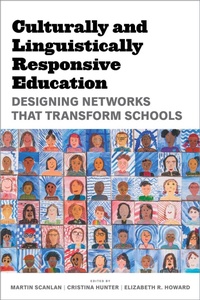
Culturally and Linguistically Responsive Education
Designing Networks That Transform Schools
Will be published approx. on 30. November 2019
Book
Paperback/Softback
248 pages
978-1-68253-399-4 (ISBN)
Description
Culturally and Linguistically Responsive Education provides a much-needed blueprint for how school leaders can leverage the power of collaborative learning to create more culturally and linguistically responsive schools.
The book describes an innovative network of twenty preK-8 schools located across the United States striving to address the barriers to inclusive education. Based on an ongoing initiative begun in 2012 by a team at Boston College, the book shows how these schools transformed to better serve their diverse, multilingual communities by adopting a two-way immersion model with the help of local faculty and other experts in bilingual education serving as mentors.
Culturally and Linguistically Responsive Education describes the founding of the network, the theory of action that drove its design, and the compelling evidence linking the networked approach to subsequent growth in student achievement and enrollment at the schools. Chapters written by the network's mentors examine in detail six practices that were key to driving the schools' transformation, including critical conversations, fidelity assurances to the two-way immersion model, coordinated professional development, teacher reflection cycles, family engagement, and distributive leadership.
The editors draw key lessons from this network for other leaders and argue for increased attention to culturally and linguistically responsive schooling that builds on students' sociocultural competence, cultivates an appreciation and proficiency in multiple languages, and promotes high levels of academic achievement.
The book describes an innovative network of twenty preK-8 schools located across the United States striving to address the barriers to inclusive education. Based on an ongoing initiative begun in 2012 by a team at Boston College, the book shows how these schools transformed to better serve their diverse, multilingual communities by adopting a two-way immersion model with the help of local faculty and other experts in bilingual education serving as mentors.
Culturally and Linguistically Responsive Education describes the founding of the network, the theory of action that drove its design, and the compelling evidence linking the networked approach to subsequent growth in student achievement and enrollment at the schools. Chapters written by the network's mentors examine in detail six practices that were key to driving the schools' transformation, including critical conversations, fidelity assurances to the two-way immersion model, coordinated professional development, teacher reflection cycles, family engagement, and distributive leadership.
The editors draw key lessons from this network for other leaders and argue for increased attention to culturally and linguistically responsive schooling that builds on students' sociocultural competence, cultivates an appreciation and proficiency in multiple languages, and promotes high levels of academic achievement.
More details
Language
English
Place of publication
Cambridge
United States
Target group
Professional and scholarly
Product notice
Paperback (trade)
Unsewn / adhesive bound
Dimensions
Height: 226 mm
Width: 152 mm
Thickness: 15 mm
Weight
295 gr
ISBN-13
978-1-68253-399-4 (9781682533994)
Copyright in bibliographic data and cover images is held by Nielsen Book Services Limited or by the publishers or by their respective licensors: all rights reserved.
Schweitzer Classification
Persons
Martin Scanlan is an associate professor in educational leadership at the Lynch School of Education and Human Development at Boston College.
Cristina Hunter is the associate director of research initiatives for the Roche Center for Catholic Education.
Elizabeth R. Howard is an associate professor of bilingual education in the Neag School of Education at the University of Connecticut.
Cristina Hunter is the associate director of research initiatives for the Roche Center for Catholic Education.
Elizabeth R. Howard is an associate professor of bilingual education in the Neag School of Education at the University of Connecticut.