

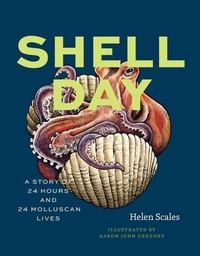
Shell Day
A Story of 24 Hours and 24 Molluscan Lives
Will be published approx. on 3. July 2026
Book
Hardback
208 pages
978-0-226-84052-9 (ISBN)
Description
An hourly guide that follows twenty-four mollusks to reveal the fascinating lives behind their shells.
From morning to night and from the Arctic to the equator, snails, clams, and other shell-making mollusks have busy days. In this short book, acclaimed author and marine biologist Helen Scales shows readers exactly how these animals spend their time. Each chapter of Shell Day features a single mollusk during a single hour, highlighting twenty-four different species.
Far in the north, the Svalbard archipelago lies deep in the darkness of the polar night. And yet, in what remains a scientific mystery, Iceland scallops continue their daily rhythms, closing and opening their fan-shaped shells using an internal clock. At noon, we observe a clam shell sitting still on the seabed of a sandy tropical lagoon. The two shells open slightly, and a pair of rounded eyes peep out. A small, rust-colored coconut octopus hiding inside lets the clam shells fall apart and gathers them up in her arms. This mollusk's ancestors long ago lost the ability to produce their own shells, but the cephalopod is happy to use another animal's castoff as a temporary home. At ten that night, we find ourselves in Southern France. A male moon snail uses his huge, fleshy foot like a plow as he digs down into the seabed in search of food. When the moon snail finds a cockle, he swiftly smothers it, then sets about drilling, aided by a daub of acidic slime. Cockles are tasty, but so are other moon snails, and his snacking has a cannibalistic flavor.
For each chapter, illustrator and cartoonist Aaron John Gregory has depicted molluscan scenes with entrancing pen-and-ink drawings. Working together to narrate and illustrate these unique moments in time, Scales and Gregory have created an engaging read that is a perfect way to spend an hour or two-and a true gift for beachcombers, naturalists, or anyone eager to learn about the mollusks that make their favorite shells.
From morning to night and from the Arctic to the equator, snails, clams, and other shell-making mollusks have busy days. In this short book, acclaimed author and marine biologist Helen Scales shows readers exactly how these animals spend their time. Each chapter of Shell Day features a single mollusk during a single hour, highlighting twenty-four different species.
Far in the north, the Svalbard archipelago lies deep in the darkness of the polar night. And yet, in what remains a scientific mystery, Iceland scallops continue their daily rhythms, closing and opening their fan-shaped shells using an internal clock. At noon, we observe a clam shell sitting still on the seabed of a sandy tropical lagoon. The two shells open slightly, and a pair of rounded eyes peep out. A small, rust-colored coconut octopus hiding inside lets the clam shells fall apart and gathers them up in her arms. This mollusk's ancestors long ago lost the ability to produce their own shells, but the cephalopod is happy to use another animal's castoff as a temporary home. At ten that night, we find ourselves in Southern France. A male moon snail uses his huge, fleshy foot like a plow as he digs down into the seabed in search of food. When the moon snail finds a cockle, he swiftly smothers it, then sets about drilling, aided by a daub of acidic slime. Cockles are tasty, but so are other moon snails, and his snacking has a cannibalistic flavor.
For each chapter, illustrator and cartoonist Aaron John Gregory has depicted molluscan scenes with entrancing pen-and-ink drawings. Working together to narrate and illustrate these unique moments in time, Scales and Gregory have created an engaging read that is a perfect way to spend an hour or two-and a true gift for beachcombers, naturalists, or anyone eager to learn about the mollusks that make their favorite shells.
Reviews / Votes
"The 'Earth Day' series takes to the seas with the newest installment, looking at shells and what lives in them. Marine biologist Scales (Cambridge Univ.; Around the Ocean in 80 Fish and Other Sea Life) views shells as 'gateway treasures' to the ocean; the mollusks in the book include marine, freshwater, and terrestrial species. Each chapter shares the common and scientific name of the mollusk, where it's found, the time of day readers meet it, and a detailed pen-and-ink illustration. For marine species for whom tides influence much of their lives, tidal regimes are included. Scales offers exciting glimpses into the lives of mollusks and brings context to the animal's life, explaining the whys behind its way of being. It may be scientific, but it is a magical peek into their world. Chapters hint at the bleak future these creatures face if manmade threats are allowed to continue. The book ends with a call to action, encouraging readers to make minor life changes that have a significant impact on the oceans. VERDICT Ocean lovers and shell admirers will find plenty to enjoy; a must for libraries with the rest of the series in their collection." * Library Journal * "Do you ever ask yourself, What do mollusks do all day? Or perhaps even, What is a mollusk? You'll find the answers here. You're sure to learn something, as I did, while you enjoy this informative book that highlights members of the second-most diverse but often-overlooked animal phylum, which includes snails, squids, clams, and slugs. Though still animals, those creatures are about as distantly related to you and me as possible. They offer a different and fascinating take on life." * Janet Voight, author of "From the Seashore to the Seafloor" * "Marine biologist Helen Scales introduces readers to twenty-four remarkable species of mollusks, each revealing fascinating behaviors that unfold over the course of a typical molluscan day. Beautifully illustrated and packed with engaging and informative stories, this book offers delightful insights into the lives of those extraordinary animals." * Andreia Salvador, senior curator of marine Mollusca at the Natural History Museum, London * "With the soul of a poet and a talent for finding the most intriguing trivia about familiar seaside sights, marine biologist Scales turns the mundane into the magical." -- Praise for Scales * Discover * "A sprawling, ambitious underwater journey studded with fascinating tidbits." -- Praise for Scales * New York Times Book Review * "Punctures assumptions with the power of a cone snail dart." -- Praise for Scales * Spectator * "An enchanting, accessible tour of the seashell and its place and purpose within the natural world." -- Praise for Scales * Kirkus Reviews * "Scales . . . brings a marine biologist's eye and aficionado's heart to these musings on seashells. . . . [Her] eclectic approach to this ancient bridge between the human and natural worlds conveys her curiosity and appreciation." -- Praise for Scales * Publishers Weekly * "A fascinating journey into the strange and captivating world of mollusks. Carefully researched and entertaining throughout. . . . Relentlessly interesting." -- Praise for Scales * Science *More details
Series
Language
English
Place of publication
Chicago
United States
Publishing group
The University of Chicago Press
Illustrations
25 halftones
Dimensions
Height: 152 mm
Width: 121 mm
Weight
454 gr
ISBN-13
978-0-226-84052-9 (9780226840529)
Copyright in bibliographic data and cover images is held by Nielsen Book Services Limited or by the publishers or by their respective licensors: all rights reserved.
Schweitzer Classification
Persons
Helen Scales is a marine biologist, author, and broadcaster who teaches at the University of Cambridge. She is a regular contributor to National Geographic Magazine and The Guardian and is a storytelling ambassador for the Save Our Seas Foundation. Her most recent books include What the Wild Sea Can Be and Ocean Art: From the Shore to the Deep. Aaron John Gregory is a scientific illustrator and professional aquarist living on the coast in Pacifica, California with his wife and two daughters. Shell Day is his fifth collaboration with Helen Scales.
Content
Preface
Artist's Note
Midnight Garter Cone Snail (West Africa)
1 AM Jenner's Cowrie (South America)
2 AM-Low Tide Common Limpet (Europe)
3 AM Iceland Scallop (Arctic)
4 AM Humboldt Squid (Eastern Pacific)
5 AM Bobtail Squid (Hawaiian Islands)
6 AM Chambered Nautilus (Western Pacific)
7 AM Wavy-Rayed Lampmussel (North America)
8 AM-High Tide Dog Whelk (Northern Europe)
9 AM Giant Clam (Southeast Asia)
10 AM Button Top Shell (Singapore)
11 AM Caribbean Hermit Crab (Caribbean Sea)
Noon Coconut Octopus (Red Sea)
1 PM Deep-Sea Hydrothermal Vent Mussel (East Pacific)
2 PM-Low Tide Spire Snail (Europe)
3 PM Argonaut (Indian Ocean)
4 PM Sea Butterfly (Southern Ocean)
5 PM Nutmeg Snail (Eastern Pacific)
6 PM Giant Cuttlefish (Southern Australia)
7 PM Polynesian Tree Snail (South Pacific)
8 PM-High Tide Pacific Abalone (Japan)
9 PM Queen Conch (Caribbean Sea)
10 PM Moon Snail (Mediterranean)
11 PM Giant Triton (Australia)
Epilogue
Acknowledgments
Further Reading
Index
Artist's Note
Midnight Garter Cone Snail (West Africa)
1 AM Jenner's Cowrie (South America)
2 AM-Low Tide Common Limpet (Europe)
3 AM Iceland Scallop (Arctic)
4 AM Humboldt Squid (Eastern Pacific)
5 AM Bobtail Squid (Hawaiian Islands)
6 AM Chambered Nautilus (Western Pacific)
7 AM Wavy-Rayed Lampmussel (North America)
8 AM-High Tide Dog Whelk (Northern Europe)
9 AM Giant Clam (Southeast Asia)
10 AM Button Top Shell (Singapore)
11 AM Caribbean Hermit Crab (Caribbean Sea)
Noon Coconut Octopus (Red Sea)
1 PM Deep-Sea Hydrothermal Vent Mussel (East Pacific)
2 PM-Low Tide Spire Snail (Europe)
3 PM Argonaut (Indian Ocean)
4 PM Sea Butterfly (Southern Ocean)
5 PM Nutmeg Snail (Eastern Pacific)
6 PM Giant Cuttlefish (Southern Australia)
7 PM Polynesian Tree Snail (South Pacific)
8 PM-High Tide Pacific Abalone (Japan)
9 PM Queen Conch (Caribbean Sea)
10 PM Moon Snail (Mediterranean)
11 PM Giant Triton (Australia)
Epilogue
Acknowledgments
Further Reading
Index