

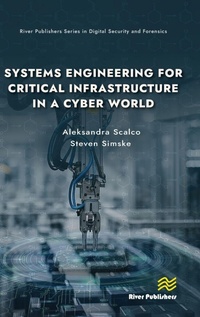
Systems Engineering for Critical Infrastructure in a Cyber World
1st Edition
Published on 5. February 2026
Book
Hardback
432 pages
978-87-438-0911-1 (ISBN)
Description
This book is a practical guide to defending critical infrastructure in today's cyber world. Critical infrastructure includes energy, power, water, transportation, manufacturing, and facility systems, along with the sensors and actuators that make up operational technology (OT). It presents a systems engineering framework for coordinating interdependent organizations and technologies, ensuring seamless performance across multiple fields.
Bridging the traditional divide between information technology (IT), operational technology (OT), and cybersecurity, the book offers practical starting points and disciplined approaches for governance boards, project managers, and engineers. Clear guidance is provided on how to implement cybersecurity mitigations within critical infrastructure, making complex concepts accessible and actionable.
Many professionals in infrastructure operations, engineering, and technical management feel unprepared to address cyber threats. This book fills that gap, serving as both a self-study resource and a refresher for those without formal training in computer science, cyber, or control systems-and as a teaching tool for explaining these principles to others.
The goal is to present enduring cybersecurity concepts through proven systems engineering methods, along with new techniques to align stakeholders and resources. From technicians and operators to designers and decision-makers, readers will gain tools to connect cybersecurity practices with mission objectives.
By combining systems engineering and cyber defense principles, this book equips professionals to work effectively with incident responders, analysts, engineers, and senior management. Decision-making skills are presented in a clear, easy-to-understand style, supported by candid questions, current strategies, and real-world, case-based examples.
Bridging the traditional divide between information technology (IT), operational technology (OT), and cybersecurity, the book offers practical starting points and disciplined approaches for governance boards, project managers, and engineers. Clear guidance is provided on how to implement cybersecurity mitigations within critical infrastructure, making complex concepts accessible and actionable.
Many professionals in infrastructure operations, engineering, and technical management feel unprepared to address cyber threats. This book fills that gap, serving as both a self-study resource and a refresher for those without formal training in computer science, cyber, or control systems-and as a teaching tool for explaining these principles to others.
The goal is to present enduring cybersecurity concepts through proven systems engineering methods, along with new techniques to align stakeholders and resources. From technicians and operators to designers and decision-makers, readers will gain tools to connect cybersecurity practices with mission objectives.
By combining systems engineering and cyber defense principles, this book equips professionals to work effectively with incident responders, analysts, engineers, and senior management. Decision-making skills are presented in a clear, easy-to-understand style, supported by candid questions, current strategies, and real-world, case-based examples.
More details
Series
Language
English
Place of publication
Gistrup
Denmark
Target group
College/higher education
Professional and scholarly
Academic, Postgraduate, and Professional Practice & Development
Illustrations
46 farbige Abbildungen, 10 Farbfotos bzw. farbige Rasterbilder, 5 s/w Zeichnungen, 36 farbige Zeichnungen, 12 s/w Tabellen, 5 s/w Abbildungen
12 Tables, black and white; 36 Line drawings, color; 5 Line drawings, black and white; 10 Halftones, color; 46 Illustrations, color; 5 Illustrations, black and white
Dimensions
Height: 240 mm
Width: 161 mm
Thickness: 30 mm
Weight
872 gr
ISBN-13
978-87-438-0911-1 (9788743809111)
Copyright in bibliographic data and cover images is held by Nielsen Book Services Limited or by the publishers or by their respective licensors: all rights reserved.
Schweitzer Classification
Other editions
Additional editions
Aleksandra Scalco | Steven Simske
Systems Engineering for Critical Infrastructure in a Cyber World
E-Book
02/2026
1st Edition
River Publishers
€145.99
Available for download
Aleksandra Scalco | Steven Simske
Systems Engineering for Critical Infrastructure in a Cyber World
E-Book
02/2026
1st Edition
River Publishers
€145.99
Available for download
Persons
Dr. Scalco is currently Professor of Systems Engineering at the US Department of Defense (DOD) Acquisition University (DAU) (since 2024). Prior to DAU, Aleksandra held various government systems engineering and information systems security designer (ISSD) positions and was designated as a cybersecurity subject matter expert for control systems. She draws on more than 25 years of experience in systems engineering to provide insight into cybersecurity for control systems. She has helped teams design, develop, and field solutions to enhance cybersecurity for high-impact, national-level initiatives, employing systems engineering principles, along with knowledge of the ""problem space"" and available products and practices (the ""solution space""). She is the author of numerous publications and has authored curriculum and instructional design content on cybersecurity for critical infrastructure. Dr. Scalco is a Senior Member of the Institute of Electrical and Electronics Engineers (IEEE). She is a member of the seventh cohort of the International Council on Systems Engineering (INCOSE) Institute for Technical Leadership and holds a Certified Systems Engineering Professional (CSEP) designation. She is an Expert Certified in Information Technology Infrastructure Library (ITIL) IT Service Management. Aleksandra was a Colorado State University (CSU) Systems Engineering Outstanding Dissertation Awardee, 2021-2022. She is happily married (Rich).
Dr. Simske is currently (since 2018) Professor of Systems Engineering at Colorado State University (CSU). Prior to CSU, Steve held various positions at HP, HP Inc, and HP Labs, including the role of technical Fellow and Vice President/Director from 2011-2018. Before HP, Steve worked in a NASA CCDS (Center for the Commercial Development of Space) for 20 years (the last 13 years part-time) as a Ph.D. candidate, Post Doc and Research Professor, flying 18 experiments on 13 Space Shuttle missions (including ISS and KC-135 elements) as payload manager/designer, along with various sounding rockets. His degrees and PostDoc are in Biomedical, Electrical, and Aerospace Engineering. He has more than 240 US Patents and has helped create exercise-responsive pacemakers, impedance tomography systems, several plant and animal modules for spaceflight, digital scanners, digital senders, digital cameras, document digitization services, wireless wearable health monitors, forensic imaging devices, mobile authentication services, and 3D printing materials. Steve has written seven books and four more are in process. Steve is a Fellow of IEEE, NAI, IST, and CSU FIIE, and a winner of the 2022 CSU Best Teacher Award. Steve is happily married (Tess) and has two wonderful sons (Kieran, Dallen).
Dr. Simske is currently (since 2018) Professor of Systems Engineering at Colorado State University (CSU). Prior to CSU, Steve held various positions at HP, HP Inc, and HP Labs, including the role of technical Fellow and Vice President/Director from 2011-2018. Before HP, Steve worked in a NASA CCDS (Center for the Commercial Development of Space) for 20 years (the last 13 years part-time) as a Ph.D. candidate, Post Doc and Research Professor, flying 18 experiments on 13 Space Shuttle missions (including ISS and KC-135 elements) as payload manager/designer, along with various sounding rockets. His degrees and PostDoc are in Biomedical, Electrical, and Aerospace Engineering. He has more than 240 US Patents and has helped create exercise-responsive pacemakers, impedance tomography systems, several plant and animal modules for spaceflight, digital scanners, digital senders, digital cameras, document digitization services, wireless wearable health monitors, forensic imaging devices, mobile authentication services, and 3D printing materials. Steve has written seven books and four more are in process. Steve is a Fellow of IEEE, NAI, IST, and CSU FIIE, and a winner of the 2022 CSU Best Teacher Award. Steve is happily married (Tess) and has two wonderful sons (Kieran, Dallen).
Content
1. Understanding the Game 2. History of the Term "Cyber" 3. Cyber Policy, Regulations, and Guidelines 4. Cyber Is a Medium (Not a Domain) 5. Cyber Paradox 6. Cyber Vulnerabilities Start at the Hardware Level 7. Threats to Information-intensive Systems 8. Use Cases and Operational View (OV) Illustrations 9. Road to Commoditization 10. Transition of Innovation to Operations 11. Lifecycle Phases 12. Concept Development 13. Needs Analysis 14. Detail Design 15. Design tradeoffs 16. Modernization Strategies 17. Architecture Approaches 18. Software Approaches 19. Biometrics 20. Foundations of Systems Engineering 21. Workforce 22. Managing Risk 23. Abstraction Models 24. Creating a Model-based Organization 25. Stakeholder Alignment 26. Conclusion Appendix Questionnaire Resource