

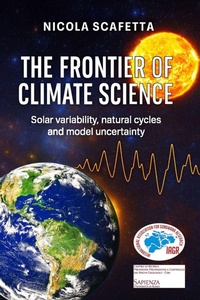
The Frontier of Climate Science
Solar variability, natural cycles and model uncertainty
Published on 4. March 2026
Book
Paperback/Softback
502 pages
979-12-986176-0-5 (ISBN)
Description
How well do we truly understand Earth's climate? What natural forces remain beyond our grasp? Is Net Zero the only viable path forward? The Frontier of Climate Science explores climate dynamics through physics, complex systems, and astronomy, synthesizing several decades of peer¿reviewed research.
The book critically reviews the scientific foundations of modern climate theory, the evolution of IPCC assessments, and the limits of global climate models (GCMs) when confronted with observations. It investigates natural variability across multiple timescales, including oceanic oscillations, solar variability, and astronomical cycles driving both solar and climate variability, integrating satellite data, paleoclimate reconstructions, and empirical modeling approaches.
From this evidence emerges a balanced view of climate risk, favoring pragmatic adaptation over narrowly defined policy pathways such as Net Zero. Rich in insights and analytical approaches, the book helps readers understand climate variability, assess risks, think critically, and explore key open questions in climate science.
Endorsed by the International Association for Gondwana Research (IAGR) and by the "Centro di Ricerca Previsione, Prevenzione e Controllo dei Rischi Geologici" (CERI), Sapienza University of Rome.
Forewords by Prof. M. Santosh, Prof. Alberto Prestininzi, and Prof. Judith Curry
This work synthesizes findings from more than 650 peer¿reviewed scientific papers at the frontier of climate science.
More details
Person
Nicola Scafetta is a physicist and climate scientist, and Professor of Oceanography, Meteorology, and Climatology at the University of Naples Federico II. He earned his Ph.D. in Physics from the University of North Texas and has conducted research at leading U.S. universities, primarily at Duke University. He served as a cöinvestigator on NASA-JPL's ACRIM project, dedicated to the satellite measurement of total solar irradiance. Since 2017, he has been ranked among the "World's Top 2% Scientists" in the Stanford University-Elsevier listing.