

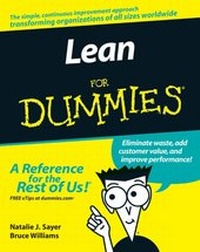
Lean For Dummies
1st Edition
Published on 2. March 2007
Book
Paperback/Softback
384 pages
978-0-470-09931-5 (ISBN)
Description
Create a culture that embraces change
The fun and easy way to do more with less
Competitive pressures force everyone to satisfy more demanding customers while using less of everything -- time, energy, space, materials, and money. This no-nonsense guide shows you how to apply the proven philosophies and techniques of Lean to eliminate waste and maximize the effectiveness of your resources. You'll see step-by-step how to implement Lean practices in any type of organization.
Discover how to
* Understand Lean and how it?s implemented
* Speak the language of Lean
* Identify and eliminate the seven forms of waste
* Construct and use Value Stream Maps and other Lean tools
* Engage people in a Lean transformation
The fun and easy way to do more with less
Competitive pressures force everyone to satisfy more demanding customers while using less of everything -- time, energy, space, materials, and money. This no-nonsense guide shows you how to apply the proven philosophies and techniques of Lean to eliminate waste and maximize the effectiveness of your resources. You'll see step-by-step how to implement Lean practices in any type of organization.
Discover how to
* Understand Lean and how it?s implemented
* Speak the language of Lean
* Identify and eliminate the seven forms of waste
* Construct and use Value Stream Maps and other Lean tools
* Engage people in a Lean transformation
More details
Edition
1., Auflage
Language
English
Place of publication
Chichester
United Kingdom
Publishing group
John Wiley and Sons Ltd
Target group
Professional and scholarly
Illustrations
Illustrations
Dimensions
Height: 23.3 cm
Width: 18.7 cm
Thickness: 21 mm
Weight
535 gr
ISBN-13
978-0-470-09931-5 (9780470099315)
Schweitzer Classification
Other editions
New editions
Natalie J. Sayer | Bruce Williams
Lean For Dummies
Book
03/2012
2nd Edition
Wiley
€27.50
Shipment within 15-20 days
Additional editions
Persons
Natalie J. Sayer began studying and applying Lean before it was formally known as Lean. Over her 20-year career in the automotive industry in the United States and Mexico, Natalie honed her skills applying Lean and Organizational Development methods across functional areas of Fortune 130 companies. In 1996, Natalie was an instrumental team member in the Lean transformation of a GM facility in Matamoros, Mexico. The team was awarded the 1996 GM President's Council Honors for the project. While working with General Motors, she had multiple opportunities to visit and learn from New United Motor Manufacturing, Inc. (NUMMI). Natalie has trained, coached, mentored, and rolled up her sleeves to implement Lean practices, whether working in a company or volunteering at a food bank.
She received a Bachelor of Mechanical Engineering from the University of Dayton in 1988 and a Master of Manufacturing Systems Engineering from the University of Michigan in 1992. She is a graduate of Coach University and Corporate Coach University. Natalie is also a Six Sigma Black Belt and a Global Leadership Executive Coach.
In 2003, Natalie founded I-Emerge, an Arizona-based global consultancy dedicated to the facilitation of people and processes experiencing significant change. The I-Emerge toolbox includes executive and personal coaching, group facilitation, Lean methods, public speaking, and Organizational Development tools and assessments. She is a passionate people person, who lives her life with the convictions that "there is always a better way" and "change won't happen without the people."
Bruce Williams strives for perfection and added value as a scientist, educator, consultant, and entrepreneur. Leveraging the Lean principle of standardized work, this is his third For Dummies book in three years, having previously coauthored the best-selling Six Sigma For Dummies in 2005 and the Six Sigma Workbook For Dummies in 2006.
Undergraduate degrees in physics and astrophysics from the University of Colorado testify to his early pursuit of understanding the ultimate nature of root cause.
She received a Bachelor of Mechanical Engineering from the University of Dayton in 1988 and a Master of Manufacturing Systems Engineering from the University of Michigan in 1992. She is a graduate of Coach University and Corporate Coach University. Natalie is also a Six Sigma Black Belt and a Global Leadership Executive Coach.
In 2003, Natalie founded I-Emerge, an Arizona-based global consultancy dedicated to the facilitation of people and processes experiencing significant change. The I-Emerge toolbox includes executive and personal coaching, group facilitation, Lean methods, public speaking, and Organizational Development tools and assessments. She is a passionate people person, who lives her life with the convictions that "there is always a better way" and "change won't happen without the people."
Bruce Williams strives for perfection and added value as a scientist, educator, consultant, and entrepreneur. Leveraging the Lean principle of standardized work, this is his third For Dummies book in three years, having previously coauthored the best-selling Six Sigma For Dummies in 2005 and the Six Sigma Workbook For Dummies in 2006.
Undergraduate degrees in physics and astrophysics from the University of Colorado testify to his early pursuit of understanding the ultimate nature of root cause.
Content
Introduction.
Part I: Lean Basics.
Chapter 1: Defining Lean.
Chapter 2: The Foundation and Language of Lean.
Part II: Understanding Flow and the Value Stream.
Chapter 3: Seeing Value through the Eyes of the Customer.
Chapter 4: A Resource Runs through It: Value Stream Mapping.
Chapter 5: Charting the Course: Using Value Stream Maps.
Chapter 6: Flowing in the Right Direction: Lean Projects and Kaizen.
Part III: The Lean Toolbox.
Chapter 7: Customer and Value-Stream Tools.
Chapter 8: Flow and Pull Tools.
Chapter 9: Perfection Tools.
Chapter 10: Management Tools.
Part IV: The Lean Enterprise.
Chapter 11: Lean in the Organization: Principles, Behaviors, and Change.
Chapter 12: Power to the People.
Chapter 13: Go Lean: Implementation Strategy, Startup, and Evolution.
Chapter 14: Lean within the Enterprise.
Chapter 15: Lean across Industry.
Part V: The Part of Tens.
Chapter 16: Ten Best Practices of Lean.
Chapter 17: Ten Pitfalls to Avoid.
Chapter 18: Ten Places to Go for Help.
Glossary.
Index.
Part I: Lean Basics.
Chapter 1: Defining Lean.
Chapter 2: The Foundation and Language of Lean.
Part II: Understanding Flow and the Value Stream.
Chapter 3: Seeing Value through the Eyes of the Customer.
Chapter 4: A Resource Runs through It: Value Stream Mapping.
Chapter 5: Charting the Course: Using Value Stream Maps.
Chapter 6: Flowing in the Right Direction: Lean Projects and Kaizen.
Part III: The Lean Toolbox.
Chapter 7: Customer and Value-Stream Tools.
Chapter 8: Flow and Pull Tools.
Chapter 9: Perfection Tools.
Chapter 10: Management Tools.
Part IV: The Lean Enterprise.
Chapter 11: Lean in the Organization: Principles, Behaviors, and Change.
Chapter 12: Power to the People.
Chapter 13: Go Lean: Implementation Strategy, Startup, and Evolution.
Chapter 14: Lean within the Enterprise.
Chapter 15: Lean across Industry.
Part V: The Part of Tens.
Chapter 16: Ten Best Practices of Lean.
Chapter 17: Ten Pitfalls to Avoid.
Chapter 18: Ten Places to Go for Help.
Glossary.
Index.