

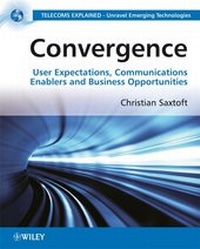
Convergence
User Expectations, Communications Enablers and Business Opportunities
Published on 4. April 2008
Book
Paperback/Softback
250 pages
978-0-470-72708-9 (ISBN)
Description
Convergence: User Expectations, Communications Enablers and Business Opportunities offers a user-centric and business-oriented analysis of the rapidly changing communications industry. Clear summaries of key technology areas provide the backdrop for an extensive analysis of the expectations set by users and the challenges and opportunities this presents to companies.
The process of convergence is characterized by complex interactions between different technical fields, business areas and end-user relations, where traditional telecommunications services, internet-based services and media broadcast services are blending into a continuum of rich new offerings. With these changes the existing hardwired links between user services and specific industry segments are rapidly dissolving.
* Presents guide to end-user market trends and expectations
* Includes models and analysis of new industry structures and dynamics
* Contains comprehensive discussion of innovation as a business driver
* Provides wide range of references to reflect the cross-disciplinary scope of convergence
* Offers motivation and suggestions for refocus of key business strategies
Convergence bridges the fields of business, economics, technology and social studies and analyses business models and practices from across a range of industry segments. the wide scope makes the book an ideal text for technically-minded executives, business-oriented engineers and anyone with an interest in the intricacies of the convergence triggered market changes.
More details
Other editions
Additional editions
E-Book
08/2008
Wiley
€50.99
Available for download
Person
Noman Muhammad works at Nokia Siemens Networks as a Solutions Manager for their Customer and Market Organisation in the UK. He works closely with service providers on IP Multimedia Subsystems (IMS), fixed mobile convergence, mobile packet core and value-added services. Noman has a Masters degree in Telecommunications Engineering (Networking) and a first degree in Electronics and Communications Engineering. His 10-year career working in the telecoms and Internet industries has included positions in services product development, end-to-end network planning, mobile services development and web solutions development.
Christian Saxtoft currently works as a Senior Process Architect in Nokia Siemens? Networks' SW Business Development and Strategy group. He obtained a Ph.D. with a dissertation titled 'Telecommunications Network Architectures' as well as an MBA in Strategic Business Planning. During his 15-year career in the telecoms industry, Christian has held various R & D, marketing, sales and management positions at British Telecom, Alcatel, Tellabs and Nokia. His research interests include operator processes, strategic planning and convergence, and some of his work has featured in recent telecoms white papers.
Davide Chiavelli works in the Consulting & System Integration group of Nokia Siemens Networks as a Product Manager for their Service Optimisation / E2E Consultancy. He has a 'Laurea in Ingegneria' degree from the Politecnico Milano in Italy. Davide has worked in the telecoms industry for more than 12 years; first in R&D planning for the Telecom Italia Group, and later at Nokia in Senior Network Planning, Programme Management and Product Business Management roles. Davide's main interests include service optimisation, E2E and the translation of technical problems into their financial equivalents.
Christian Saxtoft currently works as a Senior Process Architect in Nokia Siemens? Networks' SW Business Development and Strategy group. He obtained a Ph.D. with a dissertation titled 'Telecommunications Network Architectures' as well as an MBA in Strategic Business Planning. During his 15-year career in the telecoms industry, Christian has held various R & D, marketing, sales and management positions at British Telecom, Alcatel, Tellabs and Nokia. His research interests include operator processes, strategic planning and convergence, and some of his work has featured in recent telecoms white papers.
Davide Chiavelli works in the Consulting & System Integration group of Nokia Siemens Networks as a Product Manager for their Service Optimisation / E2E Consultancy. He has a 'Laurea in Ingegneria' degree from the Politecnico Milano in Italy. Davide has worked in the telecoms industry for more than 12 years; first in R&D planning for the Telecom Italia Group, and later at Nokia in Senior Network Planning, Programme Management and Product Business Management roles. Davide's main interests include service optimisation, E2E and the translation of technical problems into their financial equivalents.
Content
Introduction.
List of Abbreviations.
PART I: EXPERIENCE OF THE END-USER.
Chapter 1: Communications in a User Perspective.
1.1 History of the Communications Services Users.
1.2 The 'Long Tail'.
1.3 A Fragmented User Community.
1.4 Knowledge: A Human Resource.
1.5 Summary.
1.6 References.
Chapter 2: The Convergence Culture Square.
2.1 Different Dimensions to Convergence.
2.2 Social Changes.
2.3 Convergence in Thinking.
2.4 Change Management Challenges.
2.5 Value Perception.
2.6 Summary.
2.7 References.
PART II: CONVERGENT BUSINESS MODELS.
Chapter 3: Market Trends and Predictions.
3.1 Towards End-User Focus.
3.2 Changing Patterns in the Communications Industry.
3.3 Important Market Characteristics.
3.4 Value Systems in the Communications Industry.
3.5 Value Grid in the Communications Industry.
3.6 Summary.
3.7 References.
Chapter 4: Structures and Strategies.
4.1 The Competitive Environment.
4.2 Diminishing Control.
4.3 Web 2.0-Driven Business Models.
4.4 The Sphere of Influence.
4.5 User Expectations.
4.6 Advertising.
4.7 Summary.
4.8 References.
Chapter 5: Strategic Opportunities.
5.1 Generic Business Strategies.
5.2 Quality Versus Cost: A Trade-Off.
5.3 'Lean Operator' and Beyond.
5.4 Summary.
5.5 References.
PART III: TECHNOLOGIES AND SERVICES.
Chapter 6: Enabling Technologies.
6.1 Core Network Technologies and Systems.
6.2 Access Network Technologies and Systems.
6.3 Consumer Products.
6.4 Summary.
6.5 References.
Chapter 7: Convergent Services and Systems.
7.1 Services on Mobile Terminals.
7.2 Television and Video Services.
7.3 Other Convergent Services.
7.4 Fixed-Mobile Convergence.
7.5 Summary.
7.6 References.
PART IV: BUSINESS PROCESSES IN CONVERGENT COMMUNICATIONS MARKETS.
Chapter 8: Management of Convergent Services.
8.1 Enterprise Software Environment.
8.2 Enterprise System Integration Challenges.
8.3 Enterprise Process Optimization.
8.4 Methodologies for Business Process Optimization.
8.5 Summary.
8.6 References.
Chapter 9: New Business Opportunities.
9.1 The Network - a Managed Dynamic Business Asset.
9.2 Knowledge Based Organisations.
9.3 Opportunities in Outsourcing.
9.4 Summary.
9.5 References.
Chapter 10: Management of User Expectations.
10.1 Mobile Terminals and Convergence of Services.
10.2 Control of End-User QoE.
10.3 Terminal Characteristics and User Preferences.
10.4 CSP Crossroads.
10.5 Summary.
10.6 References.
Chapter 11: Billing and Convergent Charging.
11.1 Convergent Charging System Architecture.
11.2 Standardized Charging and Billing Frameworks.
11.3 Data Sources in Charging and Billing Systems.
11.4 Summary.
11.5 References.
PART V: CONVERGENCE AND BEYOND.
Chapter 12: Innovation and New Opportunities.
12.1 Categories of Innovation.
12.2 Methods to Facilitate Innovation.
12.3 Innovation Frameworks.
12.4 Convergence of Experience.
12.5 Future Trends.
12.6 Summary.
12.7 References.
Chapter 13: The Future of Communications.
13.1 A Different Paradigm.
13.2 The New Challenges.
13.3 The New Horizons.
13.4 Summary.
13.5 References.
Index.