

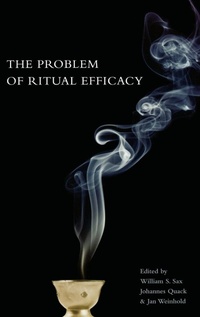
The Problem of Ritual Efficacy
Published on 25. February 2010
Book
Hardback
208 pages
978-0-19-539440-5 (ISBN)
Description
Rituals transform citizens into presidents and princesses into queens. They transform sick persons into healthy ones, and public space into prohibited sanctuary. Shamanic rituals heal, legal rituals bind, political rituals ratify, and religious rituals sanctify. But how exactly do they accomplish these things? How do rituals work? This is the question of ritual efficacy, and although it is one of the very first questions that people everywhere ask of rituals, surprisingly little has been written on the topic. In fact, this collection of 10 contributed essays is the first to explicitly address the question of ritual efficacy. The authors do not aspire to answer the question 'how do rituals work?' in a simplistic fashion, but rather to show how complex the question is. While some contributors do indeed advance a particular theory of ritual efficacy, others ask whether the question makes any sense at all, and most show how complex it is by referring to the sociocultural environment in which it is posed, since the answer depends on who is asking the question, and what criteria they use to evaluate the efficacy of ritual. In his introduction, William Sax emphasizes that the very notion of ritual efficacy is a suspicious one because, according to a widespread 'modern' and 'scientific' viewpoint, rituals are merely expressive, and therefore cannot be efficacious. Rituals are thought of as superficial, 'merely symbolic,' and certainly not effective. Nevertheless many people insist that rituals 'work,' and the various positions taken on the question tell us a great deal about the social and historical background of the people involved. One essay, for example, illuminates a dispute between 'materialist' and 'enlightenment' Catholics in Ecuador, with the former affirming the notion of ritual efficacy and the latter doubting it. In other essays, contributors address instances in which orthodox religious figures (mullahs, church authorities, and even scientific positivists) discount the efficacy of rituals. In several of the essays, 'modern' people are suspicious of rituals and tend to deny their efficacy, confirming the theme highlighted in Sax's introduction.
Reviews / Votes
This collection of essays addresses the knotty and important problem of the efficacy of ritual from a variety of perspectives spanning the disciplines of anthropology and theology. Thematically focused and substantively rich, the volume will have considerable appeal to scholars and students in the fields of anthropology of religion, history of religions, ritual studies, and theology. * Thomas J. Csordas, author of Body/Meaning/Healing and The Sacred Self: A Cultural Phenomenology of Charismatic Healing * ...no reader of Magic, Ritual, and Witchcreaft is likely to regret the purchase of this engaging and valuable book. * Claire Fanger, Rice University *More details
Series
Language
English
Place of publication
New York
United States
Target group
College/higher education
Professional and scholarly
Dimensions
Height: 240 mm
Width: 161 mm
Thickness: 16 mm
Weight
476 gr
ISBN-13
978-0-19-539440-5 (9780195394405)
Copyright in bibliographic data and cover images is held by Nielsen Book Services Limited or by the publishers or by their respective licensors: all rights reserved.
Schweitzer Classification
Other editions
Additional editions
William Sax | Johannes Quack | Jan Weinhold
The Problem of Ritual Efficacy
E-Book
01/2010
OUP USA
€21.99
Available for download
William Sax | Johannes Quack | Jan Weinhold
The Problem of Ritual Efficacy
E-Book
01/2010
1st Edition
OUP USA
€17.49
Available for download
Persons
William S. Sax is Professor of Anthropology, South Asia Institute, University of Heidelberg
Jan Weinhold is research psychologist, Collaborative Research Centre Dynamics of Ritual (SFB 619 Ritualdynamik), Institute of Medical Psychology, University of Heidelberg.
Johannes Quack is lecturer of Religious Studies and Anthropology, South Asia Institute, University of Heidelberg.
Paul Toebelmann, Research Assistant, Historical Seminar, University of Heidelberg.
Jan Weinhold is research psychologist, Collaborative Research Centre Dynamics of Ritual (SFB 619 Ritualdynamik), Institute of Medical Psychology, University of Heidelberg.
Johannes Quack is lecturer of Religious Studies and Anthropology, South Asia Institute, University of Heidelberg.
Paul Toebelmann, Research Assistant, Historical Seminar, University of Heidelberg.
Editor
Professor of AnthropologyProfessor of Anthropology, South Asia Institute, University of Heidelberg
Lecturer of Religious Studies and AnthropologyLecturer of Religious Studies and Anthropology, South Asia Institute, University of Heidelberg
Research psychologistResearch psychologist, Collaborative Research Centre, Institute of Medical Psychology, University of Heidelberg
Content
1. Ritual and the Problem of Efficacy ; 2. Ritual Healing and the Investiture of the Babylonian King ; 3. Jesus and his Followers as Healers: Symbolic Healing in Early Christianity ; 4. Healing Rituals in the Mediaeval West ; 5. Excommunication in the Middle Ages: A meta-ritual and the many faces of its efficacy ; 6. The Work of Zar: Women and Spirit Possession in Northern Sudan ; 7. Ritual Humility in Modern Laboratories: Or, Why Ecuadorian IVF Practitioners Pray ; 8. Ritual, Medicine, and the Placebo Response ; 9. Bell, Bourdieu and Wittgenstein on Ritual Sense