

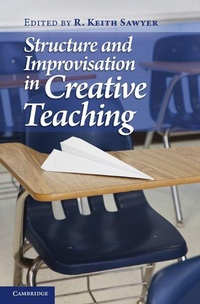
Structure and Improvisation in Creative Teaching
Published on 27. June 2011
Book
Hardback
318 pages
978-0-521-76251-9 (ISBN)
Description
With an increasing emphasis on creativity and innovation in the twenty-first century, teachers need to be creative professionals just as students must learn to be creative. And yet, schools are institutions with many important structures and guidelines that teachers must follow. Effective creative teaching strikes a delicate balance between structure and improvisation. The authors draw on studies of jazz, theater improvisation and dance improvisation to demonstrate that the most creative performers work within similar structures and guidelines. By looking to these creative genres, the book provides practical advice for teachers who wish to become more creative professionals.
Reviews / Votes
'This book should be recommended to teachers who are willing to develop creative teaching practices and to take a constructivist teaching approach within their classrooms. It should also be recommended as a useful teachers' training handbook since it provides a key to successful creative teaching approaches that make the fixed structures of expertise productive within the everyday improvisation of classroom practices.' Tim Higgins, London Review of EducationMore details
Language
English
Place of publication
Cambridge
United Kingdom
Target group
Professional and scholarly
College/higher education
Illustrations
9 Tables, unspecified; 4 Halftones, unspecified; 6 Line drawings, unspecified
Dimensions
Height: 235 mm
Width: 157 mm
Thickness: 22 mm
Weight
613 gr
ISBN-13
978-0-521-76251-9 (9780521762519)
Copyright in bibliographic data and cover images is held by Nielsen Book Services Limited or by the publishers or by their respective licensors: all rights reserved.
Schweitzer Classification
Other editions
Additional editions
R. Keith Sawyer
Structure and Improvisation in Creative Teaching
E-Book
12/2011
1st Edition
Cambridge University Press
€35.49
Available for download
R. Keith Sawyer
Structure and Improvisation in Creative Teaching
Book
06/2011
Cambridge University Press
€52.20
Shipment within 15-20 days
R. Keith Sawyer
Structure and Improvisation in Creative Teaching
E-Book
06/2011
Cambridge University Press
€29.49
Available for download
Person
Dr R. Keith Sawyer is internationally known as an expert in the learning sciences and in the psychology of creativity. He is editor or author of more than seventy scholarly articles and ten books, including The Cambridge Handbook of the Learning Sciences (2006), Explaining Creativity: The Science of Human Innovation (2006) and Group Genius: The Creative Power of Collaboration (2007).
Content
Foreword David Berliner; 1. What makes good teachers great? The artful balance of structure and improvisation R. Keith Sawyer; Part I. The Teacher Paradox: 2. Professional improvisation and teacher education: opening the conversation Stacy DeZutter; 3. Creativity, pedagogic partnerships, and the improvisatory space of teaching Pamela Burnard; 4. Improvising within the system: creating new teacher performances in inner city schools Carrie Lobman; 5. Teaching for creativity with disciplined improvisation Ronald A. Beghetto and James C. Kaufman; Part II. The Learning Paradox: 6. Taking advantage of structure to improvise in instruction: examples from elementary school classrooms Frederick Erickson; 7. Breaking through the communicative cocoon: improvisation in secondary school foreign language classrooms Juergen Kurtz; 8. Improvising with adult English language learners Anthony Perone; 9. Productive improvisation and collective creativity: lessons from the dance studio Janice E. Fournier; Part III. The Curriculum Paradox: 10. How 'scripted' materials might support improvisational teaching: insights from the implementation of a reading comprehension curriculum Annette Sassi; 11. Disciplined improvisation to extend young children's scientific thinking A. Susan Jurow and Laura Creighton; 12. Improvisational understanding in the mathematics classroom Lyndon C. Martin and Jo Towers; 13. Conclusion: presence and the art of improvisational teaching Lisa Barker and Hilda Borko.