

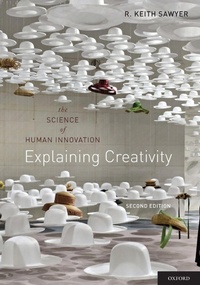
Explaining Creativity
The Science of Human Innovation
2nd Edition
Published on 19. January 2012
Book
Paperback/Softback
568 pages
978-0-19-973757-4 (ISBN)
Description
Explaining Creativity is an accessible introduction to the latest scientific research on creativity. The book summarizes and integrates a broad range of research in psychology and related scientific fields. In the last 40 years, psychologists, anthropologists, and sociologists have devoted increased attention to creativity; we now know more about creativity than at any point in history. Explaining Creativity considers not only arts like painting and writing, but also science, stage performance, business innovation, and creativity in everyday life.
Sawyer's approach is interdisciplinary. In addition to examining psychological studies on creativity, he draws on anthropologists' research on creativity in non-Western cultures, sociologists' research on the situations, contexts, and networks of creative activity, and cognitive neuroscientists' studies of the brain. He moves beyond the individual to consider the social and cultural contexts of creativity, including the role of collaboration in the creative process.
Sawyer's approach is interdisciplinary. In addition to examining psychological studies on creativity, he draws on anthropologists' research on creativity in non-Western cultures, sociologists' research on the situations, contexts, and networks of creative activity, and cognitive neuroscientists' studies of the brain. He moves beyond the individual to consider the social and cultural contexts of creativity, including the role of collaboration in the creative process.
Reviews / Votes
R. Keith Sawyer's second edition of Explaining Creativity: The Science of Human Innovation is so expanded that it is a truly different book from the first edition. The first edition was (correctly) praised and appreciated; the second edition is required reading for anyone interested in the topic. In a just world, Sawyer's thorough and nuanced volume would be the best seller... Sawyer's book is easily the most thorough creativity text on the market. Graduate students and burgeoning researchers will want this book on their shelves. We highly recommend this book. * PsyCritiques * Sawyer has put together a mountain of research from a variety of fields to create a unified approach to understanding how people manage to do something different. His book is readable and learned, origninal, but mindful of its relation to all that other work, and well worth the attention of anyone who wants to think seriously about innovation in the arts and in social organizations. * Howard S. Becker, author of Art World, Tricks of the Trade and Outsiders (for the previous edition) * An extremely knowledgable, wide-ranging, integrative summary of how the social sciences understand creativity. Keith Sawyer has again produced an intelligent and valuable contribution to knowledge. This is a volume that any scholar or lay-person interested in what creativity entails will want to have. * Mihaly Csikszentmihalyi, Director, Quality of Life Research Center and C.S. and D.J. Davidson, Professor, Peter F. Drucker School of Management, Claremont Graduate University (for the previous edition) * With the publication of Explaining Creativity, Keith Sawyer has emerged as the leading young scholar and proponent of a sociocultural approach to the study of creativity. And with his remarkable grasp of this young field, Professor Sawyer has written the most comprehensive and compelling work on creativity studies in years. * David Henry Feldman, Professor, Eliot-Pearson Department of Child Development, Tufts University, and author of Changing the World (for the previous edition) * Without doubt Explaining Creativity is the most comprehensive single-volume presentation of what we know about the creative process, person, and product. Besides that, the book is extremely well written. It would be my first recommendation for anyone fascinated with creativity in all of its complexities and manifestations. There's simply nothing better out there for either specialist or general reader. * Dean Keith Simonton, Distinguished Professor, Department of Psychology, University of California, Davis, and author of Origins of Genius *More details
Edition
2nd Revised edition
Language
English
Place of publication
New York
United States
Target group
College/higher education
Undergraduate and graduate students in courses on creativity (particularly in psychology departments and business schools)
Edition type
Revised edition
Illustrations
B/W 17 HT and 27 Line
Dimensions
Height: 254 mm
Width: 178 mm
Thickness: 31 mm
Weight
1054 gr
ISBN-13
978-0-19-973757-4 (9780199737574)
Copyright in bibliographic data and cover images is held by Nielsen Book Services Limited or by the publishers or by their respective licensors: all rights reserved.
Schweitzer Classification
Other editions
Additional editions
E-Book
10/2011
2nd Edition
OUP eBook
€68.49
Available for download
Previous edition
Book
01/2006
Oxford University Press Inc
€32.19
Article exhausted; check for reprint
Person
R. Keith Sawyer, a professor of psychology, education, and business at Washington University in St. Louis, is one of the world's leading scientific experts on creativity. He combines this scientific expertise with a strong hands-on background in real-world creativity. After receiving his computer science degree from MIT in 1982, he began his career with a two-year stint designing videogames for Atari. In 1990, Dr. Sawyer began his doctoral studies in psychology, studying creativity with Dr. Mihaly Csikszentmihalyi. Dr. Sawyer has also been a jazz pianist for over 20 years, and spent several years playing piano with Chicago improv theater groups.
Content
Part I: Conceptions ; Chapter 1: Introduction ; Chapter 2: Conceptions of Creativity ; Part II: Individualist Approaches ; Chapter 3: Defining creativity through assessment ; Chapter 4: The creative personality ; Chapter 5: The creative process, part 1 ; Chapter 6: The creative process, part 2 ; Chapter 7: The creative process, part 3 ; Chapter 8: Computer simulations of the creative process ; Chapter 9: Biology and creativity ; Chapter 10: Cognitive neuroscience and creativity ; Part III: Sociocultural Approaches ; Chapter 11: Sociology ; Chapter 12: Group creativity ; Chapter 13: Organizational creativity ; Chapter 14: Culture and creativity ; Chapter 15: History and creativity ; Part IV: Creativity in the Domains ; Chapter 16: Visual Arts ; Chapter 17: Writing ; Chapter 18: Music ; Chapter 19: Theater ; Chapter 20: Science ; Part V: Everyday Creativity ; Chapter 21: Education and creativity ; Chapter 22: How to be more creative ; Chapter 23: Conclusion: The future of creativity ; Appendices ; The domain of creativity research ; Appendix A: Creativity timeline ; Appendix B: Creativity overviews ; Appendix C: Journals that publish creativity research ; Appendix D: Influential books in creativity research ; Appendix E: Journal special issues ; The field of creativity research ; Appendix F: Important creativity researchers ; Appendix G: Colleges and universities with a degree or certificate in creativity ; Appendix H: Professional associations and conferences ; References