

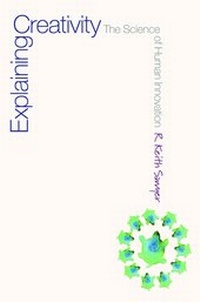
Explaining Creativity
The Science of Human Innovation
Published on 19. January 2006
Book
Paperback/Softback
336 pages
978-0-19-530445-9 (ISBN)
Description
Explaining Creativity is an accessible introduction to the latest scientific research on creativity. In the last 50 years, psychologists, anthropologists, and sociologists have increasingly studied creativity, and we now know more about creativity than at any point in history. It considers not only arts like painting and writing, but also science, stage performance, and business innovation. Until about a decade ago, creativity researchers tended to focus on highly valued activities like fine art painting and Nobel prize winning science. Sawyer brings this research up to date by including movies, music videos, cartoons, video games, hypertext fiction, and computer technology. For example, this is the first book on creativity to include studies of performance and improvisation. Sawyer draws on the latest research findings to show the importance of collaboration and context in all of these creative activities.Today's science of creativity is interdisciplinary; in addition to psychological studies of creativity the book includes research by anthropologists on creativity in non-Western cultures, and research by sociologists about the situation, contexts, and networks of creative activity.
It brings these approaches together within the sociocultural approach to creativity pioneered by Howard Becker, Mihaly Csikszentmihalyi, and Howard Gardner. The sociocultural approach moves beyond the individual to consider the social and cultural contexts of creativity, emphasizing the role of collaboration and context in the creative process.
It brings these approaches together within the sociocultural approach to creativity pioneered by Howard Becker, Mihaly Csikszentmihalyi, and Howard Gardner. The sociocultural approach moves beyond the individual to consider the social and cultural contexts of creativity, emphasizing the role of collaboration and context in the creative process.
More details
Language
English
Place of publication
New York
United States
Target group
College/higher education
Professional and scholarly
Illustrations
line ill., tab., num. photographs
Numerous photographs, tables and line illustrations
Dimensions
Height: 234 mm
Width: 156 mm
Thickness: 17 mm
Weight
539 gr
ISBN-13
978-0-19-530445-9 (9780195304459)
Copyright in bibliographic data and cover images is held by Nielsen Book Services Limited or by the publishers or by their respective licensors: all rights reserved.
Schweitzer Classification
Other editions
New editions
Book
01/2012
2nd Edition
Oxford University Press Inc
€80.70
Shipment within 15-20 days
Content
PART I: CONCEPTIONS; 1. Introduction; 2. Conceptions of creativity; INTERLUDE 1: DEFINING CREATIVITY; PART II: INDIVIDUALIST APPROACHES; 3. Personality psychology; 4. The second wave: Cognitive psychology; 5. Biology; 6. Computational approaches; INTERLUDE 2: FROM INDIVIDUAL TO CONTEXT; PART III: CONTEXTUALIST APPROACHES; 7. Sociology; 8. Culture; 9. History; INTERLUDE 3: APPLYING INDIVIDUALIST AND CONTEXTUALIST APPROACHES TO CREATIVITY; PART IV: ARTISTIC CREATIVITY; 10. Visual creativity; 11. Writing; 12. Music; 13. Acting; INTERLUDE 4: GOODBYE TO OUR CREATIVITY MYTHS; PART V: EVERYDAY CREATIVITY; 14. Science; 15. Business creativity; 16. How to be more creative; EPILOGUE