

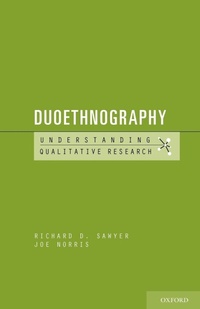
Duoethnography
Published on 29. November 2012
Book
Paperback/Softback
142 pages
978-0-19-975740-4 (ISBN)
Description
Duoethnography is a collaborative research methodology in which two or more researchers engage in a dialogue on their disparate histories in a given phenomenon. Their goal is to interrogate and re-conceptualize existing beliefs through a conversation that is written in a play-script format. The methodology of duoethnography serves as the focus of this book. Duoethnography facilitates stratified, nested, auto-ethnographic accounts of a given research context or question, designed to emphasize the complex, reflexive, and aesthetic aspects of both the work in process and the product. As a curriculum and a research method, duoethnography explores two seminal issues: representation in qualitative research (how to represent findings when findings are created within a dynamic phenomenonological text), and praxis (how research contributes to a sense of personal change). Duoethnography allows researchers to explore their hybrid identities and to see how their lives have been situated socially and culturally. Recent duoethnographic studies have examined a range of topics, including forms of institutionalized racism, beauty, post-colonialism, multicultural identity construction, and professional boundaries between patient and practitioner in mental health professions.
Reviews / Votes
"[Duoethnography: Understanding Qualitative Research] is an edited collection containing 11 duoethnographic studies bookended by the editors' explanation, rationale, and perspectives on the method. The studies explore a range of curricular topics such as identity, power, and privilege. They also consider the role of duoethnographic methods as they relate to the contributing authors' transformative learnings. [...] Duoethnography presses our fieldforward by legitimizing a space to revive repressed, embodied knowing, challenging our socially constructed frameworks." -Pauline Sameshima, Journal of the Canadian Association for Curriculum Studies
More details
Series
Language
English
Place of publication
New York
United States
Target group
College/higher education
Professional and scholarly
Research methodologists, narrative researchers, self-study researchers, reflective practitioners, and curriculum theorists
Dimensions
Height: 216 mm
Width: 140 mm
Thickness: 8 mm
Weight
191 gr
ISBN-13
978-0-19-975740-4 (9780199757404)
Copyright in bibliographic data and cover images is held by Nielsen Book Services Limited or by the publishers or by their respective licensors: all rights reserved.
Schweitzer Classification
Other editions
Additional editions
Joe Norris Richard D. Sawyer
Duoethnography
E-Book
10/2012
1st Edition
Oxford University Press, USA
€42.19
Available for download
Persons
Richard Sawyer is Associate Professor of Education at Washington State University in Vancouver, Washington. He chairs the EdD Program in Teacher Leadership at Washington State University and the MIT Secondary Certification Program at Washington State University, Vancouver. His research includes curriculum studies and qualitative methodologies that are focused on emergent understandings and grounded epistemologies, in order to improve society and promote participatory democracy.
Joe Norris is Professor of Drama in Education and Applied Theatre in the Department of Dramatic Arts at Brock University. He is an advocate of the arts as a means of knowing, doing, and being, and he has spent a number of years pioneering research methodologies and instructional and assessment strategies that employ arts-based approaches. His book Playbuilding as Qualitative Research: A Participatory Arts-Based Approach, which is based on his extensive work with Mirror Theatre (a social issues theatre company), received the American Educational Research Association's Qualitative Research SIG's 2011 Outstanding Book Award. With co-editors Laura McCammon and Carole Miller, he edited Learning to Teach Drama: A Case Narrative Approach, which includes case narratives written by student teachers about their field experiences.
Joe Norris is Professor of Drama in Education and Applied Theatre in the Department of Dramatic Arts at Brock University. He is an advocate of the arts as a means of knowing, doing, and being, and he has spent a number of years pioneering research methodologies and instructional and assessment strategies that employ arts-based approaches. His book Playbuilding as Qualitative Research: A Participatory Arts-Based Approach, which is based on his extensive work with Mirror Theatre (a social issues theatre company), received the American Educational Research Association's Qualitative Research SIG's 2011 Outstanding Book Award. With co-editors Laura McCammon and Carole Miller, he edited Learning to Teach Drama: A Case Narrative Approach, which includes case narratives written by student teachers about their field experiences.
Content
Chapter 1: Introduction ; Chapter 2: Research Design ; Chapter 3: Writing-up the Methods Section ; Chapter 4: Writing-up the Research Findings ; Chapter 5: Discussion ; Chapter 6: References/Additional Readings