

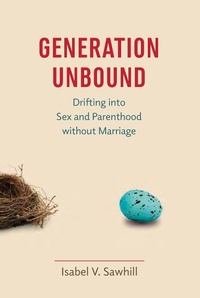
Generation Unbound
Drifting into Sex and Parenthood without Marriage
Published on 25. September 2014
Book
Hardback
212 pages
978-0-8157-2558-9 (ISBN)
Description
Half of all pregnancies in the United States are either unplanned or unintended. Moreover, while fewer people are getting married, childbearing outside of wedlock is on the rise. These trends suggest that couples who have unplanned children are ambivalent or unenthusiastic about becoming parents, or, at the very least, are unprepared for parenthood. What kind of future does this mean for their kids . . . and for society as a whole?
In Generation Unbound, nationally known budget expert Isabel V. Sawhill presents likely causes for the recent changes in the traditional family structure, such as the increase in women's economic opportunities, declining economic prospects of men, access to birth control and abortion, and new social norms that allow young people more choices - but provide less guidance on what it means to be an adult.
Sawhill reveals an emerging class divide in patterns of marriage and childbearing: at the top of the ladder are "planners," who are marrying and having children only after establishing a career; at the bottom, and increasingly in the middle, are "drifters" who are having children early, outside of marriage, and without the stable support of the second parent.
Sawhill sees merit in the views of those on the political left, who argue for more social support for the drifters, including expanded child care, parental leave, family-friendly workplaces, and financial assistance, and for those on the right who argue for restoring traditional marriage so that children are raised in a stable family. But, she also points out that while collective responses are needed, they alone can't solve the problem. Any such efforts must be combined with the exercise of greater personal responsibility by potential parents themselves.
In Generation Unbound, nationally known budget expert Isabel V. Sawhill presents likely causes for the recent changes in the traditional family structure, such as the increase in women's economic opportunities, declining economic prospects of men, access to birth control and abortion, and new social norms that allow young people more choices - but provide less guidance on what it means to be an adult.
Sawhill reveals an emerging class divide in patterns of marriage and childbearing: at the top of the ladder are "planners," who are marrying and having children only after establishing a career; at the bottom, and increasingly in the middle, are "drifters" who are having children early, outside of marriage, and without the stable support of the second parent.
Sawhill sees merit in the views of those on the political left, who argue for more social support for the drifters, including expanded child care, parental leave, family-friendly workplaces, and financial assistance, and for those on the right who argue for restoring traditional marriage so that children are raised in a stable family. But, she also points out that while collective responses are needed, they alone can't solve the problem. Any such efforts must be combined with the exercise of greater personal responsibility by potential parents themselves.
Reviews / Votes
This superbly written book, drawing on insights from behavioral economics, provides clearheaded, actionable recommendations on how we can change course and ensure that every young person can achieve their full potential."- Mark Edwards, Executive Director, Opportunity Nation;"No one is better qualified than Isabel Sawhill to tackle two of the most important questions facing America today. At a time of rapidly changing family structure, who is best able to raise children? And how can we do a better job of making sure the children who are born are welcomed by parents who are prepared to give them the love and sustained attention they deserve? Full of new research and analysis, this book will make you re-think what you know about both."- Judy Woodruff, PBS Newshour;
"Forty years ago, Isabel Sawhill inspired a generation of scholars, including myself, with her landmark research on divorce. Now she does it again, turning her sharp eye on nonmarital childbearing with equal success. Free of ideology and comprehensive in scope, her story highlights how the decline in marriage is affecting children's life chances and what might be done to reverse the trend."- Sara S. McLanahan, William S. Tod Professor of Sociology and Public Affairs, Princeton University;
"Dr. Sawhill makes a thoughtful, fresh, rigorously documented case for reducing unplanned pregnancies. She pushes against a strong headwind to argue for two-parent families as often as possible. If she is right about the economic and cultural implications of our changing procreation behavior, we have a lot of work to do."- Donna Shalala, former Secretary of Health and Human Services
More details
Language
English
Place of publication
United States
Publishing group
Bloomsbury Publishing Plc
Target group
Professional and scholarly
Product notice
sewn/stitched
Cloth over boards
With dust jacket
Dimensions
Height: 242 mm
Width: 159 mm
Thickness: 22 mm
Weight
485 gr
ISBN-13
978-0-8157-2558-9 (9780815725589)
Copyright in bibliographic data and cover images is held by Nielsen Book Services Limited or by the publishers or by their respective licensors: all rights reserved.
Schweitzer Classification
Other editions
Additional editions
E-Book
09/2014
1st Edition
Brookings Institution
€26.99
Available for download
Person
Isabel V. Sawhill is a senior fellow in Economic Studies at Brookings, where she holds the Cabot Family Chair. She also serves as codirector of the Budgeting for National Priorities project and codirector of the Center on Children and Families. She is the author of Creating an Opportunity Society (Brookings, 2009) and editor of The Future of Children: The Next Generation of Antipoverty Policies (2007), both with Ron Haskins.
Content
1. An Introduction
2. Changes in the Family: More Diversity, a Bigger Divide
3. Why We Should Worry: The Consequences of Choices about Marriage and Childbearing
4. A Growing Class Divide: Planners vs. Drifters
5. The Traditionalists vs. the Villagers: Why Government Alone Can't Solve the Marriage Problem
6. Making Better Decisions: The Need to Change the Default
7. Peering into the Future: Less Marriage, Fewer Children?
2. Changes in the Family: More Diversity, a Bigger Divide
3. Why We Should Worry: The Consequences of Choices about Marriage and Childbearing
4. A Growing Class Divide: Planners vs. Drifters
5. The Traditionalists vs. the Villagers: Why Government Alone Can't Solve the Marriage Problem
6. Making Better Decisions: The Need to Change the Default
7. Peering into the Future: Less Marriage, Fewer Children?