

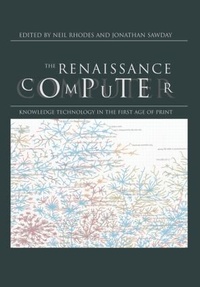
The Renaissance Computer
Knowledge Technology in the First Age of Print
Published on 24. August 2000
Book
Hardback
224 pages
978-0-415-22063-7 (ISBN)
Description
In the fifteenth century the printing press was the 'new technology'. The first ever information revolution began with the advent of the printed book, enabling Renaissance scholars to formulate new ways of organising and disseminating knowledge.
As early as 1500 there were already 20 million books in circulation in Europe. How did this rapid explosion of ideas impact upon the evolution of new disciplines?
The Renaissance Computer looks at the fascinating development of new methods of information storage and retrieval which took place at the very beginning of print culture. And it asks some crucial questions about the intellectual conditions of our own digital age. A dazzling array of leading experts in Renaissance culture explore topics of urgent significance today, including:
* the contribution of knowledge technologies to state formulation and national identity
*the effect of multimedia, orality and memory on education
*the importance of the visual display of information and how search engines reflect and direct ways of thinking.
As early as 1500 there were already 20 million books in circulation in Europe. How did this rapid explosion of ideas impact upon the evolution of new disciplines?
The Renaissance Computer looks at the fascinating development of new methods of information storage and retrieval which took place at the very beginning of print culture. And it asks some crucial questions about the intellectual conditions of our own digital age. A dazzling array of leading experts in Renaissance culture explore topics of urgent significance today, including:
* the contribution of knowledge technologies to state formulation and national identity
*the effect of multimedia, orality and memory on education
*the importance of the visual display of information and how search engines reflect and direct ways of thinking.
Reviews / Votes
'The latest in a series . . . this pioneering study . . . about how the emerging technology of printing revolutionised the concept of knowledge in Europe . . . is actually a rather fascinating bibliographical analysis.' - Steven Poole, The GuardianMore details
Language
English
Place of publication
London
United Kingdom
Publishing group
Taylor & Francis Ltd
Target group
College/higher education
Professional and scholarly
General
Dimensions
Height: 246 mm
Width: 174 mm
Weight
570 gr
ISBN-13
978-0-415-22063-7 (9780415220637)
Copyright in bibliographic data and cover images is held by Nielsen Book Services Limited or by the publishers or by their respective licensors: all rights reserved.
Schweitzer Classification
Other editions
Additional editions
Jonathan Sawday | Neil Rhodes
The Renaissance Computer
Knowledge Technology in the First Age of Print
E-Book
09/2002
Routledge
€54.99
Available for download
Jonathan Sawday | Neil Rhodes
The Renaissance Computer
Knowledge Technology in the First Age of Print
E-Book
09/2002
Routledge
€55.49
Available for download
Jonathan Sawday | Neil Rhodes
The Renaissance Computer
Knowledge Technology in the First Age of Print
Book
08/2000
Routledge
€69.55
Shipment within 15-20 days
Persons
Neil Rhodes is Reader in English Literature at the university of St Andrews. His previous publications include The Power of Eloquence and English Renaissance Literature (1992), John Donne: Selected Prose (1987), and Elizabethan Grotesque (1980). Jonathan Sawday is Senior Lecturer in English Literature at Strathclyde University. He is author of The Body Emblazoned (1995), and co-editor of Literature and the English Civil War.
Content
Introduction 1. The Silence of the Archive and the Noise of Cyberspace 2. Towards the Renaissance Computer 3. Ramus, Pedagogy and Technology 4. Textual Icons: Reading Early Modern Illustrations 5. The Early Modern Search Engine: Indices, Titlepages, Marginalia and Contents 6. National and International Knowledge: the Limits of the Histories of Nations 7. Arachne's Web: Intertextual Mythography and the Renaissance Actaeon 8. The Daughters of Memory: Thomas Heywood's Gunaikeion and the Female Computer 9. Pierre de La Primaudaye's French Academy: Growing Encyclopedic 10. Structure in the Wilderness Forms: Ideas and Things in Thomas Browne's Cabinets of Curiosity 11. Articulate Networks: the Self, the Book and the World