

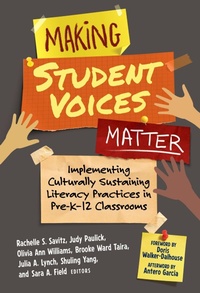
Making Student Voices Matter
Implementing Culturally Sustaining Literacy Practices in Pre-K-12 Classrooms
Published on 27. March 2026
Book
Hardback
256 pages
978-0-8077-8352-8 (ISBN)
Description
This book offers educators actionable models for creating responsive, affirming learning environments that cultivate student agency, joy, and commitment to social transformation.
These essays show how pre-K-12 educators enact culturally sustaining literacy pedagogies (CSLP)-drawing on students' cultural and linguistic knowledge to foster identity, critical consciousness, and academic skills.
Each chapter features a practitioner coauthor and highlights concrete classroom strategies that challenge whiteness and center the experiences of communities of Color. The authors also provide a practical discussion of how each teaching practice can be levelled across the grades, and what it might look like when used with different age groups. Topics range from family and community literacies to critical language practices and multimodal assessment.
With many user-friendly tools, Making Student Voices Matter is a valuable resource for inservice professional learning, teacher preparation programs, and equity-centered coaching.
Book Features:
Bridges Critical Theory and Everyday Practice: Theoretical concepts-such as critical consciousness, cultural humility, and reflexivity-are translated into concrete, classroom-tested practices.
Centers Practitioner Voices and Lived Experience: Teacher-authored chapters offer firsthand accounts of implementing CSLP in real-world school contexts.
Expands the Definition of Literacy: Offers an interdisciplinary and multimodal understanding of literacy that includes language, arts, digital media, oral traditions, and nature-based literacies.
Disrupts Whiteness in Instructional Practice: Shows how educators can actively challenge whiteness, white ideology, and curricular erasure by affirming the identities of students from historically marginalized communities.
Includes User-Friendly Features for Immediate Application: Provides tools such as instructional snapshots, classroom vignettes, student work samples, and reflection prompts.
These essays show how pre-K-12 educators enact culturally sustaining literacy pedagogies (CSLP)-drawing on students' cultural and linguistic knowledge to foster identity, critical consciousness, and academic skills.
Each chapter features a practitioner coauthor and highlights concrete classroom strategies that challenge whiteness and center the experiences of communities of Color. The authors also provide a practical discussion of how each teaching practice can be levelled across the grades, and what it might look like when used with different age groups. Topics range from family and community literacies to critical language practices and multimodal assessment.
With many user-friendly tools, Making Student Voices Matter is a valuable resource for inservice professional learning, teacher preparation programs, and equity-centered coaching.
Book Features:
Bridges Critical Theory and Everyday Practice: Theoretical concepts-such as critical consciousness, cultural humility, and reflexivity-are translated into concrete, classroom-tested practices.
Centers Practitioner Voices and Lived Experience: Teacher-authored chapters offer firsthand accounts of implementing CSLP in real-world school contexts.
Expands the Definition of Literacy: Offers an interdisciplinary and multimodal understanding of literacy that includes language, arts, digital media, oral traditions, and nature-based literacies.
Disrupts Whiteness in Instructional Practice: Shows how educators can actively challenge whiteness, white ideology, and curricular erasure by affirming the identities of students from historically marginalized communities.
Includes User-Friendly Features for Immediate Application: Provides tools such as instructional snapshots, classroom vignettes, student work samples, and reflection prompts.
More details
Series
Language
English
Place of publication
New York
United States
Target group
Professional and scholarly
Product notice
sewn/stitched
Cloth over boards
Dimensions
Height: 235 mm
Width: 160 mm
Thickness: 21 mm
Weight
440 gr
ISBN-13
978-0-8077-8352-8 (9780807783528)
Copyright in bibliographic data and cover images is held by Nielsen Book Services Limited or by the publishers or by their respective licensors: all rights reserved.
Schweitzer Classification
Persons
Rachelle S. Savitz is an associate professor at East Carolina University and a former K-12 literacy coach/interventionist.
Judy Paulick is an associate professor at the University of Virginia and a former elementary literacy specialist.
Olivia Ann Williams is a literacy researcher and a high school English teacher in Virginia.
Brooke Ward Taira is an associate professor at the University of Hawai?i at Manoa.
Julia A. Lynch is a Black-poet-assistant professor at the University of North Carolina Wilmington.
Shuling Yang is an assistant professor at the University of Maryland.
Sara A. Field is high school teacher and an adjunct professor at George Mason University.
Judy Paulick is an associate professor at the University of Virginia and a former elementary literacy specialist.
Olivia Ann Williams is a literacy researcher and a high school English teacher in Virginia.
Brooke Ward Taira is an associate professor at the University of Hawai?i at Manoa.
Julia A. Lynch is a Black-poet-assistant professor at the University of North Carolina Wilmington.
Shuling Yang is an assistant professor at the University of Maryland.
Sara A. Field is high school teacher and an adjunct professor at George Mason University.
Content
Contents
Foreword Doris Walker-Dalhouse ?ix
Acknowledgments ?xiii
Introduction
Olivia Ann Williams, Julia A. Lynch, Brooke Ward Taira, Sara A. Field, Shuling Yang, Judy Paulick, and Rachelle S. Savitz ?1
?1. ?The Journey to Culturally and Linguistically Sustaining Literacy: Using a Critical Community of Practice to Transform Teaching ?23
Abigail A. Amoako Kayser, Brian R. Kayser, Carly Dirghangi, Sharlene Chang, and Michele Yeaton
?2. ?These Are the Things No One Taught Me: Critical Literacy to Center Black Student Experiences ?43
Janell Miller, Caitlin Donovan, and Myriama Smith-Traore
?3. ?Centering Criticality in Practice in Special Education: Realizing Culturally Sustaining Pedagogies Through Critical Compassion ?59
Antonio L. Ellis and Keisha Woods
?4. ?Decolonizing the Early Childhood Classroom: Using Critical Language Awareness to Support Identity Development and Sustain Culture ?79
Jessica Hiltabidel and Chrystena Hill
?5. ?Bridging Privileged Distances: Developing Critical Literacy in a Grade 12 English Literature Class ?97
Manuel Lorenzo M. Aldeguer IV
?6. ?Making Their Mark: Reading Stamped in 9th-Grade English Language Arts ?113
Sarah Fleming and Catherine De Forest* (Pseudonym)
?7. ?Strengthening Community Connections Through 'Aina-Based Education ?127
Paul Balazs, Janelle 'Anela Matsuura, and Rainbow Pharaon
?8. ?Black Oral History Experience: Creating a Culturally Sustaining History Lesson ?143
Elizabeth McCauley McDonald and Tara V. R. Dozier
?9. ?And They Lived Happily Ever After: Translanguaging Fairy Tales in an International School ?159
Catherine McDougall, Sarah Ratcliffe, Katelyn Cuny, and Ashley Sawyer
?10. ?Fostering Asset-Based Literacy Practices Through Community Asset Mapping ?175
Ching-Ching Lin, Kayla Benton, Youngmi Joo, Cielo Inicio Pezo, Camila Minaya, and Renata Nadia Bajana Yepez
?11. ?Centering Students' Lives in Their Texts: Writing Culturally Relevant Texts With Emerging and Uninspired Readers ?193
Gabriella M. Diaz and Mary E. Lyons
Afterword: Vibrating Freely for the Classrooms of Tomorrow Antero Garcia ?209
Index ?215
About the Editors and Contributors ?227
Foreword Doris Walker-Dalhouse ?ix
Acknowledgments ?xiii
Introduction
Olivia Ann Williams, Julia A. Lynch, Brooke Ward Taira, Sara A. Field, Shuling Yang, Judy Paulick, and Rachelle S. Savitz ?1
?1. ?The Journey to Culturally and Linguistically Sustaining Literacy: Using a Critical Community of Practice to Transform Teaching ?23
Abigail A. Amoako Kayser, Brian R. Kayser, Carly Dirghangi, Sharlene Chang, and Michele Yeaton
?2. ?These Are the Things No One Taught Me: Critical Literacy to Center Black Student Experiences ?43
Janell Miller, Caitlin Donovan, and Myriama Smith-Traore
?3. ?Centering Criticality in Practice in Special Education: Realizing Culturally Sustaining Pedagogies Through Critical Compassion ?59
Antonio L. Ellis and Keisha Woods
?4. ?Decolonizing the Early Childhood Classroom: Using Critical Language Awareness to Support Identity Development and Sustain Culture ?79
Jessica Hiltabidel and Chrystena Hill
?5. ?Bridging Privileged Distances: Developing Critical Literacy in a Grade 12 English Literature Class ?97
Manuel Lorenzo M. Aldeguer IV
?6. ?Making Their Mark: Reading Stamped in 9th-Grade English Language Arts ?113
Sarah Fleming and Catherine De Forest* (Pseudonym)
?7. ?Strengthening Community Connections Through 'Aina-Based Education ?127
Paul Balazs, Janelle 'Anela Matsuura, and Rainbow Pharaon
?8. ?Black Oral History Experience: Creating a Culturally Sustaining History Lesson ?143
Elizabeth McCauley McDonald and Tara V. R. Dozier
?9. ?And They Lived Happily Ever After: Translanguaging Fairy Tales in an International School ?159
Catherine McDougall, Sarah Ratcliffe, Katelyn Cuny, and Ashley Sawyer
?10. ?Fostering Asset-Based Literacy Practices Through Community Asset Mapping ?175
Ching-Ching Lin, Kayla Benton, Youngmi Joo, Cielo Inicio Pezo, Camila Minaya, and Renata Nadia Bajana Yepez
?11. ?Centering Students' Lives in Their Texts: Writing Culturally Relevant Texts With Emerging and Uninspired Readers ?193
Gabriella M. Diaz and Mary E. Lyons
Afterword: Vibrating Freely for the Classrooms of Tomorrow Antero Garcia ?209
Index ?215
About the Editors and Contributors ?227