

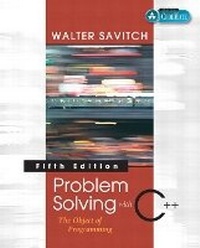
Problem Solving with C++
The Object of Programming: United States Edition
5th Edition
Published on 2. July 2004
Book
Paperback/Softback
960 pages
978-0-321-26865-5 (ISBN)
Description
Problem Solving with C++, 5e brings the best-selling text book for introducing C++ to fully embrace the most up-to-date C++ standards. Suitable for beginning students, the text covers C++ and basic programming techniques. Students will learn how to define their own classes while gaining a solid understanding of basic tools such as simple control structures and function definitions. By defining their own classes early, students are getting a hands-on experience unrivaled by any other text on the market.
Flexible by design, the order in which chapters and sections are covered can easily be changed without any loss on continuity in reading. Instructors can therefore mold this text around the way they want to teach rather than have the text dictate their course's organization.
Flexible by design, the order in which chapters and sections are covered can easily be changed without any loss on continuity in reading. Instructors can therefore mold this text around the way they want to teach rather than have the text dictate their course's organization.
More details
Edition
5th edition
Language
English
Place of publication
United States
Publishing group
Pearson Education (US)
Target group
College/higher education
Dimensions
Height: 232 mm
Width: 187 mm
Weight
1370 gr
ISBN-13
978-0-321-26865-5 (9780321268655)
Copyright in bibliographic data and cover images is held by Nielsen Book Services Limited or by the publishers or by their respective licensors: all rights reserved.
Schweitzer Classification
Other editions
New editions
Book
04/2006
6th Edition
Pearson
€74.45
Article exhausted; check for reprint
Previous edition
Walter Savitch
Problem Solving with C++
The Object of Programming, CodeMate Enhanced Edition: United States Edition
Book
09/2003
4th Edition
Pearson
€73.23
Article exhausted; check for reprint
Content
1. Introduction to Computers and C++ Programming.
Computer Systems.
Programming and Problem Solving.
Introduction to C++.
Testing and Debugging.
2. C++ Basics.
Variables and Assignments.
Input and Output.
Data Types and Expressions.
Simple Flow of Control.
Program Style.
3. Functions that Return a Value.
Top-Down Design.
Programmer-Defined Functions.
Procedural Abstraction.
Local Variables.
Overloading Function Names.
4. Functions for All Subtasks.
void-Functions.
Call-by-Reference Parameters.
Using Procedural Abstraction.
5. I/O Streams as an Introduction to Objects and Classes.
Streams and Basic File I/O.
Tools for Stream I/O.
Character I/O.
Inheritance.
6. Defining Classes.
Structures.
Classes.
Abstract Data Types.
7. More Flow of Control.
Using Boolean Expressions.
Multiway Branches.
Designing Loops.
8. Friends and Overload Operators.
Friend Function.
Overloading Operators.
9. Separate Compilation and Namespaces.
Separate Compilation.
Namespaces.
10. Arrays.
Introduction to Arrays.
Arrays in Functions.
Programming with Arrays.
Arrays and Classes.
Multidimensional Arrays.
11. Strings and Vectors.
An Array Type for Strings.
Vectors.
12. Pointers and Dynamic Arrays.
Pointers.
Dynamic Arrays.
Classes and Dynamic Arrays.
13. Recursion.
Recursive Functions for Tasks.
Recursive Functions for Values.
Thinking Recursively.
14. Templates.
Templates of Algorithm Abstraction.
Syntax for Class Templates.
15. Pointers and Linked Lists.
Nodes and Linked Lists.
A Linked List Application.
16. Inheritance.
Inheritance Basics.
Inheritance Details.
Polymorphism.
17. Exception Handling.
Exception Handling Basics.
Programming Techniques for Exception Handling.
18. Standard Template Library.
Iterators.
Containers.
Generic Algorithms.
Appendices.
Appendix 1. C++ Keywords.
Appendix 2. Precedence of Operators.
Appendix 3. ASCII Character Set.
Appendix 4. Some Library Functions.
Appendix 5. The Assert Statement.
Appendix 6. Inline Functions.
Appendix 7. Overloading the Array Index Square Brackets.
Appendix 8. The This Pointer.
Appendix 9. Overloading Operators as Member Operators.
Computer Systems.
Programming and Problem Solving.
Introduction to C++.
Testing and Debugging.
2. C++ Basics.
Variables and Assignments.
Input and Output.
Data Types and Expressions.
Simple Flow of Control.
Program Style.
3. Functions that Return a Value.
Top-Down Design.
Programmer-Defined Functions.
Procedural Abstraction.
Local Variables.
Overloading Function Names.
4. Functions for All Subtasks.
void-Functions.
Call-by-Reference Parameters.
Using Procedural Abstraction.
5. I/O Streams as an Introduction to Objects and Classes.
Streams and Basic File I/O.
Tools for Stream I/O.
Character I/O.
Inheritance.
6. Defining Classes.
Structures.
Classes.
Abstract Data Types.
7. More Flow of Control.
Using Boolean Expressions.
Multiway Branches.
Designing Loops.
8. Friends and Overload Operators.
Friend Function.
Overloading Operators.
9. Separate Compilation and Namespaces.
Separate Compilation.
Namespaces.
10. Arrays.
Introduction to Arrays.
Arrays in Functions.
Programming with Arrays.
Arrays and Classes.
Multidimensional Arrays.
11. Strings and Vectors.
An Array Type for Strings.
Vectors.
12. Pointers and Dynamic Arrays.
Pointers.
Dynamic Arrays.
Classes and Dynamic Arrays.
13. Recursion.
Recursive Functions for Tasks.
Recursive Functions for Values.
Thinking Recursively.
14. Templates.
Templates of Algorithm Abstraction.
Syntax for Class Templates.
15. Pointers and Linked Lists.
Nodes and Linked Lists.
A Linked List Application.
16. Inheritance.
Inheritance Basics.
Inheritance Details.
Polymorphism.
17. Exception Handling.
Exception Handling Basics.
Programming Techniques for Exception Handling.
18. Standard Template Library.
Iterators.
Containers.
Generic Algorithms.
Appendices.
Appendix 1. C++ Keywords.
Appendix 2. Precedence of Operators.
Appendix 3. ASCII Character Set.
Appendix 4. Some Library Functions.
Appendix 5. The Assert Statement.
Appendix 6. Inline Functions.
Appendix 7. Overloading the Array Index Square Brackets.
Appendix 8. The This Pointer.
Appendix 9. Overloading Operators as Member Operators.