

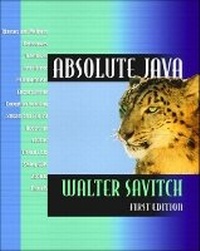
Absolute Java
International Edition
Published on 24. December 2003
Book
Mixed media product
1088 pages
978-0-321-24265-5 (ISBN)
Description
Absolute Java offers complete coverage of the Java programming language. Written by Walt Savitch, one of the most widely read authors in the area of programming, it provides all the tools necessary for experienced and novice programmers to master Java, including thorough coverage of the Java Library, complete and fully executable code throughout, sections highlighting programming tips and common pitfalls, and a logical order of coverage of Java topics in order for students to better understand the language.
The book is appropriate for introductory courses covering Java, intermediate programming courses introducing Java to students familiar with another language, or as a reference for students and industry professionals.
The book is appropriate for introductory courses covering Java, intermediate programming courses introducing Java to students familiar with another language, or as a reference for students and industry professionals.
More details
Language
English
Place of publication
United States
Publishing group
Pearson Education (US)
Target group
College/higher education
Dimensions
Height: 232 mm
Width: 190 mm
Thickness: 38 mm
Weight
1626 gr
ISBN-13
978-0-321-24265-5 (9780321242655)
Copyright in bibliographic data and cover images is held by Nielsen Book Services Limited or by the publishers or by their respective licensors: all rights reserved.
Schweitzer Classification
Other editions
New editions
Book
05/2005
2nd Edition
Pearson
€66.84
Article exhausted; check for reprint
Content
(Each chapter concludes with a summary, answers to self-test exercises, and programming projects.)
1. Getting Started.
Introduction to Java.
Expressions and Assignment Statements.
The Class String.
Program Style.
2. Console Input and Output.
Screen Output.
JOptionPane.
Console Input Using BufferedReader.
Input Using ConsoleIn.
3. Flow of Control.
Branching Mechanism.
Boolean Expressions.
Loops.
4. Defining Classes I.
Class Definitions.
Information Hiding and Encapsulation.
Overloading.
Constructors.
5. Defining Classes II.
Static Methods and Static Variables.
References and Class Parameters.
Using and Misusing References.
Packages and javadoc.
Arrays.
Introduction to Arrays.
Arrays and References.
Programming with Arrays.
Multidimensional Arrays.
7. Inheritance.
Inheritance Basics.
Encapsulation and Inheritance.
Programming with Inheritance.
8. Polymorphism and Abstract Classes.
Polymorphism.
Abstract Classes.
9. Exception Handling.
Exception Handling Basics.
Throwing Exceptions in Methods.
More Programming Techniques for Exception Handling.
10. File I/O.
Introduction to File I/O.
Text Files.
The File Class.
Binary Files.
Random Access to Binary Files.
11. Recursion.
Recursive void Methods.
Recursive Methods that Return a Value.
Thinking Recursively.
12. UML and Patterns.
UML.
Patterns.
13. Interfaces and Inner Classes.
Interfaces.
Simple Uses of Inner Classes.
More About Inner Classes.
14. Linked Data Structures.
Java Linked Lists.
Trees.
15. Collections and Iterators.
Vectors.
Collections.
Iterators.
16. Swing I.
Event-Driven Programming.
Buttons, Events, and Other Swing Basics.
Containers and Layout Managers.
Menus and Buttons.
Text Fields and Text Areas.
17. Applets.
A Brief Introduction to HTML.
Programming Applets.
Applets in HTML Documents.
18. Swing II.
Window Listeners.
Icons and Scroll Bars.
The Graphics Class.
Colors.
Fonts and the drawString Method.
19. Java Never Ends.
Multithreading.
JavaBeans.
Java and Database Connections.
Appendix 1. Keywords.
Appendix 2. Precedence and Associativity Rules.
Appexdix 3. Unicode Character Set.
Appendix 4. Summary of Classes and Interfaces.
Appendix 5. ConsoleIn.
Index.
1. Getting Started.
Introduction to Java.
Expressions and Assignment Statements.
The Class String.
Program Style.
2. Console Input and Output.
Screen Output.
JOptionPane.
Console Input Using BufferedReader.
Input Using ConsoleIn.
3. Flow of Control.
Branching Mechanism.
Boolean Expressions.
Loops.
4. Defining Classes I.
Class Definitions.
Information Hiding and Encapsulation.
Overloading.
Constructors.
5. Defining Classes II.
Static Methods and Static Variables.
References and Class Parameters.
Using and Misusing References.
Packages and javadoc.
Arrays.
Introduction to Arrays.
Arrays and References.
Programming with Arrays.
Multidimensional Arrays.
7. Inheritance.
Inheritance Basics.
Encapsulation and Inheritance.
Programming with Inheritance.
8. Polymorphism and Abstract Classes.
Polymorphism.
Abstract Classes.
9. Exception Handling.
Exception Handling Basics.
Throwing Exceptions in Methods.
More Programming Techniques for Exception Handling.
10. File I/O.
Introduction to File I/O.
Text Files.
The File Class.
Binary Files.
Random Access to Binary Files.
11. Recursion.
Recursive void Methods.
Recursive Methods that Return a Value.
Thinking Recursively.
12. UML and Patterns.
UML.
Patterns.
13. Interfaces and Inner Classes.
Interfaces.
Simple Uses of Inner Classes.
More About Inner Classes.
14. Linked Data Structures.
Java Linked Lists.
Trees.
15. Collections and Iterators.
Vectors.
Collections.
Iterators.
16. Swing I.
Event-Driven Programming.
Buttons, Events, and Other Swing Basics.
Containers and Layout Managers.
Menus and Buttons.
Text Fields and Text Areas.
17. Applets.
A Brief Introduction to HTML.
Programming Applets.
Applets in HTML Documents.
18. Swing II.
Window Listeners.
Icons and Scroll Bars.
The Graphics Class.
Colors.
Fonts and the drawString Method.
19. Java Never Ends.
Multithreading.
JavaBeans.
Java and Database Connections.
Appendix 1. Keywords.
Appendix 2. Precedence and Associativity Rules.
Appexdix 3. Unicode Character Set.
Appendix 4. Summary of Classes and Interfaces.
Appendix 5. ConsoleIn.
Index.