

On Reconciliation
What It Will Take to Bring Peace Between Israelis and Palestinians
Will be published approx. on 19. November 2026
Book
Paperback/Softback
216 pages
978-1-63608-209-7 (ISBN)
Description
All conflicts end. It's in their nature. The only question is how much time and how many lives will be lost, and when the hard but necessary work of healing begins. Maya Savir, an Israeli professional in humanitarian and development work and peacebuilding, and a mother, spent years working in Rwanda and South Africa, countries that went through successful reconciliation processes many had thought impossible. In this book, she dares to ask whether what she observed and learned there can be applied to the Israeli-Palestinian conflict.
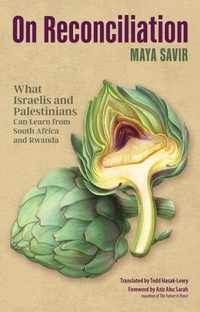
Reconciliation is an artichoke. It's not an onion, made up of layer upon layer you peel away until nothing is left. It has layers, yes, but at its center is a heart. This book peels away those characteristics that are not essential for reconciliation until all that is left is the heart. But before examining this heart, we take a close look at the outer layers in specific conflicts, because although they vary with context and may not all be necessary to bring about reconciliation, they are among the most noble and inspiring human expressions and can be part of the dynamics of reconciliation.
Savir invites readers to explore this process of reconciliation candidly and soberly, showing what it takes for peacemaking and restoration to unfold between peoples and within individuals after conflicts. She leads the reader on this journey with compassion, intellectual precision, literary skill, and conviction. Though healing is difficult to imagine in the wake of October 7 and the war in Gaza, On Reconciliation helps us to reconsider the limits of what is possible.
Reconciliation is an artichoke. It's not an onion, made up of layer upon layer you peel away until nothing is left. It has layers, yes, but at its center is a heart. This book peels away those characteristics that are not essential for reconciliation until all that is left is the heart. But before examining this heart, we take a close look at the outer layers in specific conflicts, because although they vary with context and may not all be necessary to bring about reconciliation, they are among the most noble and inspiring human expressions and can be part of the dynamics of reconciliation.
Savir invites readers to explore this process of reconciliation candidly and soberly, showing what it takes for peacemaking and restoration to unfold between peoples and within individuals after conflicts. She leads the reader on this journey with compassion, intellectual precision, literary skill, and conviction. Though healing is difficult to imagine in the wake of October 7 and the war in Gaza, On Reconciliation helps us to reconsider the limits of what is possible.
Reviews / Votes
"Maya Savir speaks the language of humanity, empathy, and equality. Her voice rises above divisions, carrying the stories of hope and healing in the most dire of situations. In a world often torn by conflict, she reminds us that another way is possible. She is not just a witness. She is a partner in our shared journey toward justice, healing and peace." -Aziz Abu Sarah, Palestinian peace activist, journalist, social entrepreneur, and coauthor of The Future Is Peace"On Reconciliation opens a window of light and hope in a reality that is hard, almost unbearable. It reminds us that reconciliation is not a weakness but a brave and necessary action. Savir invites us to observe the importance of reconciliation not only between nations but also within each nation, and demonstrates that it is possible to turn despair to hope. For Savir, writing is not only a tool, it is a vehicle for change. She writes from her soul, and this soul guides us to the most painful places, where she insists on seeking reconciliation between her Jewish nation and my Palestinian nation." -Ayman Odeh, Palestinian Israeli lawyer, Knesset member and leader of the Hadash alliance
"I have a dream. I dream that this book will be taught in high schools, in seminars, in government. Maya Savir's work is a lesson in the history of conflicts, in a citizenry that strives to improve the lives of both the individual and the majority, in a humane approach, in intelligent politics, in a commitment to a common future. ... Savir's prose is straightforward, elegant, and objective." -Maariv
"The encounters, the conversations, the characters, the descriptions and the insights Savir presents here are fascinating and thought-provoking. Savir somehow brings forth the stories gently but without sugar-coating them, in a clear and confident tone, and with humility." -Globe
More details
Language
English
Place of publication
United States
Product notice
With flaps
Illustrations
Not illustrated
Dimensions
Height: 216 mm
Width: 140 mm
Thickness: 13 mm
ISBN-13
978-1-63608-209-7 (9781636082097)
Copyright in bibliographic data and cover images is held by Nielsen Book Services Limited or by the publishers or by their respective licensors: all rights reserved.
Schweitzer Classification
Persons
Maya Savir has been a human rights and peace activist all of her adult life. She serves as Israel country director for Search for Common Ground, the largest international organization dedicated to peacebuilding. A professional in humanitarian and development work, she spent a decade working in Africa, where the stories of Rwandans and South Africans she met inspired her to write this book. She is the author of two works of adult nonfiction, one young adult novel, three children's books and one work of adult fiction. The daughter of Oslo Accords architect Uri Savir, she lives in Tel Aviv with her husband and four children.
Todd Hasak-Lowy is a novelist, essayist, translator, and short story writer. He is a professor of creative writing and literature at the School of the Art Institute of Chicago.
Aziz Abu Sarah, a Palestinian whose brother was killed in the conflict, is the co-author of The Future Is Peace. He runs a nonprofit dedicated to Middle East peace, and a travel company offering tours aimed at building empathy.
Todd Hasak-Lowy is a novelist, essayist, translator, and short story writer. He is a professor of creative writing and literature at the School of the Art Institute of Chicago.
Aziz Abu Sarah, a Palestinian whose brother was killed in the conflict, is the co-author of The Future Is Peace. He runs a nonprofit dedicated to Middle East peace, and a travel company offering tours aimed at building empathy.
Content
Foreword
Introduction
Prologue
Chapter One: A Consciousness Cast in Conflict
Chapter Two: The Uniqueness of a Conflict
Chapter Three: The Distance Between the Idea and Reality
Chapter Four: Between Romanticism and Pragmatism
Chapter Five: Layers
Chapter Six: The Heart
Chapter Seven: On Reconciliation After October Seventh
Introduction
Prologue
Chapter One: A Consciousness Cast in Conflict
Chapter Two: The Uniqueness of a Conflict
Chapter Three: The Distance Between the Idea and Reality
Chapter Four: Between Romanticism and Pragmatism
Chapter Five: Layers
Chapter Six: The Heart
Chapter Seven: On Reconciliation After October Seventh