

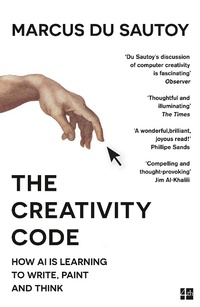
The Creativity Code
How Ai is Learning to Write, Paint and Think
Published on 19. March 2020
Book
Paperback/Softback
336 pages
978-0-00-828819-8 (ISBN)
Description
'Du Sautoy's discussion of computer creativity is fascinating' Observer
CAN MACHINES BE CREATIVE?
In The Creativity Code, Marcus du Sautoy examines the nature of creativity, asking how much of our emotional response to art is a product of our brains reacting to pattern and structure, and exactly what it is to be creative in mathematics, art, language and music.
Exploring how long it might be before machines compose a symphony or paint a masterpiece, and whether they might jolt us into being more imaginative in turn, The Creativity Code is a fascinating and very different exploration into the essence of what it means to be human.
CAN MACHINES BE CREATIVE?
In The Creativity Code, Marcus du Sautoy examines the nature of creativity, asking how much of our emotional response to art is a product of our brains reacting to pattern and structure, and exactly what it is to be creative in mathematics, art, language and music.
Exploring how long it might be before machines compose a symphony or paint a masterpiece, and whether they might jolt us into being more imaginative in turn, The Creativity Code is a fascinating and very different exploration into the essence of what it means to be human.
Reviews / Votes
'What a wonderful, brilliant, joyous read! Marcus makes it seem so easy, and such fun, to begin to understand that which appears complex, frightening and beautiful, and the magic of being human' Philippe Sands'The Creativity Code is only partly a book about AI art. It is as much about how AI thinks and how it does mathematics - du Sautoy's own special subject. And on these topics, he is thoughtful and illuminating' The Times
'Du Sautoy is [...] the light-bearer, illuminating not only the work of coders and creators, but the mathematics of chaos that underpin art and our emotional responses to it' Hans Ulrich Obrist
'Why could a machine one day not create a truly original work of art, write a moving poem, compose an opera or even discover a mathematical theorem? The answers, in this compelling and thought-provoking book by mathematician and musician, Marcus du Sautoy, can be found by breaking down what it actually means to be creative' Jim Al-Khalili
'Fact-packed and funny, questioning what we mean by creative and unsettling the script about what it means to be human, The Creativity Code is a brilliant travel guide to the coming world of AI' Jeanette Winterson
'Fascinating book ... if all the experiences, hopes, dreams, visions, lusts, loves and hatreds that shape the human imagination amount to nothing more than a "code", then sooner or later a machine will crack it. Indeed, Du Sautoy assembles an eclectic array of evidence to show how that's happening even now' The Times
'Absorbing study ... eloquent and illuminating' Nature Magazine
More details
Language
English
Place of publication
London
United Kingdom
Publishing group
HarperCollins Publishers
Product notice
Unsewn / adhesive bound
Paperback (UK-B)
Dimensions
Height: 195 mm
Width: 127 mm
Thickness: 22 mm
Weight
240 gr
ISBN-13
978-0-00-828819-8 (9780008288198)
Copyright in bibliographic data and cover images is held by Nielsen Book Services Limited or by the publishers or by their respective licensors: all rights reserved.
Schweitzer Classification
Other editions
Additional editions
E-Book
03/2019
1st Edition
Fourth Estate Ltd
€8.99
Available for download
Person
Marcus du Sautoy holds Oxford University's prestigious Simonyi Chair for the Public Understanding of Science, a post previously held by Richard Dawkins, and is also a professor of Mathematics. He has presented numerous programmes on television and radio, including the internationally acclaimed BBC series The Story of Maths and the comedy maths show The School of Hard Sums with Dara O Briain. He writes extensively for the Guardian, The Times and the Daily Telegraph and has written and performed a new play called X&Y which has been staged in London's Science Museum and Glastonbury Festival. He received an OBE for services to science in the 2010 New Year's Honours List.