

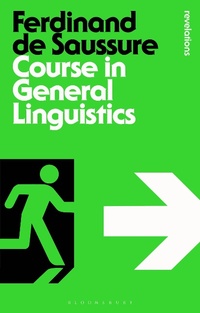
Course in General Linguistics
Published on 10. October 2013
Book
Paperback/Softback
328 pages
978-1-4725-1205-5 (ISBN)
Description
Ferdinand de Saussure is commonly regarded as one of the fathers of 20th Century Linguistics. His lectures, posthumously published as the Course in General Linguistics ushered in the structuralist mode which marked a key turning point in modern thought. Philosophers such as Jacques Derrida and Roland Barthes, psychoanalysts such as Jacques Lacan, the anthropologist ClaudeLevi-Strauss and linguists such as Noam Chomsky all found an important influence for their work in the pages of Saussure's text. Published 100 years after Saussure's death, this new edition of Roy Harris's authoritative translation is now available in the Bloomsbury Revelations series with a substantial new introduction exploring Saussure's contemporary influence and importance.
More details
Series
Language
English
Place of publication
London
United Kingdom
Publishing group
Bloomsbury Publishing PLC
Target group
College/higher education
Professional and scholarly
Dimensions
Height: 216 mm
Width: 139 mm
Thickness: 22 mm
Weight
421 gr
ISBN-13
978-1-4725-1205-5 (9781472512055)
DOI
CBID179979
Copyright in bibliographic data and cover images is held by Nielsen Book Services Limited or by the publishers or by their respective licensors: all rights reserved.
Schweitzer Classification
Other editions
Additional editions

Ferdinand De Saussure
Course in General Linguistics
E-Book
10/2013
1st Edition
Bloomsbury Academic
€26.49
Available for download

Ferdinand De Saussure
Course in General Linguistics
E-Book
10/2013
1st Edition
Bloomsbury Academic
€26.49
Available for download
Persons
Ferdinand de Saussure (1857-1913) was one of the most important thinkers of the 20th century, whose work not only laid the foundations for important developments in linguistics but also proved widely influential in philosophy, anthropology, sociology and literary theory. The Course in General Linguistics is his most important work.
Roy Harris is Emeritus Professor of General Linguistics at the University of Oxford, UK.
Roy Harris is Emeritus Professor of General Linguistics at the University of Oxford, UK.
Content
Introduction to the Bloomsbury Revelations Edition
Preface to the First Edition
Preface to the Second Edition
Preface to the Third Edition
Editor's Introduction, Roy Harris
Introduction
1. A Brief Survey of the History of Linguistics
2. Data and Aims of Linguistics: Connexions with Related Sciences
3. The Object of Study
4. Linguistics of Language Structure and Linguistics of Speech
5. Internal and External Elements of a Language
6. Representation of a Language by Writing
7. Physiological Phonetics
Appendix: Principles of Physiological Phonetics
1. Sound Types
2. Sounds in Spoken Sequences
Part One: General Principles
1. Nature of the Linguistic Sign
2. Invariability and Variability of the Sign
3. Static Linguistics and Evolutionary Linguistics
Part Two: Synchronic Linguistics
1. General Observations
2. Concrete Entities of a Language
3. Identities, Realities, Values
4. Linguistic Value
5. Syntagmatic Relations and Associative Relations
6. The Language Mechanism
7. Grammar and Its Subdivisions
8. Abstract Entities in Grammar
Part Three: Diachronic Linguistics
1. General Observations
2. Sound Changes
3. Grammatical Consequences of Phonetic Evolution
4. Analogy
5. Analogy and Evolution
6. Popular Etymology
7. Agglutination
8. Diachronic Units,Identities and Realities
Appendices
Part Four: Geographical Linguistics
1. On the Diversity of Languages
2. Geographical Diversity: Its Complexity
3. Causes of Geographical Diversity
4. Propagation of Linguistic Waves
Part Five: Questions of Retrospective Linguistics Conclusion
1. The Two Perspectives of Diachronic Linguistics
2. Earliest Languages and Prototypes
3. Reconstructions
4. Linguistic Evidence in Anthropology and Prehistory
5. Language Families and Linguistic Types
Index
Preface to the First Edition
Preface to the Second Edition
Preface to the Third Edition
Editor's Introduction, Roy Harris
Introduction
1. A Brief Survey of the History of Linguistics
2. Data and Aims of Linguistics: Connexions with Related Sciences
3. The Object of Study
4. Linguistics of Language Structure and Linguistics of Speech
5. Internal and External Elements of a Language
6. Representation of a Language by Writing
7. Physiological Phonetics
Appendix: Principles of Physiological Phonetics
1. Sound Types
2. Sounds in Spoken Sequences
Part One: General Principles
1. Nature of the Linguistic Sign
2. Invariability and Variability of the Sign
3. Static Linguistics and Evolutionary Linguistics
Part Two: Synchronic Linguistics
1. General Observations
2. Concrete Entities of a Language
3. Identities, Realities, Values
4. Linguistic Value
5. Syntagmatic Relations and Associative Relations
6. The Language Mechanism
7. Grammar and Its Subdivisions
8. Abstract Entities in Grammar
Part Three: Diachronic Linguistics
1. General Observations
2. Sound Changes
3. Grammatical Consequences of Phonetic Evolution
4. Analogy
5. Analogy and Evolution
6. Popular Etymology
7. Agglutination
8. Diachronic Units,Identities and Realities
Appendices
Part Four: Geographical Linguistics
1. On the Diversity of Languages
2. Geographical Diversity: Its Complexity
3. Causes of Geographical Diversity
4. Propagation of Linguistic Waves
Part Five: Questions of Retrospective Linguistics Conclusion
1. The Two Perspectives of Diachronic Linguistics
2. Earliest Languages and Prototypes
3. Reconstructions
4. Linguistic Evidence in Anthropology and Prehistory
5. Language Families and Linguistic Types
Index