

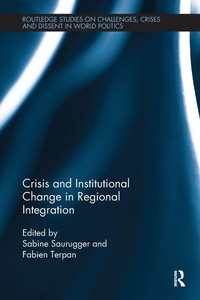
Crisis and Institutional Change in Regional Integration
1st Edition
Published on 5. February 2018
Book
Paperback/Softback
242 pages
978-1-138-48814-4 (ISBN)
Description
Comparative regional integration has met with increasing interest over the last twenty years with the emergence or reinforcing of new regional dynamics in the EU, NAFTA, MERCOSUR and ASEAN.
This volume systematically and comparatively analyses the reasons for regional integration and stalemate in European, Latin American and Asian regional integration. It examines whether regional integration systems change in crisis periods, or more precisely in periods of economic crises, and why they change in different directions. Based on a neo-institutionalist research framework and rigorously comparative research design, the individual chapters analyse why financial and economic crises lead to more or less integrated systems and which factors lead to these institutional changes. Specifically it addresses institutional change in regional integration schemes, power relations between member states and the institutions in different policy domains, and change in individual or collective citizens' attitudes towards regional integration. Adopting an actor-centred approach, the book highlights which regional integration schemes are influenced by economic and financial crises and how to explain this.
This text will be of key interest to scholars, students and policy specialists in regional integration, European Politics, International Relations, and Latin American and Asian studies.
This volume systematically and comparatively analyses the reasons for regional integration and stalemate in European, Latin American and Asian regional integration. It examines whether regional integration systems change in crisis periods, or more precisely in periods of economic crises, and why they change in different directions. Based on a neo-institutionalist research framework and rigorously comparative research design, the individual chapters analyse why financial and economic crises lead to more or less integrated systems and which factors lead to these institutional changes. Specifically it addresses institutional change in regional integration schemes, power relations between member states and the institutions in different policy domains, and change in individual or collective citizens' attitudes towards regional integration. Adopting an actor-centred approach, the book highlights which regional integration schemes are influenced by economic and financial crises and how to explain this.
This text will be of key interest to scholars, students and policy specialists in regional integration, European Politics, International Relations, and Latin American and Asian studies.
Reviews / Votes
"This up-to-date snapshot of European, Latin American and Asian regional integration is informed by a theoretical framing that touches the most important bases in the field of comparative regional studies. This book is a very useful and very readable addition to an important area of world politics and a vibrant field of scholarship." - Peter J. Katzenstein, Walter S. Carpenter Professor, Jr. of International Studies, Cornell University, USA."Are regional organisations in crisis, or are they a crucial part of the solution to addressing the challenges of contemporary crises? Saurugger and Terpan have assembled an impressive range of expertise to analyse the relationship between regionalism and crisis-response in Europe, Asia and Latin America. The result is a highly topical volume which is an important contribution to the burgeoning literature on comparative regionalism." - Thomas Christiansen, Maastricht University, the Netherlands.
More details
Series
Language
English
Place of publication
London
United Kingdom
Publishing group
Taylor & Francis Ltd
Target group
College/higher education
Illustrations
11 s/w Tabellen, 4 s/w Abbildungen, 4 s/w Zeichnungen
11 Tables, black and white; 4 Line drawings, black and white; 4 Illustrations, black and white
Dimensions
Height: 234 mm
Width: 156 mm
Thickness: 13 mm
Weight
377 gr
ISBN-13
978-1-138-48814-4 (9781138488144)
Copyright in bibliographic data and cover images is held by Nielsen Book Services Limited or by the publishers or by their respective licensors: all rights reserved.
Schweitzer Classification
Other editions
Additional editions
Sabine Saurugger | Fabien Terpan
Crisis and Institutional Change in Regional Integration
Book
04/2016
1st Edition
Routledge
€231.70
Shipment within 10-20 days
Sabine Saurugger | Fabien Terpan
Crisis and Institutional Change in Regional Integration
E-Book
03/2016
Routledge
€67.49
Available for download
Sabine Saurugger | Fabien Terpan
Crisis and Institutional Change in Regional Integration
E-Book
03/2016
Routledge
€67.49
Available for download
Persons
Sabine Saurugger is Professor of Political Science and Research Dean at Sciences Po Grenoble, France. Her research focuses on theoretical approaches to European integration, interest groups and public policy, and more recently, the interplay between politics and law in the European Union.
Fabien Terpan is Associate Professor of Public Law at Sciences Po Grenoble, France, visiting Professor at the College of Europe, Natolin, and the holder of a Jean Monnet Chair. He is also Deputy Director of the CESICE (Center for the study of international security and European cooperation) and has published widely on EU law, European external action, and the interplay between law and politics in the European Union.
Fabien Terpan is Associate Professor of Public Law at Sciences Po Grenoble, France, visiting Professor at the College of Europe, Natolin, and the holder of a Jean Monnet Chair. He is also Deputy Director of the CESICE (Center for the study of international security and European cooperation) and has published widely on EU law, European external action, and the interplay between law and politics in the European Union.
Content
European Integration 1. Regional Integration in Times of Crises: Comparative regional integration approaches and institutional change 2. European Integration in Response to the 'Euro Crisis' 2010-2013 3. The Eurozone crisis and European integration: "new intergovernmentalism" as a valid theory 4. The Transformation of Germany's Position in the Eurozone Crisis: From Greek Bailouts to Eurobonds 5. Economic crisis, crisis of support? How macro-economic performance shapes citizens' support for the EU (1973-2014) Latin American Regional Integration 6. Economic crisis and regionalism in Central America: a path dependent logic of failure 7. The contingency of agenda setting in the Union of South American Nations (UNASUR) 8. Reinforcing or ignoring the supranational level during crises? Brazilian parties' views on regionalism Asian Regional Integration 9. Crisis and Regional integration: human rights and environmental governance in ASEAN 10. ASEAN and the Response to Regional Crisis: the Limits of Integration 11. Crises, Citizens and Regional Integration in Southeast Asia 12. Regional integration in times of crises: power, institutional density and the people. A Conclusion