

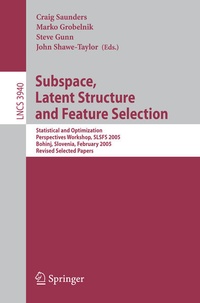
Subspace, Latent Structure and Feature Selection
Statistical and Optimization Perspectives Workshop, SLSFS 2005 Bohinj, Slovenia, February 23-25, 2005, Revised Selected Papers
Published on 16. May 2006
Book
Paperback/Softback
X, 209 pages
978-3-540-34137-6 (ISBN)
Description
This book constitutes the thoroughly refereed post-proceedings of the PASCAL (pattern analysis, statistical modelling and computational learning) Statistical and Optimization Perspectives Workshop on Subspace, Latent Structure and Feature Selection techniques, SLSFS 2005. The 9 revised full papers presented together with 5 invited papers reflect the key approaches that have been developed for subspace identification and feature selection using dimension reduction techniques, subspace methods, random projection methods, among others.
More details
Series
Edition
2006 ed.
Language
English
Place of publication
Berlin
Germany
Publishing group
Springer Berlin
Target group
Professional and scholarly
Research
Illustrations
X, 209 p.
Dimensions
Height: 235 mm
Width: 155 mm
Thickness: 13 mm
Weight
347 gr
ISBN-13
978-3-540-34137-6 (9783540341376)
DOI
10.1007/11752790
Schweitzer Classification
Content
Invited Contributions.- Discrete Component Analysis.- Overview and Recent Advances in Partial Least Squares.- Random Projection, Margins, Kernels, and Feature-Selection.- Some Aspects of Latent Structure Analysis.- Feature Selection for Dimensionality Reduction.- Contributed Papers.- Auxiliary Variational Information Maximization for Dimensionality Reduction.- Constructing Visual Models with a Latent Space Approach.- Is Feature Selection Still Necessary?.- Class-Specific Subspace Discriminant Analysis for High-Dimensional Data.- Incorporating Constraints and Prior Knowledge into Factorization Algorithms - An Application to 3D Recovery.- A Simple Feature Extraction for High Dimensional Image Representations.- Identifying Feature Relevance Using a Random Forest.- Generalization Bounds for Subspace Selection and Hyperbolic PCA.- Less Biased Measurement of Feature Selection Benefits.