

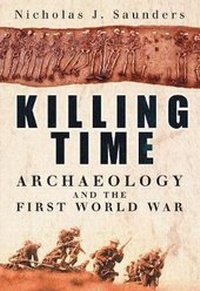
Killing Time
Archaeology and the First World War
Published on 1. April 2007
Book
Hardback
256 pages
978-0-7509-4519-6 (ISBN)
Description
Hardly a month passes without some dramatic and sometimes tragic discovery being made along the killing fields of the Western Front. Poignant remains of British soldiers buried during battle and then forgotten - lying in rows arm in arm, or found crouching at the entrance to a dugout. Whole 'underground cities' of trenches, dugouts and shelters are found, preserved in the mud of Flanders - with newspapers and blankets scattered where they were left. There are field hospitals carved out of the chalk country of the Somme, tunnels marked with graffiti by long dead hands and tons of volatile bombs and gas canisters waiting to explode. Yet, while there are innumerable books on the history of the war, there is not a single book on its archaeology. Nicholas J. Saunders' new book is therefore unique. In an authoritative and accessible way, it brings together widely scattered discoveries, and offer fresh insights into the human dimension of the war.
More details
Language
English
Place of publication
Stroud
United Kingdom
Publishing group
The History Press Ltd
Dimensions
Height: 244 mm
Width: 172 mm
Thickness: 10 mm
Weight
790 gr
ISBN-13
978-0-7509-4519-6 (9780750945196)
Copyright in bibliographic data and cover images is held by Nielsen Book Services Limited or by the publishers or by their respective licensors: all rights reserved.
Schweitzer Classification
Other editions
Additional editions
E-Book
11/2011
The History Press Ltd
€18.49
Available for download
Person
Nicholas J. Saunders is a leading authority on, and a moving force behind, the development of a modern and scientific archaeology of the First World War. He organized the first International Conference on the Anthropology and Archaeology of the First World War. His publications include books on trench art, and Ancient Americas: The Great Civilisations. He is Reader in Material Culture in the Department of Anthropology at University College, London.