

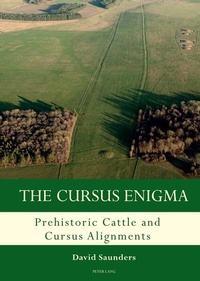
The Cursus Enigma
Prehistoric Cattle and Cursus Alignments
Published on 26. February 2021
Book
Hardback
222 pages
978-1-78997-745-5 (ISBN)
Description
This book links cattle to the construction of cursus monument sites. It suggests that these monuments commenced life as a form of cattle management prior to their possible ritual importance. As such it is an original and important contribution to the cursus monument debate. Previous cursus monument studies have tended to focus on the construction or post-construction phases of the monument rather than the practical reasons communities decided to locate and align these monuments where they did.
More details
Other editions
Additional editions
E-Book
03/2021
1st Edition
Peter Lang Verlag
€63.49
Available for download
E-Book
03/2021
1st Edition
Peter Lang Verlag
€63.49
Available for download
Person
David Saunders grew up in West Sussex in an area less than 50 metres from the River Arun. There the floodplains, meadows and cattle herds became part of his childhood playground. He read archaeology at the University of Buckingham, obtaining a doctorate investigating the interrelationships between prehistoric cattle herd movement and the placement of cursus monuments. He continues to take an active role in numerous archaeological excavations. He has spent the last six years excavating within the Stonehenge World Heritage Site at the Mesolithic site at Blick Mead, and for many years has played an active role in the University of Reading's annual archaeological field school, at excavations such as Marden Henge, the largest Neolithic henge site in the UK, at Cat's Brain, the first Neolithic Long Barrow to be excavated for over seventy years, and at the Bath House within the Roman town of Silchester. His interest in animal movement extends to the animals and signs depicted within Palaeolithic cave art, where he regularly acts as an expert guide on tours to the Dordogne region of France and the Cantabrian region of Northern Spain.
Content
CONTENTS: Background - The Openness of the Landscape during the Mesolithic/Neolithic Transition Period - Geology, Geography and Topography - The Link with Hunting or Herding - Field Research - Cursus Monuments: A Statistical Evaluation - A Statistical Evaluation of my Fieldwork - A Case Study: The Milfield Basin - Conclusion.