

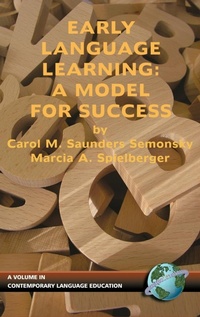
Early Language Learning
A Model for Success
Will be published approx. on 1. June 2004
Book
Hardback
176 pages
978-1-59311-083-3 (ISBN)
Description
The aim of this volume is to provide a detailed description of the process of initiating, maintaining and assessing a top quality elementary school foreign language program and to assist planners by providing them with a workable model. The book describes the successes and challenges of the Georgia Elementary School Foreign Languages Model Program. It includes a detailed description of the curriculum and of the research data showing positive effects of early language learning on elementary school students in Georgia. The primary audience for this book is policy makers, state and district level educators, including supervisors who have responsibility for foreign languages, principals, teachers and foreign language educators who are interested in components of best practices in early language learning education or who wish to begin a high quality elementary school foreign language program at the state or district level.
More details
Series
Language
English
Place of publication
Charlotte
United States
Publishing group
Emerald Publishing Inc
Target group
College/higher education
Professional and scholarly
Illustrations
bibliography
Dimensions
Height: 240 mm
Width: 161 mm
Thickness: 14 mm
Weight
435 gr
ISBN-13
978-1-59311-083-3 (9781593110833)
Copyright in bibliographic data and cover images is held by Nielsen Book Services Limited or by the publishers or by their respective licensors: all rights reserved.
Schweitzer Classification
Other editions
Additional editions
E-Book
07/2006
1st Edition
Information Age Publishing
from
€62.33
Available for download
Content
Chapter 1. Creating and Implementing the Georgia Elementary School Foreign Languages Model Program.
Chapter 2. From Theory to Practice.
Chapter 3. The Curriculum.
Chapter 4. Program and Student Assessment.
Chapter 5. Conclusion.
Chapter 2. From Theory to Practice.
Chapter 3. The Curriculum.
Chapter 4. Program and Student Assessment.
Chapter 5. Conclusion.