

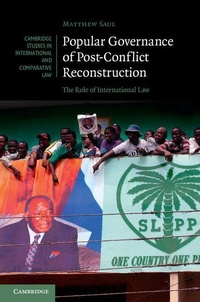
Popular Governance of Post-Conflict Reconstruction
The Role of International Law
Published on 24. July 2014
Book
Hardback
270 pages
978-1-107-05531-5 (ISBN)
Description
Under what conditions does a post-conflict government have authority? What challenges to its legitimacy does it face? To what standards can it be held accountable? Via case studies of Sierra Leone and Afghanistan, and detailed accounts of extant international law, Matthew Saul explores the international legal framework which regulates popular governance of post-conflict reconstruction.
More details
Series
Language
English
Place of publication
Cambridge
United Kingdom
Target group
Professional and scholarly
Product notice
sewn/stitched
Cloth over boards
Dimensions
Height: 229 mm
Width: 150 mm
Thickness: 20 mm
Weight
522 gr
ISBN-13
978-1-107-05531-5 (9781107055315)
Copyright in bibliographic data and cover images is held by Nielsen Book Services Limited or by the publishers or by their respective licensors: all rights reserved.
Schweitzer Classification
Other editions
Additional editions
Book
07/2019
Cambridge University Press
€44.00
Shipment within 15-20 days
E-Book
07/2014
Cambridge University Press
€21.99
Available for download
E-Book
07/2014
1st Edition
Cambridge University Press
€26.49
Available for download
Person
Matthew Saul is a postdoctoral research fellow at the University of Oslo, Norway.
Content
Introduction; Part I. Concepts and Theories: 1. The process of post-conflict reconstruction; 2. The legitimacy and effectiveness of post-conflict reconstruction; Part II. The International Legal Framework: 3. The law for identifying governments in the immediate aftermath of conflict; 4. The international law for popular governance after conflict; Part III. The Practice of Popular Governance: 5. Popular governance and international law in the reconstruction of Sierra Leone; 6. Popular governance and international law in the reconstruction of Afghanistan; Part IV. The Way Forward?: 7. Ad hoc regulation of post-conflict popular governance?; Conclusion.