

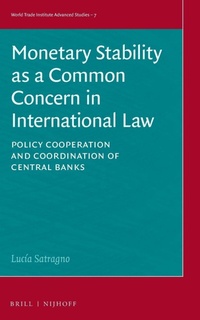
Monetary Stability as a Common Concern in International Law
Policy Cooperation and Coordination of Central Banks
Published on 10. February 2022
Book
Hardback
228 pages
978-90-04-50872-9 (ISBN)
Description
The open access publication of this book has been published with the support of the Swiss National Science Foundation.
In Monetary Stability as a Common Concern in International Law, Lucia Satragno argues that monetary stability is a global public good that must be promoted and protected at all levels of governance. In doing so, the book accomplishes two tasks. On one hand, it provides an up to date analysis of the role of law and institutions in the international monetary field since the collapse of the Bretton Woods system. On the other hand, it applies the methodological approach proposed by the novel doctrine of Common Concern of Humankind to monetary stability as a case study. Accordingly, the book examines not only the status quo of the international monetary system, but also looks at the 'new and different realism' that would be envisaged in monetary affairs in the case of a fully-fledged principle of Common Concern.
In Monetary Stability as a Common Concern in International Law, Lucia Satragno argues that monetary stability is a global public good that must be promoted and protected at all levels of governance. In doing so, the book accomplishes two tasks. On one hand, it provides an up to date analysis of the role of law and institutions in the international monetary field since the collapse of the Bretton Woods system. On the other hand, it applies the methodological approach proposed by the novel doctrine of Common Concern of Humankind to monetary stability as a case study. Accordingly, the book examines not only the status quo of the international monetary system, but also looks at the 'new and different realism' that would be envisaged in monetary affairs in the case of a fully-fledged principle of Common Concern.
More details
Series
Language
English
Place of publication
Netherlands
Publishing group
Brill
Target group
Professional and scholarly
Product notice
sewn/stitched
Cloth over boards
Dimensions
Height: 234 mm
Width: 155 mm
Thickness: 14 mm
Weight
490 gr
ISBN-13
978-90-04-50872-9 (9789004508729)
Copyright in bibliographic data and cover images is held by Nielsen Book Services Limited or by the publishers or by their respective licensors: all rights reserved.
Schweitzer Classification
Person
Lucia Satragno, Ph.D. (2020), University of Bern, is a Research Fellow at the CBFL, National University of Singapore. She has published book chapters and journal articles, including 'International Monetary Stability as a Common Concern of Humankind' in Thomas Cottier (ed), The Prospects of Common Concern of Humankind in International Law (2021).
Content
Acknowledgments??
Abbreviations and Acronyms??
Table of Cases and Legislation??
?Introduction??
1???The International Monetary System in the Post-Crisis Era??
?1?Definition and Purpose of the International Monetary System
?2?The Global Financial Crisis and the Fragility of the International Monetary System
?3?Key Aspects of the Core Elements of the International Monetary System
?3.1?First Element - Exchange Rates??
?3.2?Second and Third Elements - International Payment System and International Capital Movements??
?3.3?Fourth Element - Monetary Reserves and Access to Liquidity??
?4?Conclusion
2???Monetary Stability ?Competing Policy Objectives and Trade-Offs???
?1?Monetary Sovereignty Today
?2?A Revision of the Concept of Monetary Stability at the Different Levels of Governance
?2.1?Domestic Monetary Stability??
?2.2?International Monetary Stability??
?3?International Spillovers of Monetary Policy and Their Impact on Monetary Stability
?4?Conclusion
3???A Common Concern of Humankind Approach to Monetary Stability??
?1?Monetary Stability as a Global Public Good
?2?Common Concern of Humankind - Review of Literature and Evolution of the Principle
?2.1?Expression in Treaties and Scholarly Work??
?2.2?Foundations and Evolution of the Principle??
?3?Common Concern of Humankind - Process of Claims and Responses
?3.1?The Duty to Cooperate??
?3.2?Obligation to Do Homework??
?3.3?Securing Compliance??
?3.4?Arguments in Support of the Principle of Common Concern of Humankind??
?4?Monetary Stability as a Common Concern of Humankind - A Preliminary Assessment
?5?Conclusion
4???The Duty To Cooperate - The Fund's Role and Cooperation among States??
?1?Top-Down Approach - International Level of Governance
?1.1?The International Financial Architecture - Governance Aspects??
?1.2?The Fund's Role??
?1.3?International Standard-Setting and Soft Law??
?2?Bottom-Up Approach - Central Banking Cooperation
?2.1?The Evolution of Central Banking Cooperation??
?2.2?Diplomacy and Coordination??
?2.3?Responses to the ?gfc? and Its Aftermath??
?3?Common Concern as a Guide to Enhanced Cooperation in Monetary Affairs
?3.1?imf? Mandatory Based Surveillance??
?3.2?Improved ?gfsn???
?3.3?Harness the Commitments Assumed at the Government Networks??
?4?Conclusion
5???Domestic Obligations Concerning Monetary Stability ?The Special Role of Central Banks???
?1?Domestic Obligations - The Special Role of Central Banks
?1.1?Internal Dimension of Monetary Stability - Price Stability??
?1.1.1?Institution of a State
?1.1.2?Issuance of Money
?1.1.3?Privately Issued Virtual Currencies and Central Bank Issued Virtual Currencies
?1.1.4?Conduct of National Monetary Policy
?1.2?External Dimension of Monetary Stability - Exchange Rate Stability??
?1.2.1?Administration of a System of Exchange Control
?1.2.2?Management of a Country's Foreign Reserves
?2?Conclusion
6???Domestic Obligations Concerning Monetary Stability ?Unilateral Reactions and Securing Compliance???
?1?Domestic Obligations - Unilateral Reactions
?1.1?Exchange Restrictions??
?1.2?Capital Controls??
?1.3?Exchange Rate Manipulation??
?1.4?Other Reactions??
?2?Securing Compliance - Monetary Stability Considerations
?3?Conclusion
?Conclusions??
Bibliography??
Index??
Abbreviations and Acronyms??
Table of Cases and Legislation??
?Introduction??
1???The International Monetary System in the Post-Crisis Era??
?1?Definition and Purpose of the International Monetary System
?2?The Global Financial Crisis and the Fragility of the International Monetary System
?3?Key Aspects of the Core Elements of the International Monetary System
?3.1?First Element - Exchange Rates??
?3.2?Second and Third Elements - International Payment System and International Capital Movements??
?3.3?Fourth Element - Monetary Reserves and Access to Liquidity??
?4?Conclusion
2???Monetary Stability ?Competing Policy Objectives and Trade-Offs???
?1?Monetary Sovereignty Today
?2?A Revision of the Concept of Monetary Stability at the Different Levels of Governance
?2.1?Domestic Monetary Stability??
?2.2?International Monetary Stability??
?3?International Spillovers of Monetary Policy and Their Impact on Monetary Stability
?4?Conclusion
3???A Common Concern of Humankind Approach to Monetary Stability??
?1?Monetary Stability as a Global Public Good
?2?Common Concern of Humankind - Review of Literature and Evolution of the Principle
?2.1?Expression in Treaties and Scholarly Work??
?2.2?Foundations and Evolution of the Principle??
?3?Common Concern of Humankind - Process of Claims and Responses
?3.1?The Duty to Cooperate??
?3.2?Obligation to Do Homework??
?3.3?Securing Compliance??
?3.4?Arguments in Support of the Principle of Common Concern of Humankind??
?4?Monetary Stability as a Common Concern of Humankind - A Preliminary Assessment
?5?Conclusion
4???The Duty To Cooperate - The Fund's Role and Cooperation among States??
?1?Top-Down Approach - International Level of Governance
?1.1?The International Financial Architecture - Governance Aspects??
?1.2?The Fund's Role??
?1.3?International Standard-Setting and Soft Law??
?2?Bottom-Up Approach - Central Banking Cooperation
?2.1?The Evolution of Central Banking Cooperation??
?2.2?Diplomacy and Coordination??
?2.3?Responses to the ?gfc? and Its Aftermath??
?3?Common Concern as a Guide to Enhanced Cooperation in Monetary Affairs
?3.1?imf? Mandatory Based Surveillance??
?3.2?Improved ?gfsn???
?3.3?Harness the Commitments Assumed at the Government Networks??
?4?Conclusion
5???Domestic Obligations Concerning Monetary Stability ?The Special Role of Central Banks???
?1?Domestic Obligations - The Special Role of Central Banks
?1.1?Internal Dimension of Monetary Stability - Price Stability??
?1.1.1?Institution of a State
?1.1.2?Issuance of Money
?1.1.3?Privately Issued Virtual Currencies and Central Bank Issued Virtual Currencies
?1.1.4?Conduct of National Monetary Policy
?1.2?External Dimension of Monetary Stability - Exchange Rate Stability??
?1.2.1?Administration of a System of Exchange Control
?1.2.2?Management of a Country's Foreign Reserves
?2?Conclusion
6???Domestic Obligations Concerning Monetary Stability ?Unilateral Reactions and Securing Compliance???
?1?Domestic Obligations - Unilateral Reactions
?1.1?Exchange Restrictions??
?1.2?Capital Controls??
?1.3?Exchange Rate Manipulation??
?1.4?Other Reactions??
?2?Securing Compliance - Monetary Stability Considerations
?3?Conclusion
?Conclusions??
Bibliography??
Index??