

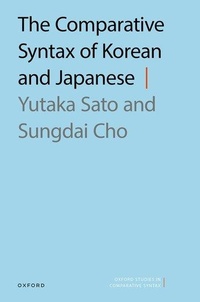
The Comparative Syntax of Korean and Japanese
Published on 21. December 2023
Book
Hardback
368 pages
978-0-19-889646-3 (ISBN)
Description
This book provides a detailed survey of Korean and Japanese syntax from a comparative perspective, based within a generative framework. Yukata Sato and Sungdai Cho demonstrate that while the two languages exhibit remarkably similar morphosyntactic features, they behave differently in specific types of construction, with the main differences observed in genitive marking, sentence negation, Negative Polarity Items, the formation of causatives, and passivization. The book also explores pragmatic and sociolinguistic issues in the two languages, and shows that they differ in the perception and realization of 'givenness' as a topic marker and in the influence of relationships of power and distance on the use of honorifics. The authors further offer additional context by exploring the typological relationship between Japanese and Korean and the surrounding languages such as Ainu, and the Chinese and Altaic languages, as well as providing socio-cultural and historical background.
More details
Series
Language
English
Place of publication
Oxford
United Kingdom
Target group
College/higher education
Product notice
sewn/stitched
Cloth over boards
Dimensions
Height: 231 mm
Width: 163 mm
Thickness: 41 mm
Weight
703 gr
ISBN-13
978-0-19-889646-3 (9780198896463)
Copyright in bibliographic data and cover images is held by Nielsen Book Services Limited or by the publishers or by their respective licensors: all rights reserved.
Schweitzer Classification
Other editions
Additional editions
Yutaka Sato | Sungdai Cho
The Comparative Syntax of Korean and Japanese
E-Book
12/2023
1st Edition
OUP eBook
€89.99
Available for download
Persons
Yutaka Sato is a Visiting Professor in the College of Liberal Arts at the International Christian University in Tokyo. His research explores Japanese linguistics, the morphosyntax of Japanese and Korean, and second language acquisition. Alongside articles in journals such as Japanese & Korean Linguistics and Child Language, he is the co-author, with Margaret Yamashita, of the textbook Nihongo: Introductory Japanese.
Sungdai Cho is Professor of Korean and Linguistics and Director of the Center for Korean Studies at the State University of New York at Binghamton. He works in the areas of syntax and morphology, and on language pedagogy for Korean. He is the co-editor of The Cambridge Handbook of Korean Linguistics (CUP, 2022), and co-author of Korean: A Linguistic Introduction (CUP, 2020), both with John Whitman, and of articles in journals such as Japanese & Korean Linguistics and Language Research.
Sungdai Cho is Professor of Korean and Linguistics and Director of the Center for Korean Studies at the State University of New York at Binghamton. He works in the areas of syntax and morphology, and on language pedagogy for Korean. He is the co-editor of The Cambridge Handbook of Korean Linguistics (CUP, 2022), and co-author of Korean: A Linguistic Introduction (CUP, 2020), both with John Whitman, and of articles in journals such as Japanese & Korean Linguistics and Language Research.
Content
1: Introduction
2: Japanese and Korean
3: Writing systems
4: Case and postpositions
5: Topic and focus
6: Word order and scrambling
7: Passives and causatives
8: Relative clauses
9: Nominalization
10: Negation
11: Tense and aspect
12: Honorifics
References
Index
2: Japanese and Korean
3: Writing systems
4: Case and postpositions
5: Topic and focus
6: Word order and scrambling
7: Passives and causatives
8: Relative clauses
9: Nominalization
10: Negation
11: Tense and aspect
12: Honorifics
References
Index