

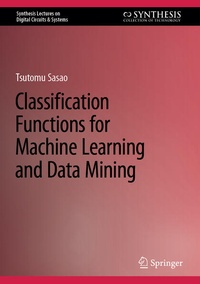
Classification Functions for Machine Learning and Data Mining
Published on 15. July 2023
Book
Hardback
XIII, 144 pages
978-3-031-35346-8 (ISBN)
Description
This book introduces a novel perspective on machine learning, offering distinct advantages over neural network-based techniques. This approach boasts a reduced hardware requirement, lower power consumption, and enhanced interpretability. The applications of this approach encompass high-speed classifications, including packet classification, network intrusion detection, and exotic particle detection in high-energy physics. Moreover, it finds utility in medical diagnosis scenarios characterized by small training sets and imbalanced data. The resulting rule generated by this method can be implemented either in software or hardware. In the case of hardware implementation, circuit design can employ look-up tables (memory), rather than threshold gates.
The methodology described in this book involves extracting a set of rules from a training set, composed of categorical variable vectors and their corresponding classes. Unnecessary variables are eliminated, and the rules are simplified before being transformed into a sum-of-products (SOP) form. The resulting SOP exhibits the ability to generalize and predict outputs for new inputs. The effectiveness of this approach is demonstrated through numerous examples and experimental results using the University of California-Irvine (UCI) dataset.
This book is primarily intended for graduate students and researchers in the fields of logic synthesis, machine learning, and data mining. It assumes a foundational understanding of logic synthesis, while familiarity with linear algebra and statistics would be beneficial for readers.
The methodology described in this book involves extracting a set of rules from a training set, composed of categorical variable vectors and their corresponding classes. Unnecessary variables are eliminated, and the rules are simplified before being transformed into a sum-of-products (SOP) form. The resulting SOP exhibits the ability to generalize and predict outputs for new inputs. The effectiveness of this approach is demonstrated through numerous examples and experimental results using the University of California-Irvine (UCI) dataset.
This book is primarily intended for graduate students and researchers in the fields of logic synthesis, machine learning, and data mining. It assumes a foundational understanding of logic synthesis, while familiarity with linear algebra and statistics would be beneficial for readers.
More details
Series
Edition
2024 ed.
Language
English
Place of publication
Cham
Switzerland
Publishing group
Springer International Publishing
Target group
Professional and scholarly
Illustrations
26 farbige Abbildungen, 19 s/w Abbildungen
XIII, 144 p. 45 illus., 26 illus. in color.
Dimensions
Height: 246 mm
Width: 173 mm
Thickness: 15 mm
Weight
456 gr
ISBN-13
978-3-031-35346-8 (9783031353468)
DOI
10.1007/978-3-031-35347-5
Schweitzer Classification
Other editions
Additional editions
Book
07/2024
Springer
€58.84
Shipment within 15-20 days
E-Book
07/2023
1st Edition
Springer
€58.84
Available for download
Person
Tsutomu Sasao received B.E., M.E., and Ph.D. degrees in Electronics Engineering from Osaka University, Osaka Japan, in 1972, 1974, and 1977, respectively. He has held faculty/research positions at Osaka University, Japan; IBM T. J. Watson Research Center, Yorktown Height, NY; the Naval Postgraduate School, Monterey, CA; Kyushu Institute of Technology, Japan; and Meiji University, Kawasaki, Japan. Currently, he is a visiting researcher of Meiji University, Japan. He is a Life Fellow of the IEEE, and has published many books on logic design.
Content
Introduction.- Definitions and Basic Properties.- Minimization of Variables: Exact Method.- Minimization of Variables: Heuristic Method.- Two-Class Functions.- Linear Decomposition.- Data Mining and Machine Learning.- Functions with Multi-Valued Inputs.- Easily Reconstructable Functions.- Functions with Continuous Variables.- References.- Conclusions.