

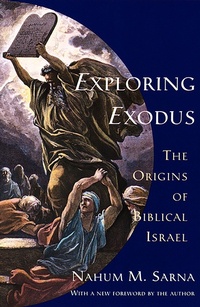
Exploring Exodus
The Origins of Biblical Israel
Published on 2. April 1996
Book
Paperback/Softback
304 pages
978-0-8052-1063-7 (ISBN)
Description
The book of Exodus records the pivotal events in the formation of biblical Israel-the deliverance from slavery, the leadership of Moses, the wilderness wanderings, and the giving of the Law at Mount Sinai. Bible scholar Nahum Sarna, whose widely praised Understanding Genesis has become a standard text, examines and illuminates the distinctiveness of the Exodus narrative in light of ancient Near Eastern history and contemporaneous cultures-Egyptian, Assyrian, Canaanite, and Babylonian. In a new foreword to this edition, Sarna takes up the debate over whether the exodus from Egypt really happened, clarifying the arguments on both sides and drawing us back to the uniqueness and enduring significance of biblical text.
More details
Language
English
Place of publication
United States
Product notice
Paperback (trade)
Dimensions
Height: 203 mm
Width: 133 mm
Thickness: 15 mm
Weight
286 gr
ISBN-13
978-0-8052-1063-7 (9780805210637)
Copyright in bibliographic data and cover images is held by Nielsen Book Services Limited or by the publishers or by their respective licensors: all rights reserved.
Schweitzer Classification
Other editions
Additional editions
E-Book
08/2011
Schocken
€9.99
Available for download
Previous edition

Book
01/1986
Schocken Books
€28.62
Article exhausted; check for reprint
Person
Nahum Sarna
Content
Foreword
xi
Preface
xix
Introduction
1
The uses of the Exodus theme; The title; The connection with Genesis; Structure and content; The historical background.
CHAPTER I
The Oppression
15
The Hyksos and their expulsion; The enslavement of the Israelites; Brickmaking; The midwives.
CHAPTER II
The Births and Youth of Moses
27
The birth of Moses; The motif of the abandoned hero; The role of women; The name "Moses"; Moses' upbringing; The Midianites; Jethro.
CHAPTER III
The Commissioning of Moses
38
The Burning Bush; The "God of the Father(s); "A land flowing with milk and honey"; The ethnic complexity; Moses' reluctance; The Divine Name; The elders; "Hebrews"; Worship the wilderness; Stripping the Egyptians; Signs and wonders; Moses' continued resistance.
CHAPTER IV
The Ten Plagues
63
The hardening of the heart; Bricks without straw; Demoralization; Signs before the pharaoh; The plagues; The literary form; Judgments on the gods of Egypt.
CHAPTER V
The Passover and the Exodus
81
The calendar; The paschal lamb and the unleavened bread; Leaven; Bitter herbs; The blood; The death of the firstborn; "Six hundred thousand men on foot."
CHAPTER VI
From Egypt to Sinai
103
The route of the Exodus; The Yam Suf; The pillar of cloud and the pillar of fire; The miracle at the sea; Manna and quails; The battle with the Amalekites; The organization of the judiciary.
CHAPTER VII
The Ten Commandments; Moses and Monotheism
130
Preparations for the theophany; The atmospheric disturbances; The covenant concept; Near Eastern parallels; Israelite innovations; The prohibition against idolatry; The Sabbath; Moses and monotheism.
CHAPTER VIII
The Laws
158
The Book of the Covenant; The casuistic formulation; The ancient Near Eastern laws; The nature of the law collections; The nature of the Torah's collections of laws; The distinctive feature of Israelite law; Lex talonis, or "an eye for an eye"; Lex talonis in the Torah.
CHAPTER IX
The Tabernacle and the Golden Calf
190
The plan of the Tabernacle; The furniture; The historical reality; The divine instructions and the celestial images; The Tabernacle and Sinai; The all-Israelite emphasis; Gradations of holiness; God's omnipresence; God's unity and perfection; The tablets; The Ark; The cherubim; The Tabernacle, the Sabbath, and Creation; The Golden Calf.
Notes
221
Abbreviations
245
Bibliography
247
Index
264
xi
Preface
xix
Introduction
1
The uses of the Exodus theme; The title; The connection with Genesis; Structure and content; The historical background.
CHAPTER I
The Oppression
15
The Hyksos and their expulsion; The enslavement of the Israelites; Brickmaking; The midwives.
CHAPTER II
The Births and Youth of Moses
27
The birth of Moses; The motif of the abandoned hero; The role of women; The name "Moses"; Moses' upbringing; The Midianites; Jethro.
CHAPTER III
The Commissioning of Moses
38
The Burning Bush; The "God of the Father(s); "A land flowing with milk and honey"; The ethnic complexity; Moses' reluctance; The Divine Name; The elders; "Hebrews"; Worship the wilderness; Stripping the Egyptians; Signs and wonders; Moses' continued resistance.
CHAPTER IV
The Ten Plagues
63
The hardening of the heart; Bricks without straw; Demoralization; Signs before the pharaoh; The plagues; The literary form; Judgments on the gods of Egypt.
CHAPTER V
The Passover and the Exodus
81
The calendar; The paschal lamb and the unleavened bread; Leaven; Bitter herbs; The blood; The death of the firstborn; "Six hundred thousand men on foot."
CHAPTER VI
From Egypt to Sinai
103
The route of the Exodus; The Yam Suf; The pillar of cloud and the pillar of fire; The miracle at the sea; Manna and quails; The battle with the Amalekites; The organization of the judiciary.
CHAPTER VII
The Ten Commandments; Moses and Monotheism
130
Preparations for the theophany; The atmospheric disturbances; The covenant concept; Near Eastern parallels; Israelite innovations; The prohibition against idolatry; The Sabbath; Moses and monotheism.
CHAPTER VIII
The Laws
158
The Book of the Covenant; The casuistic formulation; The ancient Near Eastern laws; The nature of the law collections; The nature of the Torah's collections of laws; The distinctive feature of Israelite law; Lex talonis, or "an eye for an eye"; Lex talonis in the Torah.
CHAPTER IX
The Tabernacle and the Golden Calf
190
The plan of the Tabernacle; The furniture; The historical reality; The divine instructions and the celestial images; The Tabernacle and Sinai; The all-Israelite emphasis; Gradations of holiness; God's omnipresence; God's unity and perfection; The tablets; The Ark; The cherubim; The Tabernacle, the Sabbath, and Creation; The Golden Calf.
Notes
221
Abbreviations
245
Bibliography
247
Index
264