

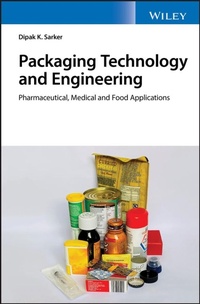
Packaging Technology and Engineering
Pharmaceutical, Medical and Food Applications
1st Edition
Published on 1. July 2020
Book
Other book format
474 pages
978-1-119-21391-8 (ISBN)
More details
Other editions
Additional editions
Dipak Kumar Sarkar
Packaging Technology and Engineering
Pharmaceutical, Medical and Food Applications
E-Book
07/2020
1st Edition
Wiley
€175.99
Available for download
Dipak Kumar Sarkar
Packaging Technology and Engineering
Pharmaceutical, Medical and Food Applications
E-Book
06/2020
1st Edition
Wiley
€175.99
Available for download
Content
List of figures
List of Tables
About the Author
Preface
Section 1. Scientific and Technological Backgroundto Materials
1 Historical perspective and evolution
1.1 Survey of packaging use
1.1.1 Primary, secondary and tertiary packaging
1.1.2 Types of packaging: an overview and the basics
1.2 References
2 Chemical engineering of packaging materials
2.1 Building blocks, extraction and raw materials
2.2 Industrial processes, wood pulping processing and smelting
2.3 Making glass
2.4 References
3 Material science and chemistry
3.1 Glasses
3.2 Metallic materials
3.2.1 Aluminium, tinplate, steel and brass
3.3 Polymeric materials
3.3.1 Polyolefins, cellulosics and polyisoprenes
3.3.2 Thermosets and thermoforming plastics
3.3.3 Laminates
3.3.4 Expanded materials
3.3.5 Paper and paperboard
3.4 Colourants, opacifiers and colouring
3.4.1 Coal tar dyes, lakes and pigments
3.5 Plasticisers and other additives
3.6 Antioxidants and preservatives
3.6.1 Oxidations by numerous processes
3.7 Barriers, barrier properties and product modification
3.7.1 Resistant coatings
3.7.2 Ageing and degradation
3.7.3 Chemical breach and leaching
3.7.4 Water and gas penetration
3.8 Estimating the shelf life of packaging
3.9 Chemical testing
3.10 Contemporary issues and controversies with modern packaging materials
3.11 References
4 The physics of packaging materials
4.1 Characterisation of packaging substrates
4.1.1 Surface and structural morphology
4.1.2 Wettability, polymorphism, crystallinity and crystallites, melting and phase behaviour
4.1.3 Toughness, tensile strength and Young's modulus
4.1.4 Brittleness, hardness and Mohs scale
4.1.5 Puncture resistance and slip
4.2 Test methods
4.3 References
5 Engineering product: design, formation and machining
5.1 Fourdrinier processing and paper-making
5.2 Sheeting, injection moulding, thermoforming, welding, extrusion, plasma treatment, annealing and curing
5.2.1 Bodies and closures
5.2.2 Seals, bungs and the septum
5.3 Classification of moulded packaging forms
5.3.1 Bottles
5.3.2 Dosators
5.3.3 Pouches, trays, wallets and cartons
5.4 References
Section 2. Application and Processing
6 Packaging for various applications
6.1 Hermetically sealed container and developments
6.1.1 The tin-plated steel can
6.1.2 Napoleon and Nicolas Appert "the father of canning"
6.2 Modern sterilisation and pasteurisation procedures and effect of chemistry, temperature, pressure and irradiation on the product and pack
6.2.1 Retorting and high-pressure steam
6.2.2 Radappertisation, radurisation and radicisation
6.2.3 Ethylene oxide
6.2.4 Hyperbaric treatment
6.2.5 Sterilised pouches and the Tetrapak®
6.3 Metered therapeutic dose devices
6.4 Heat-sealed goods and modified atmosphere
6.5 Childproof and easy-open packaging
6.6 Multi-dose pharmaceutical bottles
6.7 References
7Food, pharmaceutical and medical packaging
7.1 Food packaging
7.1.1 Restrictions and key criteria relevant to foods and beverages
7.2 Pharmaceutical packaging
7.2.1 Restrictions and key criteria relevant to therapeutics
7.3 Medical device packaging
7.3.1 Restrictions and key criteria relevant to devices
7.4 References
Section 3. Quality, Integrity and Traceability
8 Suppliers and manufacturers of packaging
8.1 Environmental concerns and sustainability
8.2 Recycling and after-use
8.3 Tracing, anti-counterfeiting technology and anti-fraud devices
8.3.1 Chemical watermarks
8.3.2 Radio-frequency identification and tracking
8.3.3 Barcoding, overt and covert identifiers
8.3.4 History and environmental logging
8.4 Accelerated testing
8.5 The distribution chain and transport logistics
8.6 Packaging regulations and guidelines
8.6.1 Labelling and information
8.7 Safety, health and practicality
8.7.1 New trends and opportunities
8.7.2 The future
8.8 References
Section 4. Revision and Information
9 Problems: questions, calculations, estimates and dilemmas
9.1 Answers to problems
9.2 References
10 Appendices, glossary of terms and abbreviations
Index
List of Tables
About the Author
Preface
Section 1. Scientific and Technological Backgroundto Materials
1 Historical perspective and evolution
1.1 Survey of packaging use
1.1.1 Primary, secondary and tertiary packaging
1.1.2 Types of packaging: an overview and the basics
1.2 References
2 Chemical engineering of packaging materials
2.1 Building blocks, extraction and raw materials
2.2 Industrial processes, wood pulping processing and smelting
2.3 Making glass
2.4 References
3 Material science and chemistry
3.1 Glasses
3.2 Metallic materials
3.2.1 Aluminium, tinplate, steel and brass
3.3 Polymeric materials
3.3.1 Polyolefins, cellulosics and polyisoprenes
3.3.2 Thermosets and thermoforming plastics
3.3.3 Laminates
3.3.4 Expanded materials
3.3.5 Paper and paperboard
3.4 Colourants, opacifiers and colouring
3.4.1 Coal tar dyes, lakes and pigments
3.5 Plasticisers and other additives
3.6 Antioxidants and preservatives
3.6.1 Oxidations by numerous processes
3.7 Barriers, barrier properties and product modification
3.7.1 Resistant coatings
3.7.2 Ageing and degradation
3.7.3 Chemical breach and leaching
3.7.4 Water and gas penetration
3.8 Estimating the shelf life of packaging
3.9 Chemical testing
3.10 Contemporary issues and controversies with modern packaging materials
3.11 References
4 The physics of packaging materials
4.1 Characterisation of packaging substrates
4.1.1 Surface and structural morphology
4.1.2 Wettability, polymorphism, crystallinity and crystallites, melting and phase behaviour
4.1.3 Toughness, tensile strength and Young's modulus
4.1.4 Brittleness, hardness and Mohs scale
4.1.5 Puncture resistance and slip
4.2 Test methods
4.3 References
5 Engineering product: design, formation and machining
5.1 Fourdrinier processing and paper-making
5.2 Sheeting, injection moulding, thermoforming, welding, extrusion, plasma treatment, annealing and curing
5.2.1 Bodies and closures
5.2.2 Seals, bungs and the septum
5.3 Classification of moulded packaging forms
5.3.1 Bottles
5.3.2 Dosators
5.3.3 Pouches, trays, wallets and cartons
5.4 References
Section 2. Application and Processing
6 Packaging for various applications
6.1 Hermetically sealed container and developments
6.1.1 The tin-plated steel can
6.1.2 Napoleon and Nicolas Appert "the father of canning"
6.2 Modern sterilisation and pasteurisation procedures and effect of chemistry, temperature, pressure and irradiation on the product and pack
6.2.1 Retorting and high-pressure steam
6.2.2 Radappertisation, radurisation and radicisation
6.2.3 Ethylene oxide
6.2.4 Hyperbaric treatment
6.2.5 Sterilised pouches and the Tetrapak®
6.3 Metered therapeutic dose devices
6.4 Heat-sealed goods and modified atmosphere
6.5 Childproof and easy-open packaging
6.6 Multi-dose pharmaceutical bottles
6.7 References
7Food, pharmaceutical and medical packaging
7.1 Food packaging
7.1.1 Restrictions and key criteria relevant to foods and beverages
7.2 Pharmaceutical packaging
7.2.1 Restrictions and key criteria relevant to therapeutics
7.3 Medical device packaging
7.3.1 Restrictions and key criteria relevant to devices
7.4 References
Section 3. Quality, Integrity and Traceability
8 Suppliers and manufacturers of packaging
8.1 Environmental concerns and sustainability
8.2 Recycling and after-use
8.3 Tracing, anti-counterfeiting technology and anti-fraud devices
8.3.1 Chemical watermarks
8.3.2 Radio-frequency identification and tracking
8.3.3 Barcoding, overt and covert identifiers
8.3.4 History and environmental logging
8.4 Accelerated testing
8.5 The distribution chain and transport logistics
8.6 Packaging regulations and guidelines
8.6.1 Labelling and information
8.7 Safety, health and practicality
8.7.1 New trends and opportunities
8.7.2 The future
8.8 References
Section 4. Revision and Information
9 Problems: questions, calculations, estimates and dilemmas
9.1 Answers to problems
9.2 References
10 Appendices, glossary of terms and abbreviations
Index