

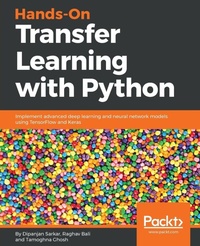
Hands-On Transfer Learning with Python
Implement advanced deep learning and neural network models using TensorFlow and Keras
Published on 31. August 2018
Book
Paperback/Softback
438 pages
978-1-78883-130-7 (ISBN)
Description
Deep learning simplified by taking supervised, unsupervised, and reinforcement learning to the next level using the Python ecosystem
Key Features
Build deep learning models with transfer learning principles in Python
implement transfer learning to solve real-world research problems
Perform complex operations such as image captioning neural style transfer
Book DescriptionTransfer learning is a machine learning (ML) technique where knowledge gained during training a set of problems can be used to solve other similar problems.
The purpose of this book is two-fold; firstly, we focus on detailed coverage of deep learning (DL) and transfer learning, comparing and contrasting the two with easy-to-follow concepts and examples. The second area of focus is real-world examples and research problems using TensorFlow, Keras, and the Python ecosystem with hands-on examples.
The book starts with the key essential concepts of ML and DL, followed by depiction and coverage of important DL architectures such as convolutional neural networks (CNNs), deep neural networks (DNNs), recurrent neural networks (RNNs), long short-term memory (LSTM), and capsule networks. Our focus then shifts to transfer learning concepts, such as model freezing, fine-tuning, pre-trained models including VGG, inception, ResNet, and how these systems perform better than DL models with practical examples. In the concluding chapters, we will focus on a multitude of real-world case studies and problems associated with areas such as computer vision, audio analysis and natural language processing (NLP).
By the end of this book, you will be able to implement both DL and transfer learning principles in your own systems.
What you will learn
Set up your own DL environment with graphics processing unit (GPU) and Cloud support
Delve into transfer learning principles with ML and DL models
Explore various DL architectures, including CNN, LSTM, and capsule networks
Learn about data and network representation and loss functions
Get to grips with models and strategies in transfer learning
Walk through potential challenges in building complex transfer learning models from scratch
Explore real-world research problems related to computer vision and audio analysis
Understand how transfer learning can be leveraged in NLP
Who this book is forHands-On Transfer Learning with Python is for data scientists, machine learning engineers, analysts and developers with an interest in data and applying state-of-the-art transfer learning methodologies to solve tough real-world problems. Basic proficiency in machine learning and Python is required.
Key Features
Build deep learning models with transfer learning principles in Python
implement transfer learning to solve real-world research problems
Perform complex operations such as image captioning neural style transfer
Book DescriptionTransfer learning is a machine learning (ML) technique where knowledge gained during training a set of problems can be used to solve other similar problems.
The purpose of this book is two-fold; firstly, we focus on detailed coverage of deep learning (DL) and transfer learning, comparing and contrasting the two with easy-to-follow concepts and examples. The second area of focus is real-world examples and research problems using TensorFlow, Keras, and the Python ecosystem with hands-on examples.
The book starts with the key essential concepts of ML and DL, followed by depiction and coverage of important DL architectures such as convolutional neural networks (CNNs), deep neural networks (DNNs), recurrent neural networks (RNNs), long short-term memory (LSTM), and capsule networks. Our focus then shifts to transfer learning concepts, such as model freezing, fine-tuning, pre-trained models including VGG, inception, ResNet, and how these systems perform better than DL models with practical examples. In the concluding chapters, we will focus on a multitude of real-world case studies and problems associated with areas such as computer vision, audio analysis and natural language processing (NLP).
By the end of this book, you will be able to implement both DL and transfer learning principles in your own systems.
What you will learn
Set up your own DL environment with graphics processing unit (GPU) and Cloud support
Delve into transfer learning principles with ML and DL models
Explore various DL architectures, including CNN, LSTM, and capsule networks
Learn about data and network representation and loss functions
Get to grips with models and strategies in transfer learning
Walk through potential challenges in building complex transfer learning models from scratch
Explore real-world research problems related to computer vision and audio analysis
Understand how transfer learning can be leveraged in NLP
Who this book is forHands-On Transfer Learning with Python is for data scientists, machine learning engineers, analysts and developers with an interest in data and applying state-of-the-art transfer learning methodologies to solve tough real-world problems. Basic proficiency in machine learning and Python is required.
More details
Language
English
Place of publication
Birmingham
United Kingdom
Target group
Professional and scholarly
Dimensions
Height: 235 mm
Width: 191 mm
Thickness: 24 mm
Weight
813 gr
ISBN-13
978-1-78883-130-7 (9781788831307)
Copyright in bibliographic data and cover images is held by Nielsen Book Services Limited or by the publishers or by their respective licensors: all rights reserved.
Schweitzer Classification
Other editions
Additional editions
Dipanjan Sarkar | Raghav Bali | Tamoghna Ghosh
Hands-On Transfer Learning with Python
Implement advanced deep learning and neural network models using TensorFlow and Keras
E-Book
06/2024
1st Edition
Packt Publishing Limited
€34.99
Available for download
Persons
Dipanjan (DJ) Sarkar is a Data Scientist at Intel, leveraging data science, machine learning, and deep learning to build large-scale intelligent systems. He holds a master of technology degree with specializations in Data Science and Software Engineering. He has been an analytics practitioner for several years now, specializing in machine learning, NLP, statistical methods, and deep learning. He is passionate about education and also acts as a Data Science Mentor at various organizations like Springboard, helping people learn data science. He is also a key contributor and editor for Towards Data Science, a leading online journal on AI and Data Science. He has also authored several books on R, Python, machine learning, NLP, and deep learning. Raghav Bali is a Data Scientist at Optum (United Health Group). His work involves research & development of enterprise level solutions based on Machine Learning, Deep Learning and Natural Language Processing for Healthcare & Insurance related use cases. In his previous role at Intel, he was involved in enabling proactive data driven IT initiatives. He has also worked in ERP and finance domains with some of the leading organizations in the world. Raghav has also authored multiple books with leading publishers. Raghav has a master's degree (gold medalist) in Information Technology from International Institute of Information Technology, Bangalore. Raghav loves reading and is a shutterbug capturing moments when he isn't busy solving problems. Tamoghna Ghosh is a machine learning engineer at Intel Corporation. He has overall 11 years of work experience including 4 years of core research experience at Microsoft Research (MSR) India. At MSR he worked as a research assistant in cryptanalysis of block ciphers. His technical expertise's are in big data, machine learning, NLP, information retrieval, data visualization and software development. He received M.Tech (Computer Science) degree from the Indian Statistical Institute, Kolkata and M.Sc (Mathematics) from University of Calcutta with specialization in functional analysis and mathematical modeling/dynamical systems. He is passionate about teaching and conducts internal training in data science for Intel at various levels.
Content
Table of Contents
Machine Learning Fundamentals
Deep Learning Essentials
Understanding Deep Learning Architectures
Transfer Learning Fundamentals
Unleash the Power of Transfer Learning
Image Recognition and Classification
Text Document Categorization
Audio Identification and Categorization
Deep Dream
Neural Style Transfer
Automated Image Caption Generator
Image Colorization
Machine Learning Fundamentals
Deep Learning Essentials
Understanding Deep Learning Architectures
Transfer Learning Fundamentals
Unleash the Power of Transfer Learning
Image Recognition and Classification
Text Document Categorization
Audio Identification and Categorization
Deep Dream
Neural Style Transfer
Automated Image Caption Generator
Image Colorization