

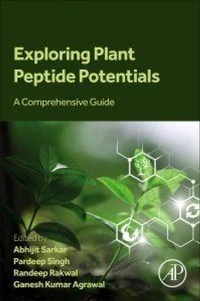
Exploring Plant Peptide Potentials
A Comprehensive Guide
Will be published approx. on 1. March 2026
Book
Paperback/Softback
380 pages
978-0-443-15652-6 (ISBN)
Description
Exploring Plant Peptide Potentials offers an in-depth overview of the latest research on these functional molecules, emphasizing their diverse biological roles and growing relevance across disciplines. The book brings together insights into their discovery, mechanisms, and applications to deepen understanding and inspire future research.
Plant peptides are key regulators of growth, development, defense, and stress responses, and they show considerable promise in pharmaceutical, nutraceutical, and herbal medicine applications. The volume spans topics from peptide identification and imaging to signaling pathways, molecular interactions, and bioinformatics approaches. It also covers both conventional and advanced tools in peptide science, including post-translational modifications, peptide mimicry, and innovations in nanotechnology and biotechnology.
Exploring Plant Peptide Potentials is a valuable resource for researchers and professionals in plant biochemistry, physiology, molecular biology, and biotechnology, as well as those developing plant-derived health and therapeutic products.
Plant peptides are key regulators of growth, development, defense, and stress responses, and they show considerable promise in pharmaceutical, nutraceutical, and herbal medicine applications. The volume spans topics from peptide identification and imaging to signaling pathways, molecular interactions, and bioinformatics approaches. It also covers both conventional and advanced tools in peptide science, including post-translational modifications, peptide mimicry, and innovations in nanotechnology and biotechnology.
Exploring Plant Peptide Potentials is a valuable resource for researchers and professionals in plant biochemistry, physiology, molecular biology, and biotechnology, as well as those developing plant-derived health and therapeutic products.
More details
Language
English
Place of publication
San Diego
United States
Publishing group
Elsevier Science Publishing Co Inc
Target group
Professional and scholarly
Product notice
Paperback (trade)
Unsewn / adhesive bound
Dimensions
Height: 229 mm
Width: 152 mm
Weight
450 gr
ISBN-13
978-0-443-15652-6 (9780443156526)
Copyright in bibliographic data and cover images is held by Nielsen Book Services Limited or by the publishers or by their respective licensors: all rights reserved.
Schweitzer Classification
Other editions
Additional editions
Abhijit Sarkar | Pardeep Singh | Randeep Rakwal
Exploring Plant Peptide Potentials
A Comprehensive Guide
E-Book
03/2026
Elsevier
€175.00
Available for download
Persons
Dr. Abhijit Sarkar is currently an Assistant Professor of Botany at the University of Gour Banga (India). He did his B.Sc. (Hons.) and M.Sc. in Botany (with specialization in Plant Physiology, Biochemistry and Plant Molecular Biology) from University of Calcutta (India), and Ph.D. in Botany from Banaras Hindu University (India) in 2012. Dr. Sarkar has major research interests in air pollution and its effect on plant biology and human health including ozone, heat, UV radiation (natural and man-made), plant pathogens with close collaborators in Japan, South Korea, Nepal, USA, Italy, and India. Pardeep Singh is Professor and Head at the School of Advanced Chemical Sciences, Shoolini University, Solan, India. He is specialized in physical chemistry and heads a lab of research scholars who work on photocatalysis with the aim of generating new knowledge on graphene-based photocatalytic materials and processes to develop novel de-pollution treatments with enhanced efficiency and pilot-scale applicability. He is also exploring the generation of bio-waste material-based activated carbon for adsorption-based removal of aqueous phase pollutants. Professor Randeep Rakwal is a Professor at the University of Tsukuba (Japan), at the Faculty of Health and Sport Sciences. Being expert in multidiscipline, he continues his research work on plants, human health and animal-human systems using omics. His major research interests in plant environmental stress biology are-jasmonic acid, ozone, heat, radiations, plant pathogens using "omics? approaches with close collaborators in Japan, South Korea, Nepal, USA, Italy, Australia and India. He is the initiator and one of the founding members of the International Plant Proteomics Organization (INPPO). Ganesh Kumar Agrawal is the Associate Director of RLABB, a non-profit research organization focusing on biotechnology and biochemistry in Kathmandu, Nepal. Dr. Agrawal is a multidisciplinary scientist focused on food security and human nutrition using high-throughput and targeted omics techniques. He has edited a comprehensive "Plant Proteomics: Technologies, Strategies, and Applications? book (John Wiley & Sons, NY, USA). He earned his Ph.D. in Applied Biological Chemistry (Biochemistry & Biotechnology, Tokyo University of Agriculture and Technology, Japan). He is an initiator of the International Plant Proteomics Organization.
Editor
Assistant Professor, Department of Botany, University of Gour Banga, Malda, India
Assistant Professor, Department of Environmental Science, PGDAV College, University of Delhi, New Delhi, India
Professor, Institute of Health and Sport Sciences, University of Tsukuba, Tsukuba City, Japan
Associate Director, Research Laboratory for Agricultural Biotechnology and Biochemistry (RLABB), Kathmandu, Nepal
Content
1. Evolutionary history of peptide science
2. The peptide world: concept, distribution, and demarcation
3. Peptide, peptidome, and peptidomics
4. Peptides: a fascinating, unique, and universal molecule with incredible potentials
5. Peptides: through the looking glass of past discoveries
6. Conventional approaches of plant peptide purification and recent tools for their identification
7. Peptide imaging: characterization and fingerprinting
8. Post-translational modification and proteolytic processing of plant peptides
9. Plant peptide hormones
10. Exploring plant peptides involved in plant-insect/microbe interactions
11. Peptides involved in cell proliferation, expansion, and differentiation
12. Peptide mimicry
13. Spatiotemporal signalling regulated by plant peptides
14. Plant peptides involved in ROS signalling and biotic and abiotic stress responses
15. Biosynthetic and chemical discoveries of cyclic plant peptides and their importance in plant systems
16. Crosstalk of peptides for plant communication
17. Plant peptides as major plant-based products: pharmaceuticals, nutraceuticals, and herbal drugs
18. Decoding the interactome of plant peptides through bioinformatics approaches
19. Metapeptidomics: concept, feasibility, and future
20. Nanotechnology and peptide science
21. Biotechnological advancements in peptide science
2. The peptide world: concept, distribution, and demarcation
3. Peptide, peptidome, and peptidomics
4. Peptides: a fascinating, unique, and universal molecule with incredible potentials
5. Peptides: through the looking glass of past discoveries
6. Conventional approaches of plant peptide purification and recent tools for their identification
7. Peptide imaging: characterization and fingerprinting
8. Post-translational modification and proteolytic processing of plant peptides
9. Plant peptide hormones
10. Exploring plant peptides involved in plant-insect/microbe interactions
11. Peptides involved in cell proliferation, expansion, and differentiation
12. Peptide mimicry
13. Spatiotemporal signalling regulated by plant peptides
14. Plant peptides involved in ROS signalling and biotic and abiotic stress responses
15. Biosynthetic and chemical discoveries of cyclic plant peptides and their importance in plant systems
16. Crosstalk of peptides for plant communication
17. Plant peptides as major plant-based products: pharmaceuticals, nutraceuticals, and herbal drugs
18. Decoding the interactome of plant peptides through bioinformatics approaches
19. Metapeptidomics: concept, feasibility, and future
20. Nanotechnology and peptide science
21. Biotechnological advancements in peptide science