

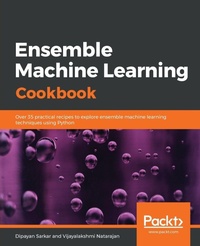
Ensemble Machine Learning Cookbook
Over 35 practical recipes to explore ensemble machine learning techniques using Python
Published on 31. January 2019
Book
Paperback/Softback
336 pages
978-1-78913-660-9 (ISBN)
Description
Implement machine learning algorithms to build ensemble models using Keras, H2O, Scikit-Learn, Pandas and more
Key Features
Apply popular machine learning algorithms using a recipe-based approach
Implement boosting, bagging, and stacking ensemble methods to improve machine learning models
Discover real-world ensemble applications and encounter complex challenges in Kaggle competitions
Book DescriptionEnsemble modeling is an approach used to improve the performance of machine learning models. It combines two or more similar or dissimilar machine learning algorithms to deliver superior intellectual powers. This book will help you to implement popular machine learning algorithms to cover different paradigms of ensemble machine learning such as boosting, bagging, and stacking.
The Ensemble Machine Learning Cookbook will start by getting you acquainted with the basics of ensemble techniques and exploratory data analysis. You'll then learn to implement tasks related to statistical and machine learning algorithms to understand the ensemble of multiple heterogeneous algorithms. It will also ensure that you don't miss out on key topics, such as like resampling methods. As you progress, you'll get a better understanding of bagging, boosting, stacking, and working with the Random Forest algorithm using real-world examples. The book will highlight how these ensemble methods use multiple models to improve machine learning results, as compared to a single model. In the concluding chapters, you'll delve into advanced ensemble models using neural networks, natural language processing, and more. You'll also be able to implement models such as fraud detection, text categorization, and sentiment analysis.
By the end of this book, you'll be able to harness ensemble techniques and the working mechanisms of machine learning algorithms to build intelligent models using individual recipes.
What you will learn
Understand how to use machine learning algorithms for regression and classification problems
Implement ensemble techniques such as averaging, weighted averaging, and max-voting
Get to grips with advanced ensemble methods, such as bootstrapping, bagging, and stacking
Use Random Forest for tasks such as classification and regression
Implement an ensemble of homogeneous and heterogeneous machine learning algorithms
Learn and implement various boosting techniques, such as AdaBoost, Gradient Boosting Machine, and XGBoost
Who this book is forThis book is designed for data scientists, machine learning developers, and deep learning enthusiasts who want to delve into machine learning algorithms to build powerful ensemble models. Working knowledge of Python programming and basic statistics is a must to help you grasp the concepts in the book.
Key Features
Apply popular machine learning algorithms using a recipe-based approach
Implement boosting, bagging, and stacking ensemble methods to improve machine learning models
Discover real-world ensemble applications and encounter complex challenges in Kaggle competitions
Book DescriptionEnsemble modeling is an approach used to improve the performance of machine learning models. It combines two or more similar or dissimilar machine learning algorithms to deliver superior intellectual powers. This book will help you to implement popular machine learning algorithms to cover different paradigms of ensemble machine learning such as boosting, bagging, and stacking.
The Ensemble Machine Learning Cookbook will start by getting you acquainted with the basics of ensemble techniques and exploratory data analysis. You'll then learn to implement tasks related to statistical and machine learning algorithms to understand the ensemble of multiple heterogeneous algorithms. It will also ensure that you don't miss out on key topics, such as like resampling methods. As you progress, you'll get a better understanding of bagging, boosting, stacking, and working with the Random Forest algorithm using real-world examples. The book will highlight how these ensemble methods use multiple models to improve machine learning results, as compared to a single model. In the concluding chapters, you'll delve into advanced ensemble models using neural networks, natural language processing, and more. You'll also be able to implement models such as fraud detection, text categorization, and sentiment analysis.
By the end of this book, you'll be able to harness ensemble techniques and the working mechanisms of machine learning algorithms to build intelligent models using individual recipes.
What you will learn
Understand how to use machine learning algorithms for regression and classification problems
Implement ensemble techniques such as averaging, weighted averaging, and max-voting
Get to grips with advanced ensemble methods, such as bootstrapping, bagging, and stacking
Use Random Forest for tasks such as classification and regression
Implement an ensemble of homogeneous and heterogeneous machine learning algorithms
Learn and implement various boosting techniques, such as AdaBoost, Gradient Boosting Machine, and XGBoost
Who this book is forThis book is designed for data scientists, machine learning developers, and deep learning enthusiasts who want to delve into machine learning algorithms to build powerful ensemble models. Working knowledge of Python programming and basic statistics is a must to help you grasp the concepts in the book.
More details
Language
English
Place of publication
Birmingham
United Kingdom
Target group
Professional and scholarly
US School Grade: College Graduate Student
Dimensions
Height: 235 mm
Width: 191 mm
Thickness: 18 mm
Weight
629 gr
ISBN-13
978-1-78913-660-9 (9781789136609)
Copyright in bibliographic data and cover images is held by Nielsen Book Services Limited or by the publishers or by their respective licensors: all rights reserved.
Schweitzer Classification
Other editions
Additional editions
Dipayan Sarkar | Vijayalakshmi Natarajan
Ensemble Machine Learning Cookbook
Over 35 practical recipes to explore ensemble machine learning techniques using Python
E-Book
09/2024
Packt Publishing
from
€51.79
Available for download
Persons
Dipayan Sarkar holds a Masters in Economics and comes with 17+ years of experience. Dipayan has won international challenges in predictive modeling and takes a keen interest in the mathematics behind machine learning techniques. Before opting to become an independent consultant and a mentor in the data science and machine learning space with various organizations and educational institutions, he had served in the capacity of a senior data scientist with Fortune 500 companies in the US and Europe. He is currently associated with Great Lakes Institute of Management as a visiting faculty (Analytics) and BML Munjal University as an adjunct faculty (Analytics and Machine Learning). He has co-authored a book on "Ensemble Machine Learning with Python" with PACKT Publishing. Vijayalakshmi Natarajan holds an ME in Computer Science, comes with 4 years of industry experience. She is a data science enthusiast and is a passionate trainer in the field of data science & data visualization. She takes keen interests in deep diving into Machine Learning techniques. Her specialization includes machine learning techniques in the field of image processing.
Content
Table of Contents
Get Closer to Your Data with Exploratory Data Analysis
Getting Started with Ensemble Machine Learning
Resampling Methods
Statistical & Machine Learning Algorithms
Bag the Models with Bagging
When in Doubt, use Random Forest
Boost up Model Performance with Boosting
Blend it with Stacking
Homogeneous Ensemble for Hand-Written Digits Recognition
Heterogeneous Ensemble Classifiers for Credit Card Default Prediction
Heterogeneous Ensemble for Sentiment Analysis using NLP
Heterogeneous Ensemble for Multi-Label Classification for Text Categorization
Get Closer to Your Data with Exploratory Data Analysis
Getting Started with Ensemble Machine Learning
Resampling Methods
Statistical & Machine Learning Algorithms
Bag the Models with Bagging
When in Doubt, use Random Forest
Boost up Model Performance with Boosting
Blend it with Stacking
Homogeneous Ensemble for Hand-Written Digits Recognition
Heterogeneous Ensemble Classifiers for Credit Card Default Prediction
Heterogeneous Ensemble for Sentiment Analysis using NLP
Heterogeneous Ensemble for Multi-Label Classification for Text Categorization