

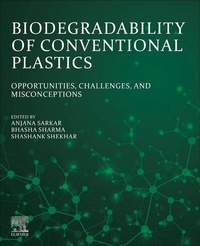
Biodegradability of Conventional Plastics
Opportunities, Challenges, and Misconceptions
Published on 15. September 2022
Book
Paperback/Softback
408 pages
978-0-323-89858-4 (ISBN)
Description
Approx.390 pages
More details
Language
English
Place of publication
Philadelphia
United States
Target group
Professional and scholarly
Researchers, scientists, and advanced students in polymer science, plastics engineering, bio-based materials, nanomaterials, chemistry, biotechnology, environmental science, and materials science and engineering. R&D, engineers, and industrialists looking to develop plastics materials with increased biodegradability or interested in plastics and sustainability
Illustrations
125 illustrations (25 in full color); Illustrations
Dimensions
Height: 235 mm
Width: 191 mm
Weight
840 gr
ISBN-13
978-0-323-89858-4 (9780323898584)
Copyright in bibliographic data and cover images is held by Nielsen Book Services Limited or by the publishers or by their respective licensors: all rights reserved.
Schweitzer Classification
Other editions
Additional editions
Anjana Sarkar | Bhasha Sharma | Shashank Shekhar
Biodegradability of Conventional Plastics
Opportunities, Challenges, and Misconceptions
E-Book
09/2022
Elsevier
€210.00
Available for download
Persons
Anjana Sarkar, Head of Department and Professor, Department of Chemistry, Netaji Subhas University of Technology, Delhi, India
Prof. Anjana Sarkar is currently Head of the Department of Chemistry at Netaji Subhas University of Technology. With 37 years of teaching and research experience at Netaji Subhas University of Technology, she has published various papers in national and international journals. Prof. Sarkar completed an AICTE sponsored R&D project on 'Ternary Complexes of Transition Metal Ions with Novel Biomolecular like Kojic Acid & L-Amino acid: Synthesis & Study of Physicochemical Properties and their Bio-efficacy', and has been awarded "Woman of the Year 1998? by the American Biographical Institute, North Carolina, USA. Dr. Bhasha Sharma is an Assistant Professor in the Department of Chemistry, Shivaji College, University of Delhi, India. She received her BSc (2011) in Polymer Sciences from the University of Delhi, and completed her Ph.D. in Chemistry in 2019. Her research interests revolve around sustainable polymers for packaging applications, environmentally benign approaches for biodegradation of plastic wastes, fabrication of bionanocomposites, and finding strategies to ameliorate the electrochemical activity of biopolymers. Shashank Shekhar
Assistant Professor, Department of Chemistry, Netaji Subhas University of Technology, Delhi, India
Dr. Shashank Shekhar is currently an Assistant Professor at Netaji Subhas University of Technology and is also associated with the Quantum Research Centre of Excellence as Associate Director in the Department of Renewable Energy. He completed his PhD in Chemistry at the University of Delhi. Dr. Shekhar has been working on biopolymers and Schiff base metal complexes for the last 5 years and has published articles in reputed international journals.
Prof. Anjana Sarkar is currently Head of the Department of Chemistry at Netaji Subhas University of Technology. With 37 years of teaching and research experience at Netaji Subhas University of Technology, she has published various papers in national and international journals. Prof. Sarkar completed an AICTE sponsored R&D project on 'Ternary Complexes of Transition Metal Ions with Novel Biomolecular like Kojic Acid & L-Amino acid: Synthesis & Study of Physicochemical Properties and their Bio-efficacy', and has been awarded "Woman of the Year 1998? by the American Biographical Institute, North Carolina, USA. Dr. Bhasha Sharma is an Assistant Professor in the Department of Chemistry, Shivaji College, University of Delhi, India. She received her BSc (2011) in Polymer Sciences from the University of Delhi, and completed her Ph.D. in Chemistry in 2019. Her research interests revolve around sustainable polymers for packaging applications, environmentally benign approaches for biodegradation of plastic wastes, fabrication of bionanocomposites, and finding strategies to ameliorate the electrochemical activity of biopolymers. Shashank Shekhar
Assistant Professor, Department of Chemistry, Netaji Subhas University of Technology, Delhi, India
Dr. Shashank Shekhar is currently an Assistant Professor at Netaji Subhas University of Technology and is also associated with the Quantum Research Centre of Excellence as Associate Director in the Department of Renewable Energy. He completed his PhD in Chemistry at the University of Delhi. Dr. Shekhar has been working on biopolymers and Schiff base metal complexes for the last 5 years and has published articles in reputed international journals.
Content
1. Life cycle assessment and environmental impact of plastic waste
2. Composition, properties, and other factors that influence the biodegradability of plastics
3. Bioplastics, biodegradable plastics, and degradation in natural environments
4. Bioplastics overview: are bioplastics the panacea for our environmental woes?
5. Generation and impact of microplastics and nanoplastics from bioplastic sources
6. Biodegradability of synthetic plastics: effective degradation mechanisms
7. Biodegradability of polyolefins: Processes and procedures
8. Biodegradability and current status of polyethylene terephthalate
9. Biodegradability and bioremediation of polystyrene-based pollutants
10. Biodegradability of poly (vinyl chloride)
11. Biodegradability of automotive plastics and composites
12. Biodegradability of agricultural plastic waste
13. Utilization of chemical additives to enhance biodegradability of plastics
14. The role of nanomaterials in plastics biodegradability
15. Microbial attachment studies on "plastic-specific? microorganisms
16. Plastic waste to plastic value: Role of industrial biotechnology
17. Future prospects for the biodegradability of conventional plastics
2. Composition, properties, and other factors that influence the biodegradability of plastics
3. Bioplastics, biodegradable plastics, and degradation in natural environments
4. Bioplastics overview: are bioplastics the panacea for our environmental woes?
5. Generation and impact of microplastics and nanoplastics from bioplastic sources
6. Biodegradability of synthetic plastics: effective degradation mechanisms
7. Biodegradability of polyolefins: Processes and procedures
8. Biodegradability and current status of polyethylene terephthalate
9. Biodegradability and bioremediation of polystyrene-based pollutants
10. Biodegradability of poly (vinyl chloride)
11. Biodegradability of automotive plastics and composites
12. Biodegradability of agricultural plastic waste
13. Utilization of chemical additives to enhance biodegradability of plastics
14. The role of nanomaterials in plastics biodegradability
15. Microbial attachment studies on "plastic-specific? microorganisms
16. Plastic waste to plastic value: Role of industrial biotechnology
17. Future prospects for the biodegradability of conventional plastics