

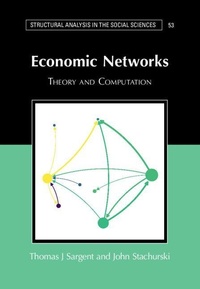
Economic Networks
Theory and Computation
Published on 25. April 2024
Book
Hardback
266 pages
978-1-009-45635-7 (ISBN)
Description
It has become increasingly clear that economies can fruitfully be viewed as networks, consisting of millions of nodes (households, firms, banks, etc.) connected by business, social, and legal relationships. These relationships shape many outcomes that economists often measure. Over the past few years, research on production networks has flourished, as economists try to understand supply-side dynamics, default cascades, aggregate fluctuations, and many other phenomena. Economic Networks provides a brisk introduction to network analysis that is self-contained, rigorous, and illustrated with many figures, diagrams and listings with computer code. Network methods are put to work analyzing production networks, financial networks, and other related topics (including optimal transport, another highly active research field). Visualizations using recent data bring key ideas to life.
More details
Series
Language
English
Place of publication
Cambridge
United Kingdom
Product notice
sewn/stitched
Cloth over boards
Illustrations
Worked examples or Exercises
Dimensions
Height: 248 mm
Width: 174 mm
Thickness: 22 mm
Weight
642 gr
ISBN-13
978-1-009-45635-7 (9781009456357)
Copyright in bibliographic data and cover images is held by Nielsen Book Services Limited or by the publishers or by their respective licensors: all rights reserved.
Schweitzer Classification
Other editions
Additional editions
Book
04/2024
Cambridge University Press
€39.50
Shipment within 15-20 days
E-Book
04/2024
Cambridge University Press
€37.99
Available for download
Persons
Thomas J. Sargent is a Nobel Prize-winning economist and Professor of Economics at New York University. He has held positions at Stanford, Minnesota, Chicago, and Princeton, and served as President of the Econometric Society and of the American Economic Association. He is renowned for his influential research on macroeconomics, rational expectations, and policy analysis.
Content
Preface; Common symbols; 1. Introduction; 2. Production; 3. Optimal flows; 4. Markov chains and networks; 5. Nonlinear interactions; Appendices; 6. Appendix.