

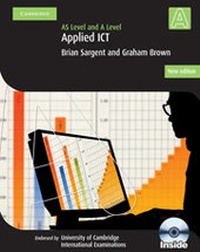
Applied AS/A Level ICT with CD-ROM
Published on 25. September 2008
Book
Mixed media product
391 pages
978-0-521-71764-9 (ISBN)
Description
AS Level and A Level Applied ICT comprehensively covers the requirements of the Cambridge syllabus for AS Level and A Level Applied Information and Communication Technology, and is endorsed by Cambridge. Written in a clear, accessible style by experienced teachers with senior examining roles, the book and free accompanying CD-ROM prepare students for the examination and help them to develop, and learn to apply, a wide range of ICT skills. The book explores the structure and use of ICT systems, including a variety of computer networks, within a broad range of organisations. It fully investigates the systems life cycle, the way in which ICT is applied in the workplace and the impact of ICT on society in general. The CD-ROM, referenced throughout the book, contains raw source-data files and sample model answers for the activities in the practical chapters.
More details
Language
English
Place of publication
Cambridge
United Kingdom
Target group
College/higher education
Dimensions
Height: 277 mm
Width: 218 mm
Thickness: 19 mm
Weight
1220 gr
ISBN-13
978-0-521-71764-9 (9780521717649)
Copyright in bibliographic data and cover images is held by Nielsen Book Services Limited or by the publishers or by their respective licensors: all rights reserved.
Schweitzer Classification
Other editions
New editions
Paul Long | Sarah Lawrey | Victoria Ellis
Cambridge International AS and A Level IT Coursebook with CD-ROM
Book
01/2016
Cambridge University Press
€63.14
Article exhausted; check for reprint
Content
Introduction; 1. ICT systems including portable communication devices; 2. How organisations use ICT 1; 3. The impact of ICT on society 1; 4. The systems life cycle; 5. How organisations use ICT 2; 6. The impact of ICT on society 2; 7. Computer networks; 8. Software selection; 9. Communication; 10. Document and presentation production; 11. Databases and charts; 12. Integration; 13. Output data 1; 14. Using spreadsheets; 15. Mail merge; 16. Automation; 17. Output data 2; Glossary; Appendices; Index