

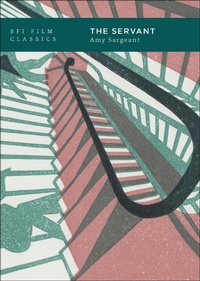
The Servant
2nd Edition
Published on 29. October 2020
Book
Paperback/Softback
120 pages
978-1-83902-167-1 (ISBN)
Description
Amy Sargeant's compelling and meticulous study of Joseph Losey's The Servant (1963) sets the film in the context of a long tradition of fictional depictions of the master-servant relationship, from Shakespeare to Cervantes, Henry James, Dorothy L. Sayers and P.G. Wodehouse. Sargeant points out that while many of these relationships are played for comic effect, that of the 'young master' Tony (James Fox) and his manservant Barrett (Dirk Bogarde) unfolds in a far more sinister manner, with Barrett coming to dominate and humiliate the hapless Tony.
Sargeant's reading pays particular attention to the contribution not only of Losey and Harold Pinter, who adapted the screenplay from Robin Maugham's novella, but also of the cinematographer Douglas Slocombe, designer Richard Macdonald and costume designer Beatrice 'Bumble' Dawson. She analyses the performances of Sarah Miles as Barrett's lover Vera and Wendy Craig as Tony's fiancee Susan, as well as those of Fox and Bogarde, and gives careful consideration to how the film uses architectural form, interior design and decoration, and clothing to establish character and relationships. In the context of the collapse of the British Empire, and a beleaguered Establishment beset by spy and sex scandals, the film can be read, Sargeant argues, as a metaphor for the 'state of the nation' in the early 1960s.
Finally, Sargeant considers the film's critical and commercial reception in Britain, Europe and the United States - its release, how it was received as one of a number of 'emigre' films, and Losey's surprising denial of a homoerotic intent in the Tony-Barrett relationship.
In her new foreword to this edition, Amy Sargeant considers contemporary resonances of the film's depiction of a twisted master-servant relationship in recent TV and cinema including The Crown, Downton Abbey and The Trial of Christine Keeler.
Sargeant's reading pays particular attention to the contribution not only of Losey and Harold Pinter, who adapted the screenplay from Robin Maugham's novella, but also of the cinematographer Douglas Slocombe, designer Richard Macdonald and costume designer Beatrice 'Bumble' Dawson. She analyses the performances of Sarah Miles as Barrett's lover Vera and Wendy Craig as Tony's fiancee Susan, as well as those of Fox and Bogarde, and gives careful consideration to how the film uses architectural form, interior design and decoration, and clothing to establish character and relationships. In the context of the collapse of the British Empire, and a beleaguered Establishment beset by spy and sex scandals, the film can be read, Sargeant argues, as a metaphor for the 'state of the nation' in the early 1960s.
Finally, Sargeant considers the film's critical and commercial reception in Britain, Europe and the United States - its release, how it was received as one of a number of 'emigre' films, and Losey's surprising denial of a homoerotic intent in the Tony-Barrett relationship.
In her new foreword to this edition, Amy Sargeant considers contemporary resonances of the film's depiction of a twisted master-servant relationship in recent TV and cinema including The Crown, Downton Abbey and The Trial of Christine Keeler.
More details
Series
Edition
2nd edition
Language
English
Place of publication
United Kingdom
Publishing group
Bloomsbury Publishing PLC
Target group
Professional and scholarly
Illustrations
60 bw illus
Dimensions
Height: 190 mm
Width: 138 mm
Thickness: 10 mm
Weight
209 gr
ISBN-13
978-1-83902-167-1 (9781839021671)
Copyright in bibliographic data and cover images is held by Nielsen Book Services Limited or by the publishers or by their respective licensors: all rights reserved.
Schweitzer Classification
Other editions
Additional editions


Previous edition
Person
Amy Sargeant teaches the London Program for Tisch School of the Arts, New York University. She is the author of British Cinema: A Critical History (BFI 2005) and co-editor of British Historical Cinema: History, Heritage and the Costume Film (2002).
Content
Foreword to the 2020 Edition
Acknowledgements
Plot Synopsis
1. Losey and Pinter
2. The House
3. Post-production: The Film in Other Houses - Cinema and Beyond
Conclusion: Pushing on an Open Door?
Notes
Credits
Bibliography
Acknowledgements
Plot Synopsis
1. Losey and Pinter
2. The House
3. Post-production: The Film in Other Houses - Cinema and Beyond
Conclusion: Pushing on an Open Door?
Notes
Credits
Bibliography