

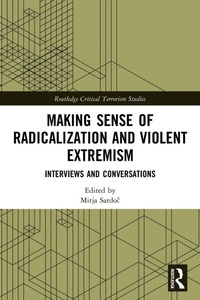
Making Sense of Radicalization and Violent Extremism
Interviews and Conversations
1st Edition
Published on 27. May 2024
Book
Paperback/Softback
168 pages
978-1-032-10226-9 (ISBN)
Description
This volume brings together interviews with leading scholars to discuss some of the most important issues associated with radicalization, violent extremism and terrorism.
The overall aim of these interviews is to move beyond the 'conventional wisdom' over radicalization and violent extremism best represented by many of its well-known slogans, metaphors, aphorisms alongside various other thought-terminating cliches. A vast range of topics are tackled in these conversations, including issues as diverse as the genealogy of radicalization and violent extremism, the rhetoric of emergency politics ('the language of fear'), the ethics of securitization, mutual radicalization, the challenges arising out of the relationship between cognitive and behavioural radicalization, Islamism bias in research on radicalization, the ethics of espionage (as an integral element of the 'war on terror'), the epistemic dimension of radicalization, the application of the just war conceptual framework to terrorism, and the ethics of exceptional means when addressing security-related issues, to name a few. The unifying assumption of the interviews in the volume is the complex nature of radicalization, violent extremism and conflicting diversity, as well as their interwoven relationship. While radicalization has become one of the 'great buzzwords' of the intelligence and security 'industry', pleas for its very abandonment as a useful analytical category have also started to emerge.
This book will be of much interest to students of terrorism studies, radicalisation, violent extremism, security studies and International Relations, in general.
The overall aim of these interviews is to move beyond the 'conventional wisdom' over radicalization and violent extremism best represented by many of its well-known slogans, metaphors, aphorisms alongside various other thought-terminating cliches. A vast range of topics are tackled in these conversations, including issues as diverse as the genealogy of radicalization and violent extremism, the rhetoric of emergency politics ('the language of fear'), the ethics of securitization, mutual radicalization, the challenges arising out of the relationship between cognitive and behavioural radicalization, Islamism bias in research on radicalization, the ethics of espionage (as an integral element of the 'war on terror'), the epistemic dimension of radicalization, the application of the just war conceptual framework to terrorism, and the ethics of exceptional means when addressing security-related issues, to name a few. The unifying assumption of the interviews in the volume is the complex nature of radicalization, violent extremism and conflicting diversity, as well as their interwoven relationship. While radicalization has become one of the 'great buzzwords' of the intelligence and security 'industry', pleas for its very abandonment as a useful analytical category have also started to emerge.
This book will be of much interest to students of terrorism studies, radicalisation, violent extremism, security studies and International Relations, in general.
More details
Series
Language
English
Place of publication
London
United Kingdom
Publishing group
Taylor & Francis Ltd
Target group
College/higher education
Professional and scholarly
Postgraduate, Professional, and Undergraduate Advanced
Dimensions
Height: 234 mm
Width: 156 mm
Thickness: 10 mm
Weight
295 gr
ISBN-13
978-1-032-10226-9 (9781032102269)
Copyright in bibliographic data and cover images is held by Nielsen Book Services Limited or by the publishers or by their respective licensors: all rights reserved.
Schweitzer Classification
Other editions
Additional editions
E-Book
04/2022
1st Edition
Routledge
€55.49
Available for download
E-Book
04/2022
1st Edition
Routledge
€55.49
Available for download
Book
04/2022
1st Edition
Routledge
€207.30
Shipment within 10-20 days
Person
Mitja Sardoc is senior research associate at the Educational Research Institute in Ljubljana, Slovenia.
Content
1. Making Sense of Radicalization and violent extremism: A critical introduction 2. Re-thinking Violence: An Interview with C.A.J. Coady 3. Radicalization, Violent Extremism and Terrorism: An Interview with Quassim Cassam 4. Violence and Social (In)Justice: An Interview with Vittorio Bufacchi 5. 9/11 at 20: An Interview with Virginia Held 6. The Ethics of Espionage: An Interview with Cecile Fabre 7. Making Sense of Political Violence: An Interview with Marc Sageman 8. The Ethics of Securitization: An Interview with Rita Floyd 9. The Psychology of Radicalization: An Interview with Fathali M. Moghaddam 10. Radicalization vs. Counter-Radicalization Narratives: An Interview with Kurt Braddock 11. Democracy and Political Violence: An Interview with Donatella Della Porta 12. Theorizing Radicalization and Violent Extremism: An Interview with Rik Coolsaet 13. Radicalization, Violent Extremism and Conflicting Diversity: An Interview with Michel Wieviorka 14. The Good, the Bad and the Ugly of Radicalization: An Interview with Arun Kundnani 15. The Trouble with Terrorism: An Interview with Mark Sedgwick 16. Making Sense of Terrorism: An Interview with Lisa Stampnitzky 17. Theorizing About Just War: An Interview with Helen Frowe 18. The Ethics of War and Terrorism: An Interview with Uwe Steinhoff