

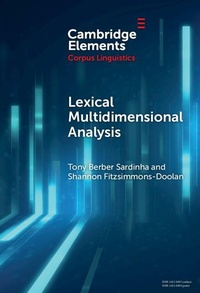
Lexical Multidimensional Analysis
Identifying Discourses and Ideologies
Published on 27. February 2025
Book
Hardback
92 pages
978-1-009-59843-9 (ISBN)
Description
Lexical Multidimensional Analysis (LMDA), an extension of Biber's (1988) Multidimensional Analysis, seeks to identify dimensions (correlated lexical features across texts in a corpus) unveiling underlying patterns of lexical co-occurrence and variation within texts that are operationalized as a variety of latent, macro-level discursive constructs. Initially developed in the 2010s, LMDA has been applied to diverse domains, including education policy, national representations, applied linguistics, music, the infodemic, religion, sustainability, and literary style. This Element introduces LMDA for the identification and analysis of discourses and ideologies, offering insights into how lexis marks discourse formations and ideological alignments. Two case studies demonstrate the application of LMDA: uncovering discourses on climate change within conservative social media and analyzing ideological discourses in migrant education.
More details
Series
Language
English
Place of publication
Cambridge
United Kingdom
Product notice
sewn/stitched
Cloth over boards
Illustrations
Worked examples or Exercises
Dimensions
Height: 229 mm
Width: 152 mm
Thickness: 6 mm
Weight
295 gr
ISBN-13
978-1-009-59843-9 (9781009598439)
Copyright in bibliographic data and cover images is held by Nielsen Book Services Limited or by the publishers or by their respective licensors: all rights reserved.
Schweitzer Classification
Other editions
Additional editions
Tony Berber Sardinha | Shannon Fitzsimmons-Doolan
Lexical Multidimensional Analysis
Identifying Discourses and Ideologies
Book
02/2025
Cambridge University Press
€24.00
Shipment within 15-20 days
Persons
Content
1. Introduction; 2. Synthesizing existing LMDA scholarship; 3. How to conduct a lexical multidimensional analysis; 4. Case study 1: the discourses around climate change on a conservative social media platform; 5. Case study 2: exploring the distribution of selected migrant education ideological discourses over time and register; 6. Conclusion; References.