

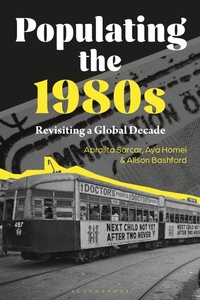
Populating the 1980s
Revisiting a Global Decade
Will be published approx. on 18. February 2027
Book
Hardback
288 pages
978-1-350-59046-5 (ISBN)
Description
The 1980s was a critical decade in world history. With the Cold War global order at its height, the decade witnessed new modes of population governance across the political spectrum, from China's One Child Policy to Reagan's Global Gag Rule, alongside fast-evolving reproductive technologies. Populating the 1980s delves into this transformative decade to offer fresh insights into the late-twentieth century world through the lens of population, and explores the economic, legal, political and religious implications for the relationship between individuals, kinship and the state.
In revisiting this remarkable decade, not only does this book identify what the reproductive politics were at that time, but highlights this period as a defining moment for reproductive freedom around the world. As the global political order was undergoing fundamental transformation, how did bio-politics and geo-politics become entangled? What does a history of the global population of the 1980s reveal about late modernity, individual freedom, family, sovereignty, gender, secularization and changing moral economies? This book addresses these themes and more to better understand the evolution of rights and justice for reproductive bodies across six continents during the 1980s, and explores how this decade laid the foundation for the myriad ethical, legal and social questions around reproductive politics today.
In revisiting this remarkable decade, not only does this book identify what the reproductive politics were at that time, but highlights this period as a defining moment for reproductive freedom around the world. As the global political order was undergoing fundamental transformation, how did bio-politics and geo-politics become entangled? What does a history of the global population of the 1980s reveal about late modernity, individual freedom, family, sovereignty, gender, secularization and changing moral economies? This book addresses these themes and more to better understand the evolution of rights and justice for reproductive bodies across six continents during the 1980s, and explores how this decade laid the foundation for the myriad ethical, legal and social questions around reproductive politics today.
More details
Language
English
Place of publication
London
United Kingdom
Publishing group
Bloomsbury Publishing PLC
Target group
College/higher education
Dimensions
Height: 234 mm
Width: 156 mm
Thickness: 25 mm
Weight
454 gr
ISBN-13
978-1-350-59046-5 (9781350590465)
Copyright in bibliographic data and cover images is held by Nielsen Book Services Limited or by the publishers or by their respective licensors: all rights reserved.
Schweitzer Classification
Persons
Aprajita Sarcar is Postdoctoral Dellow in the Laureate Centre for History and Population, University of New South Wales, Australia. She has previously held a postdoctoral position in the Centre de Sciences Humaines, New Delhi. She works on everyday governance of reproductive health and population control programme in postcolonial India. Her work is on the intersection of health, gender and urban histories of South Asia.
Aya Homei is Reader in Japanese Studies at the University of Manchester, UK. She is also a Vice President of the International Union of History and Philosophy of Science and Technology's Division of History of Science and Technology (IUHPST/DHST) Commission on Science, Technology, and Division, and an editor of East Asian Science, Technology and Society: An International Journal. She serves as a commissioned researcher for the Japanese government's National Institute of Population and Social Security Research and the author of Science for Governing Japan's Population.
Alison Bashford is Scientia Professor of History at UNSW, Sydney, Australia. Previously she was Vere Harmsworth Professor of Imperial and Naval History, University of Cambridge, UK, and is Fellow of the British Academy. Bashford is an award-winning historian, her most recent book The Huxleys: An Intimate History of Evolution, won the Nib Literary Award and was shortlisted for the Cundill History prize, and the Hughes Award, British Society for the History of Science. She was awarded the Dan David Laureate Prize (2021) for her contributions to the history of medicine. Bashford is a regular broadcaster on BBC and ABC, including The Science Show and Start the Week (Radio 4), and is commissioned to write for UnHerd, Times Literary Supplement, The New Humanist, LA Review of Books, The Lancet, London Review of Books.
Aya Homei is Reader in Japanese Studies at the University of Manchester, UK. She is also a Vice President of the International Union of History and Philosophy of Science and Technology's Division of History of Science and Technology (IUHPST/DHST) Commission on Science, Technology, and Division, and an editor of East Asian Science, Technology and Society: An International Journal. She serves as a commissioned researcher for the Japanese government's National Institute of Population and Social Security Research and the author of Science for Governing Japan's Population.
Alison Bashford is Scientia Professor of History at UNSW, Sydney, Australia. Previously she was Vere Harmsworth Professor of Imperial and Naval History, University of Cambridge, UK, and is Fellow of the British Academy. Bashford is an award-winning historian, her most recent book The Huxleys: An Intimate History of Evolution, won the Nib Literary Award and was shortlisted for the Cundill History prize, and the Hughes Award, British Society for the History of Science. She was awarded the Dan David Laureate Prize (2021) for her contributions to the history of medicine. Bashford is a regular broadcaster on BBC and ABC, including The Science Show and Start the Week (Radio 4), and is commissioned to write for UnHerd, Times Literary Supplement, The New Humanist, LA Review of Books, The Lancet, London Review of Books.
Content
Table of Contents
List of Figures
List of Tables
Notes on Contributors
Acknowledgements
Populating the 1980s: An Introduction, Aprajita Sarcar, Aya Homei, Alison Bashford
Part I: Transnationalism, Conservatism and Feminism in the 1980s: Contesting Rights and Justice
1. Choice, Consent, and Rights: US Anti-Abortion Strategies, Population Policy, and the 'Global Gag Rule', Prudence Flowers
2. Transnational Catholicism and the Billings Method of Family Planning, Raul Necochea Lopez and Alison Bashford
3. Aiding Coercion? The Transnational Response to Indian and Chinese Population Policy in the 1980s, Rebecca Williams
4. (Dis)Engaging Population: The International Women's Health Coalition and the Transnational Politics of Reproductive Health in the 1980s, Mytheli Sreenivas
5. Family Planning for Global Population Control? China-Japan Cooperation in the 1980s, Aya Homei
Part II: Populating National Borders: Sovereignty and Security in the 1980s
6. Cairo before the 'Cairo Moment': Re-Opening the Population Question in 1980s Egypt, Stephen Pascoe
7. Family Planning and Transmigration: The Violence of Liberalization in Indonesia's Population Programs, Sarah Kennedy Bates
8. Redefining the 1980s in Japan: Demographic Change and the Idea of 'Comprehensive National Power', Mina Markovic
9. Between International and National Concerns: Population Debates in 1980s Britain, Caroline Rusterholz
10. Fertility Control in 1980s South Africa, Natasha Erlank
11. Carrying Capacity: Debating Population in 1980s Australia, Ben Huf
List of Figures
List of Tables
Notes on Contributors
Acknowledgements
Populating the 1980s: An Introduction, Aprajita Sarcar, Aya Homei, Alison Bashford
Part I: Transnationalism, Conservatism and Feminism in the 1980s: Contesting Rights and Justice
1. Choice, Consent, and Rights: US Anti-Abortion Strategies, Population Policy, and the 'Global Gag Rule', Prudence Flowers
2. Transnational Catholicism and the Billings Method of Family Planning, Raul Necochea Lopez and Alison Bashford
3. Aiding Coercion? The Transnational Response to Indian and Chinese Population Policy in the 1980s, Rebecca Williams
4. (Dis)Engaging Population: The International Women's Health Coalition and the Transnational Politics of Reproductive Health in the 1980s, Mytheli Sreenivas
5. Family Planning for Global Population Control? China-Japan Cooperation in the 1980s, Aya Homei
Part II: Populating National Borders: Sovereignty and Security in the 1980s
6. Cairo before the 'Cairo Moment': Re-Opening the Population Question in 1980s Egypt, Stephen Pascoe
7. Family Planning and Transmigration: The Violence of Liberalization in Indonesia's Population Programs, Sarah Kennedy Bates
8. Redefining the 1980s in Japan: Demographic Change and the Idea of 'Comprehensive National Power', Mina Markovic
9. Between International and National Concerns: Population Debates in 1980s Britain, Caroline Rusterholz
10. Fertility Control in 1980s South Africa, Natasha Erlank
11. Carrying Capacity: Debating Population in 1980s Australia, Ben Huf