

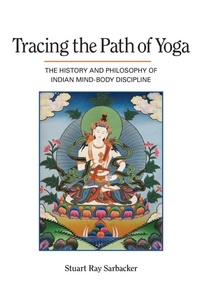
Tracing the Path of Yoga
The History and Philosophy of Indian Mind-Body Discipline
Published on 2. July 2021
Book
Paperback/Softback
451 pages
978-1-4384-8122-7 (ISBN)
Description
A comprehensive and theory-rich investigation of the history and philosophy of yoga, from its Indian origins to the contemporary context.
Clear, accessible, and meticulously annotated, Tracing the Path of Yoga offers a comprehensive survey of the history and philosophy of yoga that will be invaluable to both specialists and to nonspecialists seeking a deeper understanding of this fascinating subject. Stuart Ray Sarbacker argues that yoga can be understood first and foremost as a discipline of mind and body that is represented in its narrative and philosophical literature as resulting in both numinous and cessative accomplishments that correspond, respectively, to the attainment of this-worldly power and otherworldly liberation. Sarbacker demonstrates how the yogic quest for perfection as such is situated within the concrete realities of human life, intersecting with issues of politics, economics, class, gender, and sexuality, as well as reflecting larger Indic religious and philosophical ideals.
Clear, accessible, and meticulously annotated, Tracing the Path of Yoga offers a comprehensive survey of the history and philosophy of yoga that will be invaluable to both specialists and to nonspecialists seeking a deeper understanding of this fascinating subject. Stuart Ray Sarbacker argues that yoga can be understood first and foremost as a discipline of mind and body that is represented in its narrative and philosophical literature as resulting in both numinous and cessative accomplishments that correspond, respectively, to the attainment of this-worldly power and otherworldly liberation. Sarbacker demonstrates how the yogic quest for perfection as such is situated within the concrete realities of human life, intersecting with issues of politics, economics, class, gender, and sexuality, as well as reflecting larger Indic religious and philosophical ideals.
Reviews / Votes
"An inherently fascinating, impressively informative, thoughtful and thought-provoking work of meticulously presented scholarship, Tracing the Path of Yoga is an extraordinary and unreservedly recommended addition to personal, professional, community, college, and university library Indian Eastern Philosophy/Religion collections in general, and Yoga History/Philosophy supplemental curriculum reading lists in particular." - Midwest Book ReviewMore details
Language
English
Place of publication
Albany, NY
United States
Target group
Professional and scholarly
US School Grade: College Graduate Student and over
Product notice
Paperback (trade)
Dimensions
Height: 229 mm
Width: 152 mm
Thickness: 27 mm
Weight
729 gr
ISBN-13
978-1-4384-8122-7 (9781438481227)
Copyright in bibliographic data and cover images is held by Nielsen Book Services Limited or by the publishers or by their respective licensors: all rights reserved.
Schweitzer Classification
Other editions
Additional editions
Stuart Ray Sarbacker
Tracing the Path of Yoga
The History and Philosophy of Indian Mind-Body Discipline
E-Book
01/2021
1st Edition
De Gruyter
from
€91.99
Available for download
Person
Stuart Ray Sarbacker is Associate Professor of Philosophy and Religion at Oregon State University. He is the author of Samadhi: The Numinous and Cessative in Indo-Tibetan Yoga, also published by SUNY Press, and (with Kevin Kimple) The Eight Limbs of Yoga: A Handbook for Living Yoga Philosophy.
Content
Acknowledgments
Pronunciation Guide for Sanskrit Terms
Introduction: The History and Philosophy of Yoga
1. Defining Yoga
2. The Prehistory of Yoga: The Indus Civilization and the Vedic Tradition
3. Brahma?ical Asceticism and Srama?a Traditions
4. The Classical Hindu Model of Yoga: Patanjala Yoga and A??a?gayoga
5. Hindu Epic, Pura?ic, and Scholastic Representations of Yoga
6. Classical Srama?a Traditions of Yoga
7. The Medieval Transformation of Yoga: Bhakti, Tantra, and Ha?hayoga
8. Modern Yoga Traditions
Conclusion: Tracing the Path of Yoga
Notes
Works Cited
Index
Pronunciation Guide for Sanskrit Terms
Introduction: The History and Philosophy of Yoga
1. Defining Yoga
2. The Prehistory of Yoga: The Indus Civilization and the Vedic Tradition
3. Brahma?ical Asceticism and Srama?a Traditions
4. The Classical Hindu Model of Yoga: Patanjala Yoga and A??a?gayoga
5. Hindu Epic, Pura?ic, and Scholastic Representations of Yoga
6. Classical Srama?a Traditions of Yoga
7. The Medieval Transformation of Yoga: Bhakti, Tantra, and Ha?hayoga
8. Modern Yoga Traditions
Conclusion: Tracing the Path of Yoga
Notes
Works Cited
Index