

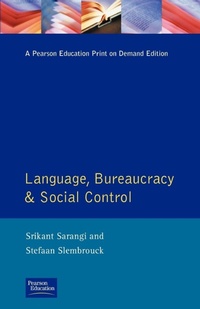
Language, Bureaucracy and Social Control
1st Edition
Published on 22. August 1996
Book
Paperback/Softback
256 pages
978-0-582-08622-7 (ISBN)
Description
Language, Bureaucracy and Social Control explores the varying inter-relationships between language, forms of bureaucratic organisation and social control. The text provides a detailed examination of the discursive dimensions of some of the key techniques of modern power: the 'productive' surveillance practices of administrative and public service institutions. Special attention is paid to recent developments within the state domain and the private economy such as the introduction of consumerism and promotional practices in welfare institutions, and the spread of bureaucratisation in contexts such as banking and education.
Reviews / Votes
"Sarangi and Slembrouck have managed to squeeze an immensely complex subject matter into a concise, highly readable and instructive book." Discourse and Society, 1997More details
Series
Language
English
Place of publication
London
United Kingdom
Publishing group
Taylor & Francis Ltd
Target group
Professional and scholarly
Dimensions
Height: 216 mm
Width: 140 mm
Thickness: 14 mm
Weight
330 gr
ISBN-13
978-0-582-08622-7 (9780582086227)
Copyright in bibliographic data and cover images is held by Nielsen Book Services Limited or by the publishers or by their respective licensors: all rights reserved.
Schweitzer Classification
Other editions
Additional editions
Srikant Sarangi | Stefaan Slembrouck
Language, Bureaucracy and Social Control
Book
02/2015
1st Edition
Routledge
€232.90
Shipment within 10-20 days
Srikant Sarangi | Stefaan Slembrouck
Language, Bureaucracy and Social Control
E-Book
01/2014
1st Edition
Routledge
€88.49
Available for download
Srikant Sarangi | Stefaan Slembrouck
Language, Bureaucracy and Social Control
E-Book
01/2014
1st Edition
Routledge
€88.49
Available for download
Persons
Authored by Sarangi, Srikant; Slembrouck, Stefan
Content
Foreword
Acknowledgements
1. Language, bureaucracy and social control
Bureaucracy
Bureacracy and social control
Language and bureaucracy
Synopsis
2. Bureaucratisation and debureaucratisation in contemporary society
Introduction: what discourse practices are construed as bureaucratic?
Bureaucratisation and debureaucratisation
Changing discourse practices as action and as process
The analysis of language use
The language-situation dynamic
Social control as an area of struggle
Conclusion
3. The pragmatics of information exchange in bureaucratic discourse
Introduction: information exchange as a focus of study
Bureaucrats seeking information and clients giving it
Interpreting information exchange in pragmatic terms
Reversing the roles: clients seeking information and institutions avoiding giving information
Conclusion: regulated information exchange and social control
4. Role behaviour in discourse
Introduction
Modes of talk and multiple role behaviour
Discourse roles
Shifting role relationships and the construction of social identities
Role perception in discourse
Conclusion
5. The client's perspective: clients as citizens
Introduction
Challenging the inhuman face of bureaucracy
Creating an edge over the institution
Talking to bureaucrats in order to maintain non-clienthood
Client's response to institutional failure: the case of lost mail
Conclusion
6. The bureaucrat's perspective: citizens as clients
Introduction
Alarming the client
Maintaining bureaucracy through official documents: forms and leaflets
Conclusion
7. The discourse of mediation: bureaucrats' dilemma and clients' wisdom
Introduction
Social workers attemting to redress the imbalance
Counselling institutions
Institutional monopolies over mediation
Conclusion: socio-economic struggles over multi-tier bureaucracy
8. Instead of a conclusion
Bibliography
Appendices
Index
Acknowledgements
1. Language, bureaucracy and social control
Bureaucracy
Bureacracy and social control
Language and bureaucracy
Synopsis
2. Bureaucratisation and debureaucratisation in contemporary society
Introduction: what discourse practices are construed as bureaucratic?
Bureaucratisation and debureaucratisation
Changing discourse practices as action and as process
The analysis of language use
The language-situation dynamic
Social control as an area of struggle
Conclusion
3. The pragmatics of information exchange in bureaucratic discourse
Introduction: information exchange as a focus of study
Bureaucrats seeking information and clients giving it
Interpreting information exchange in pragmatic terms
Reversing the roles: clients seeking information and institutions avoiding giving information
Conclusion: regulated information exchange and social control
4. Role behaviour in discourse
Introduction
Modes of talk and multiple role behaviour
Discourse roles
Shifting role relationships and the construction of social identities
Role perception in discourse
Conclusion
5. The client's perspective: clients as citizens
Introduction
Challenging the inhuman face of bureaucracy
Creating an edge over the institution
Talking to bureaucrats in order to maintain non-clienthood
Client's response to institutional failure: the case of lost mail
Conclusion
6. The bureaucrat's perspective: citizens as clients
Introduction
Alarming the client
Maintaining bureaucracy through official documents: forms and leaflets
Conclusion
7. The discourse of mediation: bureaucrats' dilemma and clients' wisdom
Introduction
Social workers attemting to redress the imbalance
Counselling institutions
Institutional monopolies over mediation
Conclusion: socio-economic struggles over multi-tier bureaucracy
8. Instead of a conclusion
Bibliography
Appendices
Index