

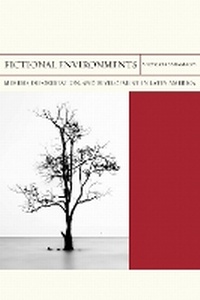
Fictional Environments
Mimesis, Deforestation, and Development in Latin America
Published on 30. November 2020
Book
Paperback/Softback
288 pages
978-0-8101-4259-6 (ISBN)
Description
Fictional Environments: Mimesis, Deforestation, and Development in Latin America investigates how fictional works have become sites for the production of knowledge, imagination, and intervention in Latin American environments. It investigates the dynamic relationship between fictional images and real places, as the lasting representations of forests, rural areas, and deserts in novels clash with collective perceptions of changes like deforestation and urbanization.
From the backlands of Brazil to a developing Rio de Janeiro, and from the rainforests of Venezuela and Peru to the Mexican countryside, rapid deforestation took place in Latin America in the second half of the twentieth century. How do fictional works and other cultural objects dramatize, resist, and intervene in these ecological transformations? Through analyses of work by JoAo GuimarAes Rosa, Alejo Carpentier, Juan Rulfo, Clarice Lispector, and Mario Vargas Llosa, Victoria Saramago shows how novels have inspired conservationist initiatives and offered counterpoints to developmentalist policies, and how environmental concerns have informed the agendas of novelists as essayists, politicians, and public intellectuals. This book seeks to understand the role of literary representation, or mimesis, in shaping, sustaining, and negotiating environmental imaginaries during the deep, ongoing transformations that have taken place from the 1950s to the present.
From the backlands of Brazil to a developing Rio de Janeiro, and from the rainforests of Venezuela and Peru to the Mexican countryside, rapid deforestation took place in Latin America in the second half of the twentieth century. How do fictional works and other cultural objects dramatize, resist, and intervene in these ecological transformations? Through analyses of work by JoAo GuimarAes Rosa, Alejo Carpentier, Juan Rulfo, Clarice Lispector, and Mario Vargas Llosa, Victoria Saramago shows how novels have inspired conservationist initiatives and offered counterpoints to developmentalist policies, and how environmental concerns have informed the agendas of novelists as essayists, politicians, and public intellectuals. This book seeks to understand the role of literary representation, or mimesis, in shaping, sustaining, and negotiating environmental imaginaries during the deep, ongoing transformations that have taken place from the 1950s to the present.
Reviews / Votes
Saramago gives a new twist to long-standing discussions about the status and function of fictional texts in environmental discourse and criticism, and whether realist and documentary modes are most appropriate for literature on environmental change. Ultimately, her innovative book engages with the more fundamental question of whether fictionality in and of itself gets in the way of 'environmental messaging." -Ursula K. Heise, author of Imagining Extinction: The Cultural Meanings of Endangered Species"Fictional Environments: Mimesis and Deforestation in Latin America makes an important and novel contribution to both Latin American literary history and to environmental humanities independently, and specifically to the incipient but expanding field of Latin American ecocriticism." -Rachel Price, author of The Object of the Atlantic: Concrete Aesthetics in Cuba, Brazil and Spain 1868-1968 (Northwestern, 2014)
More details
Series
Language
English
Place of publication
Evanston
United States
Target group
Professional and scholarly
Illustrations
5 black & white images
Dimensions
Height: 226 mm
Width: 152 mm
Thickness: 25 mm
Weight
333 gr
ISBN-13
978-0-8101-4259-6 (9780810142596)
Copyright in bibliographic data and cover images is held by Nielsen Book Services Limited or by the publishers or by their respective licensors: all rights reserved.
Schweitzer Classification
Person
Victoria Saramago is an assistant professor of Hispanic and Luso-Brazilian studies at the University of Chicago.
Content
Acknowledgements
Introduction
1. The SertAo Reconstructed: JoAo GuimarAes Rosa's Grande sertAo: veredas
2. Narrative Conservation and Conservationist Narratives: Alejo Carpentier's Gran Sabana
3. Juan Rulfo's Pedro PAramo and the Green Revolution: Modern Literary and Agricultural Dilemmas
4. Besieged Plots: Nonhuman Agency in Clarice Lispector's A cidade sitiada
5. Against Wind and Tide: Fiction, Ecology, and Politics in Mario Vargas Llosa's Amazon
Conclusion
Notes
Bibliography
Index
Introduction
1. The SertAo Reconstructed: JoAo GuimarAes Rosa's Grande sertAo: veredas
2. Narrative Conservation and Conservationist Narratives: Alejo Carpentier's Gran Sabana
3. Juan Rulfo's Pedro PAramo and the Green Revolution: Modern Literary and Agricultural Dilemmas
4. Besieged Plots: Nonhuman Agency in Clarice Lispector's A cidade sitiada
5. Against Wind and Tide: Fiction, Ecology, and Politics in Mario Vargas Llosa's Amazon
Conclusion
Notes
Bibliography
Index